
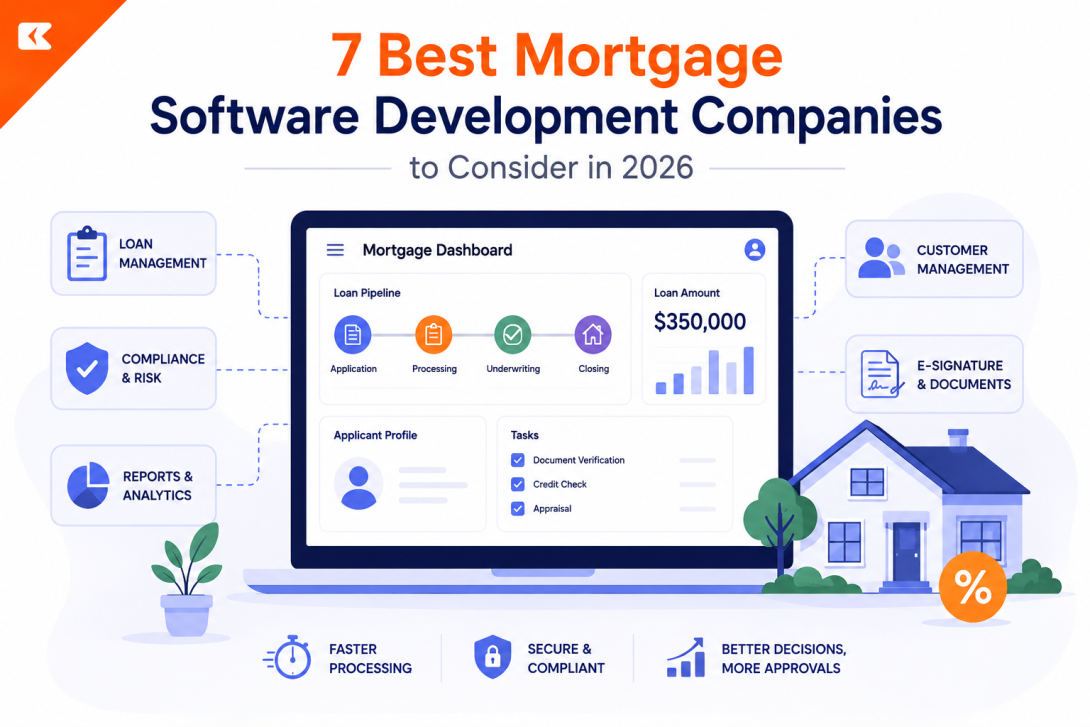
Mortgage lending involves far more than processing an application. Lenders need to manage borrower onboarding, document collection, credit checks, underwriting, compliance, approvals, payments, servicing, and communication across one connected lifecycle. Mortgage software development companies help turn these processes into secure digital workflows.
The right mortgage software development company should understand both financial technology and the operational realities of mortgage lending. Loan origination, underwriting, borrower portals, document management, integrations, audit trails, payment processing, and regulatory requirements all need to work together without creating unnecessary complexity.
How We Selected The Top Mortgage Software Development Companies
We list the companies across mortgage and lending experience, financial technology capabilities, technical expertise, client feedback, security practices, pricing, and industry recognition.
- Company Experience: A company's operating history provides useful context when evaluating its ability to develop and maintain complex financial software.
- Client Reviews: Ratings and review volumes offer additional evidence about communication, technical delivery, project management, and client satisfaction.
- Technical Expertise: Cloud development, APIs, data engineering, AI, mobile applications, automation, and secure software architecture can influence the reliability of mortgage platforms.
- Mortgage and Lending Experience: Direct exposure to loan origination, underwriting, servicing, borrower management, or related financial workflows is particularly valuable for mortgage projects.
- Security and Compliance: Mortgage applications handle highly sensitive financial and personal information, making encryption, access controls, audit trails, and regulatory requirements important considerations.
- Integration Capabilities: Mortgage platforms commonly connect with credit bureaus, banking systems, payment providers, appraisal services, title and escrow platforms, e-signature tools, and existing LOS or LMS systems.
- Pricing and Engagement Models: Hourly rates provide an initial comparison, while actual development costs depend on functionality, integrations, data migration, AI requirements, compliance needs, and project complexity.
- Awards and Recognition: Certifications, industry awards, and external recognition provide additional context when evaluating companies with similar technical capabilities.
Top 7 Mortgage Software Development Companies
The companies below bring different strengths across mortgage technology, lending platforms, financial software, enterprise development, and digital product engineering. Each profile highlights a different reason a company may be worth considering for a mortgage software project.
1. Citrusbug Technolabs
Citrusbug Technolabs develops custom mortgage software for banks, lenders, credit unions, mortgage brokers, and FinTech companies. Its mortgage capabilities cover loan origination, borrower onboarding, document collection, underwriting, mortgage CRM, servicing, and compliance workflows.
Its mortgage platforms also use AI and machine learning for credit risk scoring, fraud detection, document processing, and automated underwriting. The team supports integrations with credit bureaus, appraisal management companies, title and escrow platforms, e-signature providers, banking APIs, and existing lending systems.
Its architecture combines security, compliance, cloud infrastructure, and automation from the beginning, which is useful when a platform must support a complete lending lifecycle.
The team also brings experience from its real estate software solution work, applying similar principles of secure data handling and workflow automation to mortgage projects.
Clutch Rating- 4.7
Google Rating- 5.0
Website- https://www.citrusbug.com
2. Andersen Inc.
Andersen Inc. has dedicated lending software capabilities covering loan origination, loan management, decision support, credit scoring, debt collection, and digital mortgage solutions.
The company reports a large number of lending IT projects delivered through its financial services engineering practice. Its mortgage-related work includes digital mortgage platforms, automated lending workflows, integrations, and AI-driven customer assistance.
Andersen has also delivered a multi-channel AI assistant for a mortgage-focused bank that handled mortgage queries, document search, loan advisory, and escalation to human specialists.
Its combination of lending-domain expertise and enterprise engineering makes it suitable for organizations with complex mortgage workflows.
Clutch Rating- 4.9
Google Rating- 4.5
Website- https://andersenlab.com
3. Cleveroad
Cleveroad has a dedicated mortgage software development practice focused on structured lending workflows. Its services cover mortgage platforms, loan management, servicing, lending systems, title and closing systems, borrower engagement, compliance, payment gateways, and cloud and AI-enabled mortgage solutions.
The company also highlights integrations with loan origination systems, credit bureaus, KYC providers, and core banking environments. Its mortgage work addresses regulatory and data-protection requirements across multiple markets.
Cleveroad's architecture-first approach is relevant for lenders looking to connect origination, servicing, compliance, and automation instead of maintaining isolated systems. Its combination of financial software experience, integration capabilities, and security practices makes it a strong option for larger mortgage platforms.
Clutch Rating- 4.9
Google Rating- 5.0
Website- https://www.cleveroad.com
4. Experion Technologies
Experion Technologies provides digital engineering and software development services for financial services organizations. Its broader capabilities cover custom applications, cloud platforms, data engineering, analytics, and enterprise modernization that can support digital mortgage and lending environments.
Mortgage organizations often need to modernize existing systems rather than build an entirely new platform, and Experion's enterprise engineering capabilities make it relevant for such projects. Its work spans legacy modernization, connected financial applications, cloud adoption, and data-driven workflows.
The company typically pairs discovery and architecture planning with iterative delivery cycles. This approach helps mortgage teams reduce risk when upgrading existing loan origination or servicing systems. Experion's data engineering background can also support reporting and analytics needs across the lending lifecycle.
Company Data:
Clutch Rating- 4.9
Google Rating- 5.0
Website- https://www.experionglobal.com
5. Django Stars
Django Stars has a dedicated mortgage software practice covering loan origination, mortgage management, mortgage CRM, underwriting, servicing, document management, risk assessment, and reporting.
Its team also works with cloud-based mortgage platforms and financial integrations. Its development process includes discovery, UX design, Agile development, QA and compliance testing, cloud deployment, and ongoing optimization.
The company specifically identifies PCI DSS, GDPR, AML/KYC, SOC 2, MFA, encryption, and audit trails among the standards and controls it works with. Its direct mortgage specialization makes it particularly relevant when a project requires domain-specific functionality rather than general FinTech development.
Its combination of mortgage workflows, AI-powered automation, compliance, and cloud engineering covers a broad part of the lending lifecycle. This depth of focus is useful for lenders who want a partner already familiar with mortgage terminology and workflows.
Company Data:
Clutch Rating- 4.8
Google Rating- 4.8
Website- https://djangostars.com
6. Emerline
Emerline provides lending software development services for lenders and FinTech companies. Its lending portfolio includes loan origination, servicing, credit scoring, debt collection, collections management, fraud detection, lending CRM, and mortgage software.
For mortgage organizations, Emerline specifically covers origination, documentation, compliance reporting, and collaboration between brokers, lenders, and borrowers. Its lending architecture is designed around end-to-end workflows, from onboarding and decisioning through servicing and risk management.
Emerline's lending specialization makes it useful for projects where mortgage software needs to sit within a broader lending ecosystem. Credit scoring, fraud detection, servicing, collections, CRM, and mortgage-specific workflows can be developed as connected capabilities rather than separate systems.
Clutch Rating- 4.9
Google Rating- N/A
Website- https://emerline.com
7. Lunar Logic
Lunar Logic provides custom software development and product engineering services for businesses building specialized digital products. Its capabilities include web applications, product development, UX design, and technical engineering.
Its product-development orientation can be useful when mortgage businesses need a tailored digital experience built around an existing lending infrastructure. For projects requiring custom borrower interfaces, workflow applications, or supporting financial tools, a product-focused engineering team can provide flexibility.
Lunar Logic's approach tends to prioritize usability research and iterative design before writing production code. This can help mortgage teams validate borrower-facing features before committing to a full build. The company is generally a better fit for scoped digital products than for full end-to-end mortgage platforms.
Clutch Rating- 4.9
Google Rating- 5.0
Website- https://lunarlogic.io
How To Choose The Best Mortgage Software Development Company
Your choice should depend on your lending model, target market, existing systems, loan lifecycle, compliance requirements, and level of automation.
1. Define Your Mortgage Workflow
- Map out borrower onboarding and application intake steps from the first point of contact.
- List document collection and verification requirements for each loan type you offer.
- Identify underwriting, decisioning, and approval stages that need automation.
- Account for closing, funding, and post-closing servicing needs.
- Note payment processing, escrow, and reporting requirements.
- Flag manual steps you want to automate first so vendors can scope accurately.
2. Evaluate Lending and Mortgage Experience
- Ask for mortgage-specific project examples rather than general FinTech work alone.
- Check experience with loan origination systems (LOS) and loan management systems (LMS).
- Review how the team has handled underwriting rules or decisioning logic in past projects.
- Look for prior work with credit unions, mortgage brokers, or banks.
- Confirm familiarity with mortgage terminology, borrower journeys, and industry timelines.
- Ask how they approach edge cases such as manual underwriting overrides.
3. Review Integration Capabilities
- Confirm experience integrating with credit bureaus such as Equifax, Experian, or TransUnion.
- Check support for appraisal management companies and title or escrow platforms.
- Review e-signature and document verification integrations already in use.
- Ask about payment gateway, escrow, and banking API experience.
- Confirm compatibility with your existing LOS, LMS, or CRM platforms.
- Understand how the team handles integration failures or data mismatches.
4. Check Security and Compliance Practices
- Ask about encryption standards for data at rest and in transit.
- Review role-based access control and audit logging practices.
- Confirm familiarity with applicable lending regulations in your target markets.
- Check for certifications such as ISO 27001, SOC 2, or similar frameworks.
- Ask how the team handles data retention, backups, and deletion requests.
- Understand their incident response process for security events.
5. Assess Pricing, Scalability, and Support
- Compare hourly rates alongside expected project scope and timeline.
- Ask how the proposed architecture handles growing borrower and transaction volumes.
- Confirm post-launch maintenance, monitoring, and support options.
- Understand how change requests and new features are scoped and priced.
- Ask about team continuity and knowledge transfer after launch.
- Review contract terms covering exit, handover, or vendor transition.
Before selecting a provider, define your lending workflows, integrations, regulatory obligations, data sources, user roles, automation requirements, and post-launch responsibilities. This makes proposals easier to compare and reduces the risk of discovering major requirements after development begins.
Conclusion
Mortgage software sits at the intersection of financial services, customer experience, compliance, data, and operational workflows. A strong platform should make lending faster and more transparent without compromising security or regulatory controls.
The right development partner will depend on whether you are modernizing an existing LOS, launching a digital mortgage product, automating underwriting, building borrower self-service, or creating an end-to-end mortgage platform. The companies above provide a starting point for evaluating a mortgage software development company based on relevant technology and lending capabilities.
FAQs
What Does Mortgage Software Usually Include?
Mortgage software can include loan origination, borrower onboarding, document management, underwriting, credit assessment, compliance workflows, servicing, payments, reporting, CRM, and borrower portals.
How Long Does Mortgage Software Development Take?
A focused mortgage application may take several months. Full platforms involving underwriting, servicing, third-party integrations, compliance controls, and legacy-system migration generally require longer.
How Much Does Mortgage Software Development Cost?
The cost depends on features, integrations, data migration, AI capabilities, security requirements, and project scope. Provider rates in this list generally range from $25 to $99 per hour, with some providers not publishing an hourly rate.
Can Mortgage Software Integrate With Credit Bureaus?
Yes. Mortgage platforms can integrate with credit bureaus such as Equifax, Experian, and TransUnion, along with appraisal, title, escrow, e-signature, payment, and banking services.
Can AI Be Used In Mortgage Software?
AI can support credit risk scoring, underwriting, fraud detection, document processing, borrower assistance, predictive analytics, and workflow automation when appropriate controls and validation are in place.
What Security Features Should Mortgage Software Have?
Important controls include encryption, role-based access, multi-factor authentication, secure APIs, audit trails, access logging, data protection, backups, and appropriate regulatory safeguards.
Should Mortgage Software Include A Borrower Portal?
A borrower portal can allow applicants to submit information, upload documents, track application progress, communicate with lenders, review requirements, and complete digital signing workflows.
Why Are Integrations Important In Mortgage Software?
Mortgage lending depends on multiple external systems. Integrations allow borrower, credit, property, title, payment, document, and financial information to move between systems without excessive manual entry.