

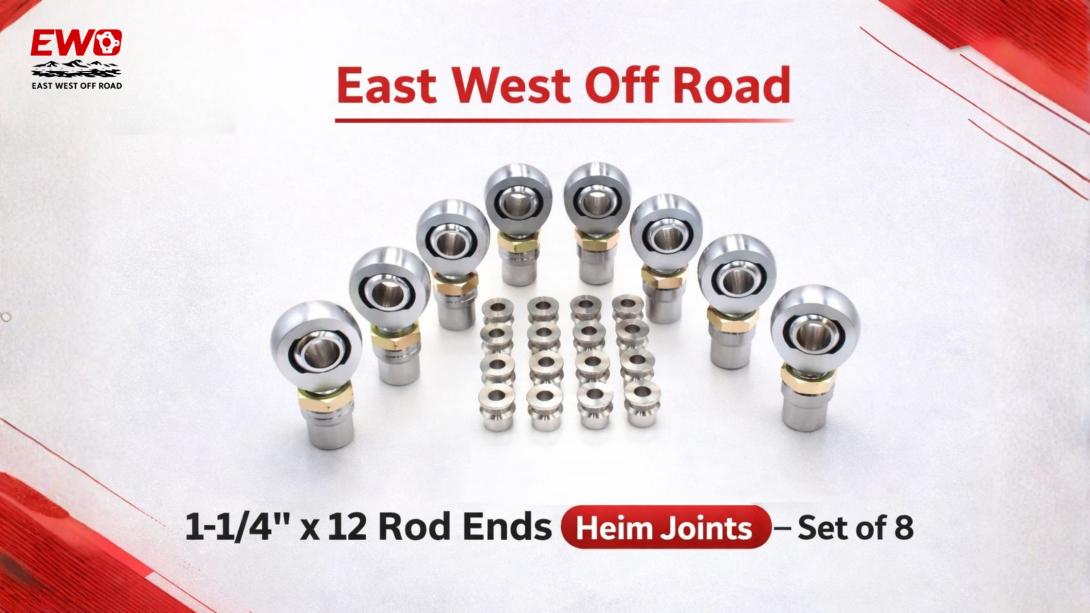
Buy Now: https://www.eastwestoffroad.com/product/1-14%22-x-12-rod-ends-(heim-joints)-set-of-8
A 4 Link Kit is a popular suspension solution for serious off-road vehicles, rock crawlers, and custom 4x4 builds that need improved axle control, articulation, and adjustable suspension geometry. Unlike a conventional leaf-spring setup, a properly designed four-link system uses multiple suspension links to control axle movement while allowing the builder to tune important suspension characteristics. Large spherical rod ends, heavy-duty link ends, DOM tubing, and correctly sized mounting hardware are key components of a dependable custom 4-link suspension.
What Is a 4 Link Kit?
A four-link suspension uses four primary links to locate an axle while allowing controlled suspension movement. Depending on the design, the links can be configured as parallel or triangulated systems.
A typical 4 Link Kit may include or require:
- Upper suspension links
- Lower suspension links
- Heim joints or spherical rod ends
- Tube adapters or weld-in bungs
- Misalignment spacers
- Suspension brackets
- Jam nuts
- DOM tubing
- Mounting hardware
The exact components depend on the vehicle, axle, chassis, ride height, and desired suspension geometry.
Why Use a 4 Link Suspension?
A properly engineered four-link system gives builders considerably more control over axle movement than many traditional suspension layouts.
Adjustable Axle Position
Link length can be adjusted to control wheelbase, axle position, and suspension geometry.
Improved Articulation
Spherical rod ends can accommodate significant angular movement, making them useful for vehicles designed to travel over uneven terrain.
Custom Suspension Geometry
One of the biggest advantages of a custom four-link is the ability to tune the suspension around the specific vehicle.
Stronger Custom Linkages
With appropriately sized DOM tubing and heavy-duty rod ends, a four-link can be designed for demanding off-road use.
1-1/4 Heim Joints for 4 Link Kits
Large rod ends are frequently used in high-performance suspension fabrication.
A 1-1/4 Heim Joint Kit can provide multiple 1-1/4 x 12 spherical rod ends for custom suspension links.
Large 1.25 Rod Ends are particularly useful when the builder needs a substantial threaded connection combined with adjustability.
For heavy-duty applications, the rod end should be selected based on the actual suspension loads rather than simply choosing the largest available joint.
How a Four-Link System Controls the Axle
The four links work together to control the axle in multiple directions.
The lower links generally help control:
- Fore-and-aft axle movement
- Wheelbase
- Pinion movement
- A portion of suspension geometry
The upper links work with the lower links to control:
- Axle rotation
- Pinion angle
- Anti-squat characteristics
- Additional axle movement
The actual function depends on whether the system is parallel, triangulated, or another configuration.
Parallel vs. Triangulated 4 Link
Parallel Four-Link
A parallel setup generally uses links that run more closely parallel to the vehicle's centerline.
This design typically requires another method of controlling lateral axle movement, such as a track bar.
Triangulated Four-Link
A triangulated design angles the links inward to help control lateral axle movement.
This can eliminate the need for a separate track bar depending on the geometry.
Neither design is automatically superior. The best configuration depends on the vehicle's chassis, available space, axle, driveshaft, ride height, and intended use.
Rock Crawler 4 Link Kit
A Rock Crawler 4 Link Kit needs to be designed around extreme articulation and impact loads.
Rock crawling can place unusual forces on suspension links when an axle climbs over rocks or when a tire becomes heavily loaded.
A suitable rock-crawling system should consider:
- Link diameter
- Tube wall thickness
- Rod-end size
- Joint misalignment
- Bracket strength
- Weld quality
- Axle bracket placement
- Chassis mounting points
- Suspension travel
- Driveshaft clearance
A strong rod end is only one part of the complete suspension system.
Heavy-Duty Rod Ends for 4 Link Suspension
Heavy Duty Rod Ends are commonly selected for custom suspension links because they provide a rigid connection while allowing angular movement.
When selecting a spherical rod end, check:
- Thread diameter
- Threads per inch
- Bearing bore
- Ball width
- Shank diameter
- Radial load rating
- Misalignment capability
- Material
- Liner construction
A 1-1/4-inch rod end can provide a substantial connection for a large off-road suspension link.
Chromoly Heim Joints
Chromoly Heim Joints are another popular choice for demanding suspension applications.
Chromoly steel can provide high strength in a properly manufactured rod end. Depending on the product, the joint may also feature a heat-treated bearing, protective finish, or liner.
For an off-road build, don't evaluate material alone. The complete rod-end design and its rated capacity are equally important.
Heim Joints With Misalignment Spacers
Four-link suspension requires substantial joint movement as the axle travels through its range.
Heim Joints with Misalignment Spacers can increase usable angular movement while adapting the bearing bore to the selected mounting hardware.
For example, a large rod end may use a spacer to accommodate a smaller mounting bolt.
Before installation, verify:
- Spacer width
- Spacer bore
- Bolt diameter
- Joint ball width
- Bracket width
- Required angular movement
Incorrect spacer dimensions can cause binding or unwanted movement.
DOM Tubing for Custom 4 Link Suspension
DOM tubing is widely used for fabricated suspension links.
A DOM Tubing Weld Adapter or weld-in bung can provide the threaded interface required to install a heim joint into the end of a suspension tube.
A typical adjustable link can be constructed around:
DOM Tube + Weld-In Bung + Heim Joint + Jam Nut
The tube adapter must match the tubing's inside diameter and wall thickness.
.120 Wall DOM
A .120-wall tube adapter is appropriate only when its dimensions and intended application match the selected tubing and suspension design.
.250 Wall DOM
Heavier .250-wall tubing is commonly considered for more demanding applications where increased wall thickness is desirable.
The final tube size should be selected based on vehicle weight, suspension loads, link length, mounting configuration, and intended use.
Weld-In Tube Adapters
A Weld-In Tube Adapter creates an internal threaded mounting point for the rod end.
The adapter should fit correctly inside the suspension tube before welding.
Builders should verify:
- Tube ID
- Adapter OD
- Thread specification
- Material compatibility
- Required weld penetration
- Link alignment
Professional fabrication practices are important because suspension links are structural components.
1-1/4-12 Threaded Rod Ends
The 1-1/4-12 specification refers to a 1-1/4-inch thread diameter with 12 threads per inch.
A 1-1/4-12 Rod End Set can provide a large threaded connection for custom suspension fabrication.
Thread direction is also important. Right-hand and left-hand rod ends may be combined in adjustable links to allow length changes without completely removing the link.
Right-Hand and Left-Hand Heim Joints
A Right-Hand Thread Rod End tightens in the conventional direction, while a left-hand rod end uses reverse threading.
Using opposing thread directions can make an adjustable suspension link easier to tune.
For example, an adjustable link with one right-hand and one left-hand end can potentially be lengthened or shortened by rotating the link while it remains installed, provided the mounting configuration allows it.
Custom 4 Link Suspension Geometry
The biggest challenge with a four-link isn't simply selecting strong parts. It is designing the geometry correctly.
Important measurements include:
- Upper link separation
- Lower link separation
- Link length
- Link angle
- Axle centerline
- Ride height
- Instant center
- Anti-squat
- Pinion angle
- Driveshaft clearance
Instant Center
The instant center is used to understand how the suspension links influence axle movement.
Changing link mounting positions changes the instant center and can significantly affect suspension behavior.
Anti-Squat
Anti-squat describes how suspension geometry responds to acceleration forces.
A builder may tune anti-squat based on the vehicle's intended use, but there is no single ideal number for every off-road vehicle.
A proper suspension design should account for the entire vehicle rather than targeting a single specification.
4 Link Kit for Rock Crawling
Rock crawlers generally prioritize articulation, controlled axle movement, durability, and clearance.
A four-link system can help achieve those goals when correctly engineered.
However, excessive articulation isn't automatically beneficial. The suspension must still maintain:
- Driveshaft clearance
- Brake-line travel
- Shock travel
- Steering clearance
- Tire clearance
- Adequate link strength
The suspension should be cycled through its full travel during fabrication to identify potential interference.
Heavy-Duty Suspension Links
A suspension link needs to withstand both tension and compression.
The link's strength depends on more than its outside diameter.
Factors include:
- Tube material
- Tube diameter
- Wall thickness
- Link length
- Mounting position
- Load direction
- Rod-end strength
- Weld quality
A properly designed link should be evaluated as a complete assembly.
1-1/4 Inch Suspension Joints
A 1.25 Inch Suspension Joint can be a strong choice for large off-road vehicles.
Large spherical joints offer the combination of:
- Large threaded connection
- High articulation
- Adjustable link length
- Replaceable components
- Compact mounting design
They are particularly attractive for custom fabrication where suspension geometry needs to be tuned after installation.
4 Link Kit for Jeep and 4x4 Builds
Four-link conversions are popular among custom Jeep and truck builders.
A properly engineered system can be used on:
- Jeep rock crawlers
- Full-size Chevy trucks
- Ford 4x4s
- Custom tube chassis
- Trail rigs
- Competition vehicles
- Custom axle swaps
The exact design should always be adapted to the specific chassis and axle.
Common 4 Link Kit Mistakes
Incorrect Link Geometry
Simply mounting links wherever there is available space can result in poor suspension performance.
Undersized Tubing
A link should be sized according to its actual loads.
Poor Bracket Placement
Weak or poorly positioned brackets can compromise an otherwise strong suspension system.
Insufficient Joint Misalignment
If the rod ends cannot accommodate the required angular movement, they may bind during suspension travel.
Ignoring Driveshaft Movement
Four-link geometry changes axle movement, which can affect driveshaft angles.
Failing to Cycle the Suspension
The complete suspension should be checked at full compression and full extension before final welding.
How to Choose the Right 4 Link Kit Components
Before purchasing components, determine:
- Vehicle weight
- Axle type
- Tire size
- Intended terrain
- Suspension travel
- Desired ride height
- Link mounting locations
- Required rod-end size
- Tube dimensions
- Steering and driveshaft clearance
This information helps determine whether a particular 4-link component package is appropriate.
East West Off Road Heim Joints for Custom 4-Link Builds
East West Off Road offers large 1-1/4 x 12 rod ends for custom off-road fabrication.
The 1-1/4 x 12 rod ends set of 8 can provide multiple heavy-duty spherical joints for builders working on custom suspension links and other fabricated applications.
For a custom 4-link system, these rod ends can be paired with correctly sized tubing, weld-in adapters, mounting brackets, and misalignment spacers.
Frequently Asked Questions (FAQs)
What is a 4 Link Kit?
A 4 Link Kit is a suspension system that uses four primary links to control axle movement while allowing the suspension to articulate.
Is a 4-link suspension good for rock crawling?
Yes. A properly designed four-link system can provide excellent axle control and articulation for rock-crawling vehicles.
What size heim joints should I use for a 4-link?
The correct size depends on vehicle weight, suspension loads, link geometry, mounting hardware, and intended use. Large 1-1/4-inch rod ends are commonly used in heavy-duty builds.
Are 1-1/4 heim joints good for 4-link suspension?
They can be an excellent choice for heavy-duty custom suspension systems when properly rated and installed.
What is the purpose of misalignment spacers?
Misalignment spacers allow the spherical bearing to accommodate a mounting bolt while increasing or controlling the usable angular movement of the joint.
What is DOM tubing?
DOM stands for Drawn Over Mandrel. DOM tubing is commonly used for fabricated suspension links because of its consistent dimensions and mechanical properties.
Is a triangulated 4-link better than a parallel 4-link?
Neither is universally better. A triangulated system can provide lateral axle control, while a parallel system may use a separate track bar. The appropriate design depends on the vehicle and suspension geometry.
Can a 4-link improve suspension articulation?
A properly designed four-link can allow substantial articulation, but actual performance depends on joint misalignment, link geometry, shock travel, axle movement, and other suspension components.
How do I maintain heim joints?
Regularly inspect the joints for play, damaged threads, corrosion, worn liners, and loose hardware. Replace joints that develop excessive movement or damage.
Can a 4-link kit be used with a custom axle?
Yes. Four-link systems are frequently fabricated around custom axle configurations, but the link geometry and mounting brackets must be designed specifically for the vehicle.
Final Thoughts
A properly engineered 4 Link Kit can transform the suspension capability of a serious off-road vehicle by providing adjustable axle control, substantial articulation, and tunable suspension geometry. Large 1.25 rod ends, DOM tubing, weld-in adapters, and correctly sized mounting hardware provide the foundation for many heavy-duty custom suspension systems.
For rock crawlers and custom 4x4s, the most important consideration is not simply buying the largest components. The rod ends, links, brackets, axle mounts, chassis mounts, and suspension geometry all need to work together as one system.