

Buy Now: https://www.eastwestoffroad.com/product/1-14%22-x-12-rod-ends-(heim-joints)-set-of-16
A properly designed 4 Link Kit can transform the way a custom 4x4 suspension handles axle movement, articulation, and off-road loads. Unlike a basic control-arm arrangement, a four-link suspension gives the builder greater control over link geometry, axle positioning, suspension travel, and adjustability. For rock crawlers, trail rigs, custom trucks, and high-performance fabrication projects, choosing strong rod ends and correctly matched tubing is critical. A heavy-duty four-link setup commonly combines large spherical rod ends, DOM tubing, weld-in tube adapters, jam nuts, mounting brackets, and carefully designed suspension geometry.
This guide explains what to look for in a 4 Link Kit, how large heim joints fit into a custom suspension, and why component selection matters for demanding off-road applications.
What Is a 4 Link Kit?
A 4 Link Kit is a suspension system that uses four links to control the movement of an axle relative to the vehicle chassis. Typically, the system uses two upper links and two lower links, although the exact geometry varies depending on whether the design is parallel, triangulated, or double-triangulated.
Four-link suspension is popular in custom 4x4 builds because it allows the fabricator to control important suspension characteristics instead of relying entirely on factory suspension geometry.
How a Four-Link Suspension Works
The upper and lower links work together to control axle movement during compression, droop, acceleration, braking, and articulation.
The geometry determines characteristics such as:
- Axle position
- Wheelbase changes through suspension travel
- Pinion angle behavior
- Anti-squat characteristics
- Roll behavior
- Suspension articulation
- Link separation
- Clearance around the driveshaft and chassis
Because these variables interact with one another, a 4-link conversion should be designed as a complete system rather than simply installing four longer arms.
Why Use a 4 Link Kit for Off-Road Vehicles?
A properly engineered four-link suspension can provide substantially more tuning flexibility than many factory suspension arrangements.
This is particularly valuable for vehicles that regularly encounter:
- Large rocks
- Steep climbs
- Uneven terrain
- Deep articulation
- Large suspension travel
- High-torque drivetrain loads
- Larger tires
- Modified axles
- Custom coilover or air-shock systems
Current four-link products on the market emphasize adjustability, heavy-duty components, and compatibility with rock crawlers and trail rigs.
Benefits of a Custom Four-Link Suspension
A custom 4-link system can allow the builder to tune suspension geometry around the actual vehicle.
Potential advantages include:
- Adjustable link length
- Improved axle control
- Greater articulation potential
- Custom wheelbase positioning
- Better packaging for large axles
- Compatibility with custom shock systems
- Greater freedom when building a one-off chassis
However, these benefits depend heavily on correct geometry and fabrication.
1-1/4 Heim Joints for a Heavy-Duty 4 Link Kit
Large spherical rod ends are commonly used in heavy-duty four-link fabrication because they provide angular movement and adjustment.
A 1-1/4-inch heim joint offers a large threaded connection and substantial joint size for applications where smaller rod ends may not provide the desired capacity.
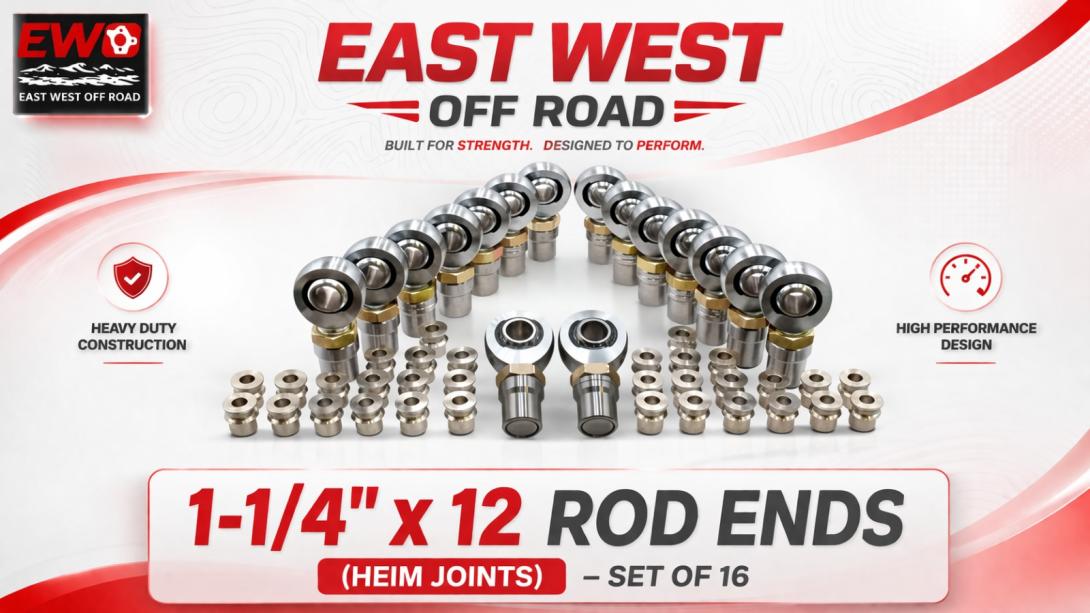
The 1-1/4 Heim Joint Kit for custom suspension fabrication is available in a 16-piece configuration for builders working on larger multi-link projects.
Chromoly Heim Joints
Chromoly heim joints are popular in off-road fabrication because 4130 Chromoly provides a high-strength material platform for demanding mechanical applications.
Heat-treated Chromoly spherical rod ends are commonly marketed for rock crawlers, custom suspension links, control arms, and other high-load applications. Competing four-link products similarly emphasize heat-treated Chromoly heims and heavy-duty construction.
Teflon-Lined Spherical Rod Ends
A Teflon-lined spherical rod end uses a low-friction liner around the bearing surface.
This design allows the spherical ball to articulate smoothly while providing a compact connection for adjustable suspension links.
For off-road builds, a Teflon or Kevlar-reinforced liner can be especially useful where the joint experiences repeated movement.
DOM Tubing and Four-Link Fabrication
The rod end is only one part of a suspension link. The tubing connecting the joints must also be selected appropriately.
DOM tubing is widely used for custom suspension links because it provides a consistent tubular structure suitable for fabrication.
A heavy-duty 4 Link Kit may use large-diameter DOM tubing depending on the vehicle, link length, expected loads, and suspension design.
Choosing Tube Diameter and Wall Thickness
There is no universal tube size that is correct for every four-link application.
Common fabrication considerations include:
- Tube outside diameter
- Wall thickness
- Link length
- Unsupported span
- Vehicle weight
- Axle weight
- Tire size
- Suspension travel
- Expected impact loads
- Mounting location
Some complete kits use 2-inch DOM tubing with approximately 1/4-inch wall thickness for heavy-duty applications, while other systems use smaller tubing depending on the vehicle and design.
The tube should therefore be selected as part of the complete suspension design.
Weld-In Tube Adapters and Threaded Bungs
Weld-in tube adapters create the threaded connection between the DOM link and the spherical rod end.
A typical fabrication setup may include:
- Weld-in tube adapter
- 1-1/4-12 threaded bung
- Tube insert
- Jam nut
- Right-hand threaded heim
- Left-hand threaded heim
The adapter must match the rod-end thread and the tubing being used.
Why Tube Adapters Matter
A properly fitted adapter provides the transition between the cylindrical DOM tube and threaded rod end.
The adapter should be positioned and welded correctly so the completed link maintains adequate thread engagement and structural integrity.
For high-load suspension fabrication, the weld and surrounding tubing are just as important as the rod end itself.
Right-Hand and Left-Hand Heim Joints
Adjustability is one of the major advantages of using spherical rod ends in a four-link system.
Using opposing thread directions allows a link to be adjusted by rotating the link when the suspension is designed for that adjustment method.
A 16-piece configuration can be useful for larger projects requiring multiple left- and right-hand threaded joints.
Why Opposing Threads Help
Imagine a suspension link that needs to become slightly longer after the vehicle is assembled.
With a correctly designed adjustable link using opposing threads, the builder can rotate the link to change its effective length rather than completely removing the link.
This can make suspension setup and future adjustments considerably easier.
Parallel vs Triangulated Four-Link Suspension
Not every 4 Link Kit uses the same geometry.
Two common designs are parallel four-link and triangulated four-link.
Parallel Four-Link
A parallel four-link generally uses links that run relatively parallel to the vehicle centerline.
Because the links do not provide all of the lateral axle location by themselves, a separate lateral locating device such as a Panhard bar is commonly used.
Current parallel four-link kits often include four suspension links plus a Panhard link.
Triangulated Four-Link
A triangulated design angles the links to provide lateral axle control.
This can reduce or eliminate the need for a separate Panhard bar, depending on the geometry.
The packaging and geometry requirements are different from a parallel system, so the chassis and axle brackets must be designed specifically for the selected configuration.
4 Link Kit for Rock Crawlers
A Rock Crawler 4 Link Kit must be capable of handling extreme suspension articulation and repeated impacts.
Rock crawling places unique demands on suspension components because the axle can move through large amounts of travel while tires encounter uneven obstacles.
A suitable setup should consider:
- Maximum articulation
- Tire clearance
- Driveshaft clearance
- Link separation
- Ground clearance
- Axle bracket strength
- Frame bracket strength
- Shock travel
- Pinion angle
- Suspension cycling
Four-link systems are widely marketed specifically for rock crawlers and trail rigs because of their adjustability and ability to withstand demanding off-road use.
How to Select the Right 4 Link Kit
Before buying components, establish the basic requirements of the vehicle.
1. Determine Vehicle Weight
A lightweight trail rig and a heavy full-size truck can place very different loads on suspension links.
2. Determine Axle Type
The axle housing determines available mounting locations and affects bracket design.
3. Establish Suspension Travel
Measure the intended compression and droop range before finalizing link positions.
4. Select Link Diameter
Choose tubing based on the complete suspension design, not simply the largest available size.
5. Choose Joint Type
Common choices include:
- Heim joints
- Johnny Joints
- Spherical rod ends
- Bushings
Each has different characteristics for articulation, noise, maintenance, and road use.
6. Plan the Mounting Brackets
Frame-side and axle-side brackets must provide sufficient clearance and structural support.
7. Cycle the Suspension
Before final welding, the complete suspension should be cycled through compression and droop to identify interference.
4 Link Installation and Fabrication
A four-link installation is significantly more involved than replacing conventional bolt-on control arms.
Professional or experienced fabrication is recommended because the suspension links and brackets are structural components.
Barnes 4WD specifically notes that four-link installation requires prior welding and advanced fabrication experience, along with equipment such as a welder, grinder, saw, jack stands, measuring tools, and an angle finder.
Mock-Up Before Final Welding
Do not immediately final-weld every bracket.
A better fabrication process is to:
- Position the vehicle securely.
- Establish ride height.
- Locate the axle.
- Mock up the lower links.
- Position the upper links.
- Check driveshaft clearance.
- Check tire and suspension clearance.
- Cycle the suspension.
- Verify joint misalignment.
- Confirm pinion angle.
- Verify link separation.
- Recheck measurements.
- Tack weld the brackets.
- Cycle the suspension again.
- Complete final welding.
This process can help identify geometry or clearance problems before they become difficult to correct.
Misalignment Spacers for Heim Joints
Misalignment spacers are often used with spherical rod ends to accommodate different bolt sizes and mounting widths while allowing the joint to articulate.
The spacer configuration should be selected according to:
- Heim bore
- Bolt diameter
- Bracket width
- Required angular movement
- Suspension travel
Incorrect spacer selection can limit articulation or create unwanted loading at the joint.
Common 4 Link Kit Mistakes
Building a four-link suspension involves more than selecting strong components.
Incorrect Link Geometry
A strong rod end cannot compensate for poor suspension geometry.
Insufficient Clearance
Always check the suspension at full compression and full droop.
Poor Bracket Placement
Frame and axle brackets need adequate structural support and proper load paths.
Inadequate Thread Engagement
Threaded rod ends and adapters need sufficient engagement for the intended application.
Ignoring Joint Misalignment
A spherical joint may articulate, but its actual usable movement depends on the complete mounting and spacer arrangement.
Final Welding Too Early
Tack weld, cycle, measure, and inspect before committing to final welds.
Why a Complete Kit Can Simplify Fabrication
Sourcing every component individually can create compatibility problems.
A complete kit can make it easier to match:
- Rod ends
- Jam nuts
- Tube adapters
- Thread specifications
- Joint sizes
- Suspension components
For builders planning multiple suspension links, the 1-1/4 x 12 rod end set provides a larger quantity of heavy-duty spherical joints for custom fabrication.
This can be especially useful when fabricating a complete four-link system, spare links, or multiple suspension components at the same time.
4 Link Kit for Custom Off-Road Fabrication
A custom 4 Link Kit is not simply a collection of suspension parts. It is the foundation of a suspension system that needs to work correctly through the entire range of vehicle movement.
The right combination of spherical rod ends, DOM tubing, threaded adapters, jam nuts, brackets, and carefully calculated geometry can provide the adjustability needed for a serious off-road build.
For fabricators working on large custom suspension systems, the heavy-duty 4-link rod end set is an option to consider when large 1-1/4-inch rod ends are required.
Key Features to Look For in a Heavy-Duty 4 Link Kit
When comparing different kits, look for:
- Large spherical rod ends
- Heat-treated Chromoly construction
- Appropriate thread size
- Right- and left-hand thread options
- Compatible tube adapters
- Heavy-duty jam nuts
- Correct misalignment spacers
- DOM tubing compatibility
- Strong frame brackets
- Strong axle brackets
- Adequate suspension articulation
- Correct link geometry
- Components suited to your vehicle weight and use
A kit should be evaluated as a complete system rather than based on a single advertised specification.
Frequently Asked Questions (FAQs)
What does a 4 Link Kit do?
A four-link suspension uses upper and lower links to control axle movement relative to the chassis. It provides the builder with greater control over suspension geometry and axle positioning.
Is a 4 Link Kit good for rock crawling?
Yes. Four-link suspension is widely used on rock crawlers and trail rigs because it can provide significant articulation and suspension tuning flexibility when properly designed.
What is the difference between parallel and triangulated four-link suspension?
A parallel four-link generally uses a separate lateral locating device such as a Panhard bar. A triangulated system angles the links to provide lateral axle control.
Do four-link systems require a Panhard bar?
It depends on the design. Parallel four-link systems commonly use a Panhard bar, while appropriately designed triangulated systems can locate the axle laterally without one.
Are heim joints good for a 4 Link Kit?
Large spherical rod ends can work very well in custom four-link systems because they provide articulation and adjustability. The joint size, tubing, brackets, and geometry must all be properly matched.
What size heim joint should I use?
There is no universal size. The correct joint depends on vehicle weight, link geometry, tubing, suspension loads, and intended use. Large 1-1/4-inch joints are commonly selected for heavy-duty off-road fabrication.
What tubing is commonly used for four-link suspension?
DOM tubing is commonly used for custom suspension links. The required diameter and wall thickness depend on link length, vehicle weight, load conditions, and suspension design.
Can I install a four-link suspension myself?
A four-link conversion requires welding, fabrication, accurate measuring, suspension geometry planning, and structural bracket installation. Experienced fabricators may perform DIY installations, but advanced fabrication experience is recommended.
What are misalignment spacers used for?
Misalignment spacers allow a spherical rod end to work with a particular bolt size and mounting width while maintaining the required joint articulation.
Why use left- and right-hand threads?
Opposing thread directions allow an adjustable link to be lengthened or shortened by rotating the link, provided the complete suspension link is designed for that adjustment method.
Can a 4 Link Kit improve suspension articulation?
A properly engineered four-link system can provide substantial articulation potential. Actual performance depends on link geometry, joint movement, shock travel, axle clearance, and the rest of the suspension design.
What should I check before final welding?
Check ride height, link geometry, axle position, pinion angle, driveshaft clearance, tire clearance, joint misalignment, shock travel, and full compression and droop before completing final welds.
Final Takeaway
A quality 4 Link Kit gives off-road builders the ability to create a suspension system around the actual vehicle instead of being restricted to factory geometry. With properly selected Chromoly heim joints, DOM tubing, threaded tube adapters, misalignment spacers, and correctly positioned brackets, a four-link setup can deliver the adjustability and articulation required for serious trail and rock-crawling applications.
The most important part is matching every component to the complete suspension design. Stronger parts alone do not guarantee a stronger suspension; geometry, fabrication quality, mounting structure, and correct installation all matter.