

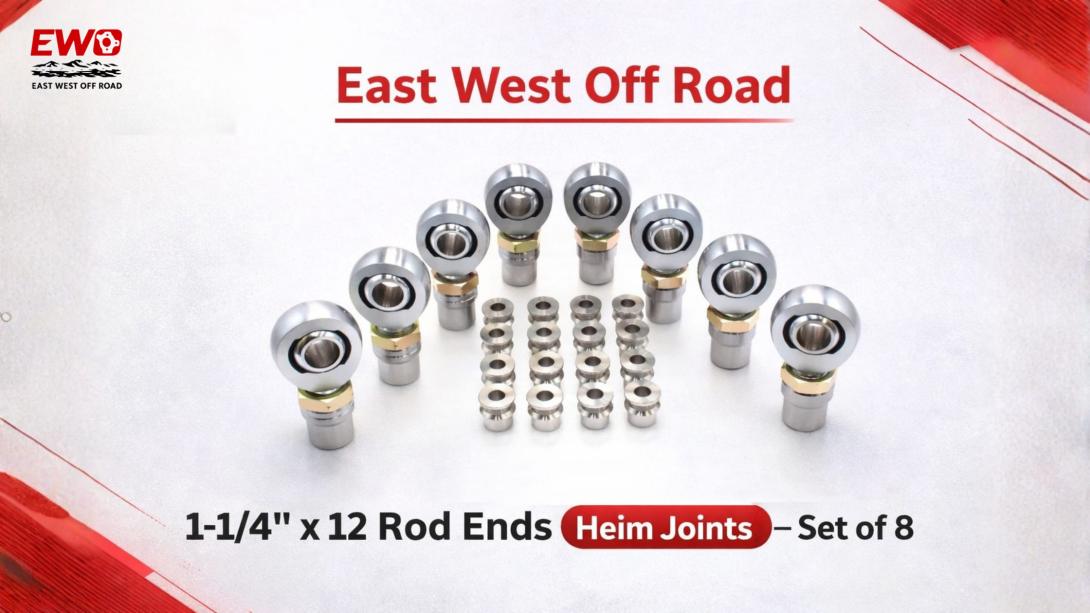
Buy Now: https://www.eastwestoffroad.com/product/1-14%22-x-12-rod-ends-(heim-joints)-set-of-8
A properly designed 4 Link Kit can transform the way an off-road vehicle handles suspension movement, axle control, and extreme articulation. For rock crawlers, trail rigs, custom trucks, and fabrication projects, high-strength rod ends provide the adjustability needed to build suspension links around the vehicle rather than forcing the build to fit fixed components. A heavy-duty setup using large spherical rod ends is especially useful when the suspension will see repeated shock loads, articulation, and demanding trail conditions.
What Is a 4 Link Kit?
A 4-link suspension uses four control links to locate an axle while allowing controlled suspension movement. Compared with basic factory-style suspension layouts, a properly engineered four-link system gives builders significantly more freedom to tune link length, mounting position, axle control, and suspension geometry.
The rod ends are one of the most important connections in the system. They allow the suspension links to articulate while providing threaded adjustment for precise fabrication and setup.
For serious off-road applications, a 4 Link Kit is commonly built around large heim joints, tube adapters, jam nuts, and misalignment spacers. The combination creates an adjustable suspension system that can be tailored to the specific chassis and axle configuration.
Why Use Large Heim Joints in a 4 Link Suspension?
Strength for Demanding Off-Road Use
Off-road suspension components experience loads that can be very different from normal street driving. Rock crawling, ledges, hard landings, and uneven terrain can put significant force through the control links.
Large 1.25 Rod Ends provide a substantial connection point for heavy-duty suspension fabrication. Chromoly Heim Joints are particularly popular among builders who want a strong, serviceable spherical joint for custom suspension links.
A properly selected Heavy Duty Rod End can provide the strength and adjustability required for demanding 4x4 suspension parts.
Improved Articulation
A spherical rod end allows controlled angular movement between the suspension link and its mounting point. This is valuable for rock crawlers where suspension articulation is a major part of the vehicle's capability.
Heim Joints with Misalignment Spacers can also help provide additional articulation while keeping the mounting hardware properly positioned.
Choosing the Right 4 Link Kit Components
A successful suspension build depends on more than simply choosing large rod ends. Every component needs to work together.
1-1/4-12 Rod End Set
The thread size is an important consideration when designing adjustable suspension links. A 1-1/4-12 Rod End Set provides a large threaded connection and is well suited for heavy-duty fabrication.
The available thread engagement also gives builders room for adjustment when setting link lengths during suspension geometry tuning.
Left- and Right-Hand Threads
A Left and Right Heim Joint Kit can make suspension adjustment considerably easier. By using opposing thread directions on the links, builders can adjust link length without completely removing the suspension link from the vehicle.
This is one reason 1-1/4 Heim Set configurations are commonly used in custom 4-link suspension fabrication.
Misalignment Spacers
Misalignment spacers are used between the rod end and mounting bracket to accommodate the required bolt size and provide additional angular movement.
A quality set of 1.25 Heim Misalignment Spacers should be selected according to the mounting bolt diameter, bracket width, and required articulation.
Building a Rock Crawler 4 Link Kit
A Rock Crawler 4 Link Kit needs to withstand repeated impacts and suspension articulation. The design should account for axle travel, link separation, driveshaft movement, exhaust clearance, steering clearance, and tire clearance.
Suspension Geometry Matters
The physical strength of the components is only part of a successful build. Link mounting locations determine how the axle behaves as the suspension cycles.
Before welding brackets permanently, builders should cycle the suspension through its expected range of travel. Check for interference between the links, axle housing, driveshaft, frame, tires, and other components.
The final geometry should be based on the vehicle's intended use rather than simply copying another build.
Custom Suspension Links
Custom Suspension Links allow the builder to select the required length, tube diameter, wall thickness, and joint configuration.
For high-load off-road applications, DOM tubing combined with properly sized rod ends creates a strong foundation for fabricated suspension systems.
Tube Adapters and Weld-In Components
A rod end is only as strong and reliable as the surrounding connection. Tube adapters provide the threaded interface between the heim joint and the suspension link.
Weld-In Tube Adapter
A Weld-In Tube Adapter or bung is installed into the suspension tube and provides the internal threaded connection required for the rod end.
Builders should verify the adapter's outside diameter, inside tube diameter, wall thickness, thread size, and weld compatibility before fabrication.
For example, a Tube Adapter for 1.5 ID Tubing is intended for a specific tube configuration, while larger DOM applications may require a different adapter.
DOM Tubing Compatibility
A Heim Joint Kit for DOM Tubing should always be matched to the actual tubing dimensions being used.
Different builds may use .120 Wall DOM Tube Adapter or .250 Wall DOM Tube Adapter configurations depending on the intended load and fabrication design.
For larger fabrication projects, builders may also encounter components such as a 1.5" Hex Tube Bung, E 60102 Tube Adapter, or other specialized Fabrication Tube Adapters.
Benefits of a Heavy-Duty 4 Link Setup
A well-designed four-link suspension offers several advantages for custom off-road vehicles.
Adjustable Suspension Geometry
Threaded rod ends allow builders to fine-tune suspension link length. This can be useful when establishing ride height, axle position, pinion angle, and other suspension parameters.
Serviceable Components
Unlike permanently fixed suspension joints, heim joints can be inspected and replaced when necessary. This makes them practical for vehicles that regularly see harsh terrain.
Stronger Suspension Connections
A properly sized High-Strength Heim Joint creates a robust connection between the suspension link and chassis or axle bracket.
Large rod ends are especially useful when the vehicle is being built around heavy axles, large tires, and high-articulation suspension systems.
4 Link Kit vs. Factory Suspension Components
Factory suspension systems are generally engineered around a specific vehicle's intended operating conditions. A custom four-link system is different because the builder can determine the suspension geometry and component selection.
A 4 Link Kit is therefore particularly attractive for custom vehicles where factory control arms or mounting locations no longer provide the desired performance.
For rock crawling and serious fabrication projects, the ability to change link length and suspension geometry can be more valuable than simply installing larger factory-style components.
Why 1.25 Rod Ends Are Popular for Custom Builds
The larger size of a 1.25" Rod End Kit makes it suitable for applications where smaller spherical joints may not provide the desired load capacity or physical size.
A properly engineered 1.25 Inch Suspension Joint can be used in custom control arms, suspension links, steering applications, and other off-road fabrication projects.
For builders working on heavy-duty vehicles, Chromoly Suspension Parts can provide a strong combination of material strength, durability, and serviceability.
Product Option for Custom Off-Road Fabrication
For builders looking for a large rod-end package, the 1-1/4 x 12 Rod Ends Set of 8 provides a practical starting point for custom suspension fabrication.
A multi-joint package can be useful when building multiple suspension links and allows the builder to maintain consistent joint sizing throughout the system.
When selecting components, always verify the exact thread direction, bore size, mounting dimensions, tubing requirements, and intended load before beginning fabrication.
Applications for a 4 Link Kit
A properly selected 4 Link Kit can be used across a wide range of custom vehicle projects, including:
- Rock crawler suspension systems
- Custom 4x4 builds
- Heavy-duty truck suspension
- Trail rigs
- Competition off-road vehicles
- Custom 4 Link Suspension
- Fabricated axle conversions
- Race Car Suspension Parts
- Off-Road Suspension Parts
- Custom Off-Road Fabrication
The correct component selection depends on the vehicle weight, axle configuration, suspension travel, driving conditions, and fabrication design.
Installation Considerations
Installing a four-link system is a fabrication project rather than a simple bolt-on modification.
Measure Before Welding
Mock up the suspension at ride height before permanently welding brackets or tube adapters. Check the complete suspension travel and make sure the links do not contact the chassis or other components.
Verify Thread Engagement
Rod ends should have adequate thread engagement inside the tube adapter. Avoid designing a suspension link around minimal thread engagement simply to achieve a desired length.
Inspect Welds and Brackets
Because suspension links are structural components, bracket placement and weld quality are critical. Use appropriate welding procedures for the selected materials and inspect all fabricated joints before operating the vehicle.
Cycle the Suspension
After installation, cycle the suspension through compression and droop. Check for binding, excessive misalignment, interference, and unwanted contact.
A professional alignment and suspension inspection should be performed before serious road or trail use.
Maintenance of Heim Joint Suspension Links
Heavy-duty rod ends still require inspection, especially on vehicles that see mud, rocks, water, and repeated high-load use.
Inspect the spherical bearing for looseness, abnormal movement, contamination, corrosion, or visible damage.
Also inspect:
- Jam nuts
- Tube adapters
- Welds
- Mounting bolts
- Misalignment spacers
- Suspension brackets
- Rod-end threads
- Link tubing
Replacing a worn joint before it becomes a failure is an important part of maintaining an off-road suspension system.
Why a Quality 4 Link Kit Matters
A four-link suspension depends on every connection working correctly. Using appropriately sized rod ends, tube adapters, misalignment spacers, jam nuts, and DOM tubing creates a system that can be fabricated and adjusted around the vehicle's specific requirements.
For builders who want a strong foundation for a custom suspension, a large-format heim setup provides the combination of adjustability, articulation, and serviceability that makes it popular in serious off-road fabrication.
The right 4 Link Kit is not simply about using the largest component available. It is about matching the joint, tubing, brackets, spacers, hardware, and suspension geometry to the vehicle and its intended use.
Frequently Asked Questions (FAQs)
What is a 4 Link Kit?
A 4 Link Kit is a suspension system that uses four control links to locate an axle while allowing controlled suspension movement. Custom systems commonly use heim joints, tube adapters, jam nuts, and misalignment spacers.
What size heim joints are best for a heavy-duty 4-link?
The appropriate size depends on vehicle weight, axle configuration, intended use, suspension geometry, and fabrication design. 1-1/4" heim joints are commonly selected for heavy-duty off-road and custom suspension applications.
Are Chromoly Heim Joints good for rock crawling?
Chromoly Heim Joints are commonly used in demanding off-road applications because they provide a strong spherical connection and allow suspension articulation. The complete suspension system must still be engineered correctly.
What do misalignment spacers do?
Misalignment spacers connect the heim joint to the mounting bracket while accommodating the required bolt size and allowing the joint to articulate through the desired range.
Can a 4 Link Kit be used for a rock crawler?
Yes. Four-link suspension systems are widely used in custom rock crawlers because they allow builders to control suspension geometry and provide substantial articulation when properly designed.
What is the purpose of a tube adapter?
A tube adapter provides the threaded connection between the suspension tube and the rod end. Weld-in adapters are commonly installed into DOM tubing during custom suspension fabrication.
Should a 4-link use left- and right-hand threaded rod ends?
Using both left- and right-hand threads can allow the suspension link to be length-adjusted without completely removing it from the vehicle. The thread configuration should match the overall fabrication design.
What should I inspect after installing a 4-link suspension?
Inspect welds, brackets, tube adapters, jam nuts, rod ends, misalignment spacers, mounting hardware, and thread engagement. Cycle the suspension through its full travel to check for interference or binding.
Is a 4-link suspension suitable for street use?
A custom four-link system can be designed for street-driven vehicles, but the suspension must be engineered and fabricated appropriately. For a road-going vehicle, professional inspection and compliance with applicable safety requirements are recommended.
Final Takeaway
A properly engineered 4 Link Kit can provide the adjustability and articulation needed for serious custom suspension projects. Large spherical rod ends, strong tube adapters, misalignment spacers, and correctly fabricated DOM links work together to create a serviceable suspension connection.
For rock crawlers, trail rigs, and custom 4x4 builds, choosing appropriately sized components and paying close attention to suspension geometry is more important than simply selecting the biggest available parts.
For builders starting a heavy-duty suspension project, a 1-1/4 x 12 rod ends set of 4 can be considered when planning a custom link system and sourcing compatible fabrication components.