

Buy Now: https://www.eastwestoffroad.com/product/4-link-tube-kit-3-feet
A 4 Link Kit is one of the most popular ways to build a custom off-road suspension system when you need controlled axle movement, adjustability, strength, and the ability to tune suspension geometry around your vehicle. Unlike a conventional leaf-spring setup, a properly designed four-link system uses separate suspension links to control axle movement while allowing the builder to configure link length, mounting locations, joint selection, and suspension geometry for the intended application.
For rock crawlers, trail rigs, custom 4x4s, competition vehicles, and fabricated suspension builds, choosing the right combination of link tubes, brackets, rod ends, jam nuts, and suspension joints is just as important as choosing the basic four-link layout.
What Is a 4 Link Kit?
A 4 Link Kit is a collection of components used to create a four-link suspension system between an axle and vehicle chassis.
A typical four-link arrangement uses four suspension links:
- Two upper links
- Two lower links
- Frame-side mounting points
- Axle-side mounting points
- Suspension joints or rod ends
- Threaded tube adapters or weld-in bungs
- Link tubing
- Jam nuts and related hardware
The exact components included in a kit vary by manufacturer. Some kits focus on brackets and joints, while others include suspension tubing or more complete fabrication packages.
For example, East West Off Road offers a dedicated 4 Link Tube Kit designed around custom off-road suspension fabrication.
How Does a Four-Link Suspension Work?
A four-link suspension controls the relationship between the axle and chassis through four separate links.
The links control important aspects of axle movement, including:
- Fore-and-aft axle movement
- Axle rotation
- Pinion movement
- Suspension articulation
- Squat and anti-squat characteristics
- Axle location depending on the chosen geometry
The actual performance of the suspension depends heavily on where the links are mounted and how their angles interact through suspension travel.
That means simply installing four strong bars does not automatically produce a properly functioning suspension system.
The geometry must be designed around the vehicle, axle location, ride height, tire size, drivetrain, intended articulation, and available chassis space.
4 Link Kit vs Leaf Springs
A four-link system can provide substantially more tuning flexibility than a traditional leaf-spring suspension.
Leaf springs perform several jobs simultaneously. They support the vehicle, locate the axle, and influence axle movement.
A four-link system separates many of these functions.
This gives the builder more control over:
- Link length
- Link mounting height
- Axle separation
- Frame-side separation
- Suspension travel
- Articulation
- Pinion behavior
- Spring and shock placement
The tradeoff is that a four-link conversion requires considerably more planning and fabrication.
For a custom off-road build, that extra complexity can be worthwhile when suspension tuning and articulation are priorities.
Types of 4 Link Suspension Layouts
Not every four-link system uses the same geometry.
Two common approaches are parallel four-link systems and triangulated four-link systems.
Parallel 4 Link
In a parallel four-link arrangement, the links generally run more closely parallel to the vehicle centerline.
Because the links provide less lateral axle location by themselves, a separate lateral locating device such as a Panhard bar may be required depending on the design.
This configuration can be useful where chassis and drivetrain packaging make triangulation difficult.
Triangulated 4 Link
A triangulated four-link uses angled links to provide additional lateral axle control.
Depending on the design, the upper links, lower links, or both can be angled toward the vehicle centerline.
Triangulation is commonly used on custom rear suspension systems because it can reduce the need for a separate lateral locating device.
However, the available space around the driveshaft, exhaust, fuel tank, transmission, frame, and axle can determine whether a triangulated design is practical.
A four-link geometry should therefore be selected based on the complete vehicle rather than simply copying another build.
Choosing the Right 4 Link Tubing
The link tubes are structural components of the suspension system, so tubing selection deserves careful consideration.
DOM steel tubing is commonly used for custom off-road suspension links because it provides a consistent material and is well suited to fabrication.
Tube diameter and wall thickness should be selected according to:
- Vehicle weight
- Tire size
- Axle weight
- Suspension design
- Link length
- Mounting configuration
- Intended terrain
- Competition requirements
- Expected loads
Avoid selecting tubing based solely on outside diameter.
A longer link can experience different loading conditions from a short link, and mounting geometry can significantly influence the forces transmitted through the suspension.
1.25 Rod Ends for a Heavy-Duty 4 Link Build
Large spherical rod ends are popular in custom four-link suspension systems because they provide articulation and allow suspension links to move through changing angles.
A 1.25" Rod End Kit from EWO is available with chromoly heim joints, tube adapters, jam nuts, and selectable misalignment spacer configurations. The product also offers left-hand, right-hand, or left-and-right-hand thread options.
A large rod end can be especially useful when building a custom suspension where adjustability and joint articulation are important.
However, the joint should always be selected according to the actual suspension loads and mounting design rather than assuming that a larger joint automatically makes the entire system stronger.
Heim Joints and Misalignment Spacers
Heim joints allow angular movement between the link and mounting bracket.
Misalignment spacers are used to reduce the joint's effective mounting width and provide additional articulation where required by the suspension design.
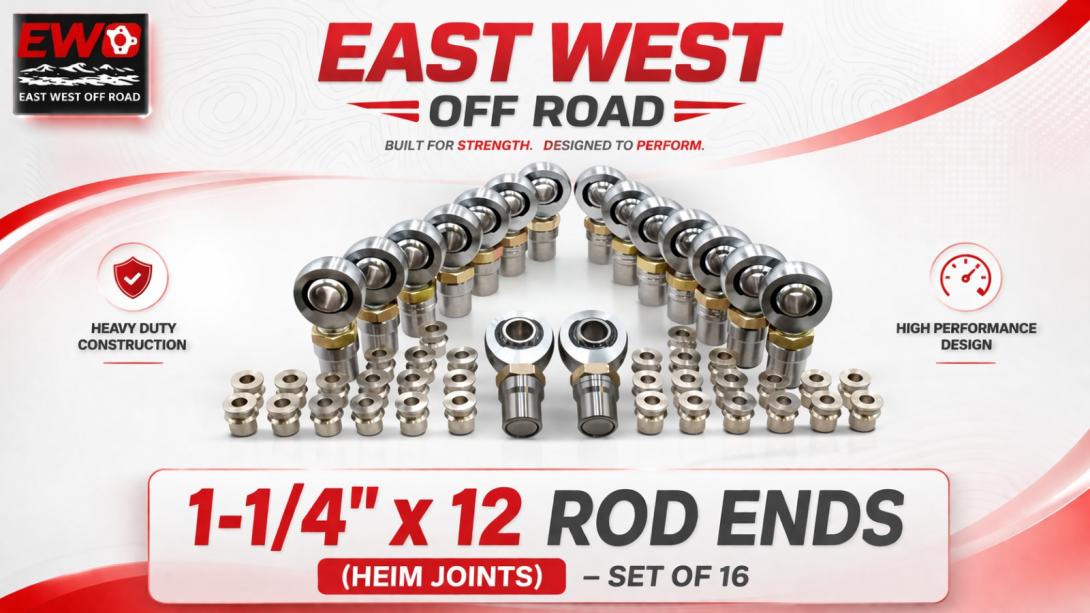
For example, EWO's 1-1/4" x 12 chromoly heim joint sets offer stainless-steel misalignment spacer options in different sizes.
The correct spacer configuration depends on:
- Bracket width
- Bolt diameter
- Required joint misalignment
- Available suspension travel
- Joint articulation
- Mounting orientation
The goal is to make sure the suspension joint can move through its intended range without binding.
Why Left-Hand and Right-Hand Threads Matter
Thread direction is an important detail when building adjustable suspension links.
Using left-hand and right-hand threaded components strategically can allow link length adjustments without completely removing the link from the vehicle.
For example, an adjustable link can be designed so that rotating the tube changes its effective length.
This can make suspension setup and final geometry adjustments considerably easier.
Before welding tube adapters or assembling links, confirm the thread direction of every component.
Mixing incompatible thread directions can create unnecessary fabrication problems and may prevent the desired adjustment range.
4 Link Kit Tube Adapters
Tube adapters connect threaded suspension joints to the link tubing.
The adapter must match the:
- Rod-end thread
- Tube inside diameter
- Tube wall thickness
- Thread direction
- Intended welding method
EWO's current 1.25" rod-end kit offers 1.5" ID hex and round tube adapter options, providing a practical starting point for custom suspension fabrication.
A hex-style adapter can also provide a useful wrenching surface when making suspension adjustments.
Why Link Geometry Is More Important Than Just Strength
One of the biggest mistakes in a custom four-link build is focusing entirely on component strength while ignoring geometry.
A suspension can use extremely strong links and joints but still perform poorly if the mounting points are incorrectly positioned.
Important geometry considerations include:
Link Separation
The vertical and horizontal separation between the upper and lower links affects how the axle reacts to braking, acceleration, and suspension movement.
Link Angles
Link angles influence suspension behavior and axle movement.
Wheelbase Change
As the suspension cycles, the axle may move forward or backward depending on the link geometry.
Pinion Movement
Rear suspension geometry can affect how the differential pinion angle changes through travel.
Anti-Squat
Anti-squat characteristics influence how the suspension reacts to acceleration.
These factors should be calculated and checked before final welding.
4 Link Kit for Rock Crawling
A Rock Crawler 4 Link Kit is typically designed around maximum articulation, durability, and controlled axle movement.
Rock crawling introduces unique suspension demands because the vehicle may experience:
- Large suspension articulation
- Uneven tire loading
- Sudden traction changes
- High axle movement
- Hard impacts
- Rocks contacting suspension components
A successful rock-crawling suspension therefore needs more than heavy-duty rod ends.
The chassis brackets, axle brackets, link tubes, welds, bolts, and suspension joints all need to work together as one system.
4 Link Kit for Custom Off-Road Fabrication
One of the biggest advantages of a universal 4 Link Kit is fabrication flexibility.
Instead of forcing a vehicle into a pre-designed suspension layout, a builder can position the brackets around the existing chassis and axle.
This is particularly useful for:
- Tube chassis builds
- Rock crawlers
- Jeep builds
- Chevy trucks
- Ford trucks
- Toyota 4x4s
- Buggy builds
- Competition vehicles
- Custom axle swaps
However, universal components do not mean universal geometry.
The builder still needs to determine the correct mounting locations for the specific vehicle.
4 Link Brackets and Mounting Locations
The brackets are responsible for transferring suspension loads between the links, chassis, and axle.
When positioning brackets, consider:
- Axle housing clearance
- Differential clearance
- Driveshaft clearance
- Exhaust clearance
- Fuel tank clearance
- Frame strength
- Link-to-link clearance
- Tire clearance
- Full bump travel
- Full droop travel
Do not final-weld brackets based only on the vehicle's static ride height.
The suspension should be cycled through its expected range before final welding.
Building Adjustable Suspension Links
Adjustability is one of the biggest benefits of a four-link suspension.
A properly designed adjustable link can allow the builder to fine-tune:
- Pinion angle
- Wheelbase
- Ride-height geometry
- Link preload
- Suspension behavior
Threaded tube adapters and jam nuts make this possible without requiring the entire suspension system to be rebuilt every time a small adjustment is needed.
The adjustment range should be planned before fabrication so there is enough usable thread engagement at the final setting.
How Many Heim Joints Does a 4 Link Need?
A basic four-link suspension has four links, and each link commonly requires a joint at both ends.
That means a complete system can require eight suspension joints.
However, the actual quantity depends on the specific design.
Some builders use different joint configurations, bushings, Johnny Joints, or other suspension joints depending on the application.
For larger custom builds, EWO also offers a 1-1/4" x 12 Chromoly Heim Joint Set of 16, which can be useful when a fabrication project requires multiple suspension or steering joints.
Installation and Fabrication Considerations
Installing a four-link system is a fabrication project, not simply a bolt-on component replacement.
Before final welding:
- Position the vehicle at the intended ride height.
- Establish axle centerline and wheelbase.
- Position the upper and lower link brackets.
- Check link separation.
- Check driveshaft clearance.
- Check differential clearance.
- Cycle the suspension.
- Check joint misalignment.
- Confirm tire and chassis clearance.
- Tack-weld and recheck measurements.
- Complete welding only after the geometry is verified.
Use appropriate welding procedures for the selected steel and bracket material.
If you are not experienced with structural suspension fabrication, professional fabrication and inspection are strongly recommended.
Common 4 Link Kit Mistakes
Choosing Components Before Designing Geometry
Do not buy every component first and then attempt to make the geometry work around them.
Design the suspension first.
Using Links That Are Too Short
Extremely short links can create aggressive geometry changes through suspension travel.
Ignoring Driveshaft Clearance
Triangulated links can compete for space with the driveshaft and differential.
Welding Brackets at Static Ride Height
A suspension that looks correct at ride height may bind at full compression or droop.
Insufficient Thread Engagement
Adjustable links require adequate thread engagement between the rod end and tube adapter.
Forgetting Steering and Brake Clearance
On front suspension systems, steering linkage, brake lines, shocks, and suspension links must all be checked through full travel.
4 Link Kit Maintenance
A four-link suspension should be inspected regularly, particularly on vehicles used for rock crawling or aggressive trail driving.
Check:
- Heim joint wear
- Rod-end movement
- Misalignment spacers
- Jam nuts
- Mounting bolts
- Bracket welds
- Link tubes
- Cracks or deformation
- Clearance issues
- Changes in suspension geometry
Spherical rod ends are wear components. Their condition should be monitored rather than assuming they will last indefinitely.
Any joint showing excessive play, damage, corrosion, or unusual movement should be investigated before continued hard use.
How to Choose the Best 4 Link Kit
Before purchasing a 4 Link Kit, evaluate the complete project.
1. Determine Your Suspension Layout
Decide whether your build will use parallel, single-triangulated, or double-triangulated geometry.
2. Select the Joint Type
Choose heim joints, bushings, or other joints based on the required articulation and intended use.
3. Determine Tube Size
Select tubing based on the actual vehicle and suspension loads.
4. Verify Thread Compatibility
Confirm thread size and left/right-hand configuration.
5. Check Tube Adapter Fitment
Make sure the tube adapter matches the tubing's inside diameter.
6. Plan Bracket Placement
Measure before cutting and welding.
7. Check Full Suspension Travel
Verify every component at full compression and droop.
8. Consider Future Adjustments
Leave enough adjustment range for suspension tuning.
Is a 4 Link Kit Worth It?
For a serious custom off-road build, a properly engineered 4 Link Kit can provide a level of suspension adjustability that is difficult to achieve with conventional suspension designs.
The biggest advantage is not simply the strength of the components. It is the ability to design the suspension around the vehicle's axle, chassis, drivetrain, tire size, ride height, and intended use.
A high-quality four-link build combines correctly selected tubing, brackets, joints, tube adapters, hardware, and carefully calculated geometry.
For builders fabricating their own suspension, EWO's range of four-link tubing, chromoly heim joints, tube adapters, and related suspension components provides multiple options for assembling a custom system.
Frequently Asked Questions
What is a 4 Link Kit?
A 4 Link Kit contains components used to build a four-link suspension system, typically including suspension links, joints, brackets, tube adapters, jam nuts, or related fabrication components depending on the kit.
Is a 4 Link Kit good for rock crawling?
Yes. Four-link suspension systems are widely used in custom rock-crawling builds because they can provide substantial articulation and allow the suspension geometry to be tuned around the vehicle.
How many links are used in a four-link suspension?
A traditional four-link suspension uses four suspension links: two upper links and two lower links.
Do I need a Panhard bar with a 4 Link Kit?
It depends on the geometry. Some parallel four-link systems use a Panhard bar for lateral axle control, while properly designed triangulated systems can provide lateral location through the links themselves.
What size tubing should I use for a 4 link?
Tubing size should be selected according to the vehicle, link length, suspension geometry, loads, and intended use. There is no single tube size that is appropriate for every four-link build.
Are Heim joints good for 4-link suspension?
Heim joints are commonly used in custom four-link systems because they provide articulation and adjustability. The joint size, misalignment spacers, mounting brackets, and load capacity must all be appropriate for the application.
What are misalignment spacers used for?
Misalignment spacers adapt the heim joint to the mounting width and allow the joint to achieve the required range of angular movement.
Can I build my own 4-link suspension?
Yes, experienced fabricators can build custom four-link systems, but suspension geometry and structural fabrication require careful measurement, proper welding, and thorough inspection.
Is a 4 Link Kit universal?
Some kits are designed as universal fabrication components, but the final suspension geometry is vehicle-specific. Brackets, tubing, joints, and mounting locations must be selected around the actual vehicle.
What should I check after installing a 4 Link Kit?
Check suspension travel, link clearance, driveshaft clearance, tire clearance, joint misalignment, bolt security, bracket welds, steering clearance, and overall suspension movement before driving the vehicle.
Final Thoughts
A 4 Link Kit gives off-road builders the flexibility to create a suspension system around the actual vehicle instead of relying on a one-size-fits-all layout.
The best results come from combining properly selected link tubing, heavy-duty suspension joints, misalignment spacers, tube adapters, brackets, and carefully planned geometry.
Whether you're building a rock crawler, custom 4x4, tube chassis, or competition vehicle, take the time to design the suspension before final welding. Strength matters, but geometry, clearance, adjustability, and proper fabrication are equally important.
EWO's 4-link tubing and suspension components can provide a practical foundation for builders who want to fabricate a custom four-link system around their own chassis and axle configuration.