

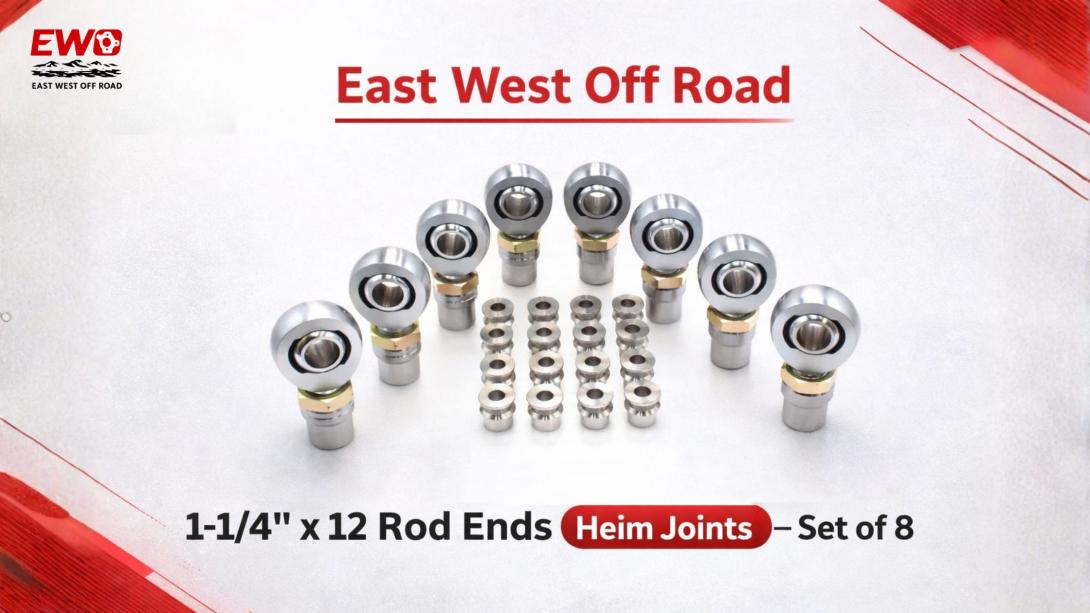
Buy Now: https://www.eastwestoffroad.com/product/1-14%22-x-12-rod-ends-(heim-joints)-set-of-8
A 4 Link Kit is one of the most versatile ways to build a custom suspension for a rock crawler, trail truck, solid-axle conversion, fabricated buggy, or other serious off-road project. Instead of relying on leaf springs to both support and locate an axle, a 4-link arrangement uses dedicated suspension links to control axle movement while coil springs, coilovers, air shocks, ORI-style struts, or another compatible spring/damper system support the vehicle. For heavy custom builds, large 1-1/4"-12 chromoly heim joints are commonly used because they provide an adjustable spherical connection capable of accommodating significant suspension articulation.
East West Off Road currently offers the E63003 1-1/4" x 12 Chromoly Heim Joint Kit as a set of eight with selectable tube adapters, jam nuts, and stainless-steel misalignment-spacer configurations, making it a useful component package for fabricators planning heavy-duty multi-link suspension systems.
What Is a 4 Link Kit?
A 4 Link Kit uses four structural suspension links to locate an axle relative to the chassis.
A typical arrangement includes:
- Two lower links
- Two upper links
- Chassis-side mounting brackets
- Axle-side mounting brackets
- Rod ends or flex joints
- Link tubing
- Mounting hardware
Depending on the design, the system may also require a separate lateral-locating device such as a track bar.
The four links control how the axle moves under:
- Acceleration
- Braking
- Suspension compression
- Suspension droop
- Articulation
The links are structural suspension components, so joint selection and geometry matter significantly.
Why Off-Road Builders Use 4-Link Suspension
A well-designed multi-link suspension gives a fabricator much more control over axle movement than a basic leaf-spring arrangement.
Builders can design around:
- Wheelbase
- Axle position
- Suspension travel
- Ground clearance
- Pinion behavior
- Tire clearance
- Shock placement
This flexibility makes 4-link suspension common in highly customized off-road vehicles.
Common 4-Link Applications
A heavy-duty 4-link setup may be used in:
- Rock crawlers
- Rock bouncers
- Trail trucks
- Jeeps
- Custom pickups
- Tube-frame buggies
- Axle-swap projects
- Ultra4-style builds
- Custom overland trucks
The correct joint and link dimensions depend on vehicle weight, suspension travel, and the complete chassis design.
The Four Basic Suspension Links
The four links are usually divided into upper and lower pairs.
Lower Links
Lower links generally carry substantial longitudinal loads and help locate the axle front-to-back.
They are commonly larger and longer than upper links in many off-road designs.
Upper Links
Upper links help control axle rotation and pinion movement.
Their position has a major influence on the suspension's behavior under acceleration and braking.
The exact arrangement should be determined as part of the vehicle's engineered suspension geometry.
What Does a 4-Link Control?
The links do much more than simply hold the axle in place.
Together, they influence:
- Axle fore/aft movement
- Axle rotation
- Pinion-angle behavior
- Suspension articulation
- Load transfer
- Chassis response during acceleration
- Chassis response during braking
Because the links are responsible for controlling such important vehicle movement, the geometry should be professionally designed rather than positioned solely according to available space.
Parallel vs. Triangulated 4-Link
One of the first decisions is the suspension architecture.
Parallel 4-Link
A parallel setup keeps the primary links relatively parallel when viewed from above.
Because that arrangement does not inherently provide enough lateral axle location in many designs, a separate track bar or Panhard bar is commonly used.
Triangulated 4-Link
A triangulated system angles one or more pairs of links inward.
The triangulation can help control lateral axle movement without a separate track bar in appropriate designs.
Both arrangements can work extremely well when correctly engineered.
Why Triangulated 4-Link Is Popular Off Road
A triangulated layout can appeal to off-road builders because it can eliminate the need for a separate track bar.
Potential advantages include:
- Fewer lateral-locating components
- Good articulation potential
- Flexible packaging in some custom chassis
However, triangulation also requires adequate space around:
- Driveshaft
- Exhaust
- Fuel tank
- Differential
- Chassis rails
Vehicle packaging determines whether the layout makes sense.
Why Parallel 4-Link Remains Popular
Parallel link systems are also common because their component placement can be easier to visualize and package in some chassis.
A track bar then manages lateral axle location.
This arrangement is frequently seen in:
- Trucks
- Jeeps
- Solid-axle conversions
- Custom front suspension
The track-bar and suspension-link geometry still need to work together correctly.
Why 1-1/4 Heim Joints Are Used in 4-Link Kits
Heavy custom suspension links often use large spherical rod ends.
A 1-1/4-inch threaded heim joint provides:
- Large threaded connection
- Adjustable suspension-link interface
- Spherical articulation
- Heavy-duty component architecture
This is why 1.25-inch rod ends appear frequently in rock-crawler and heavy-duty 4-link systems.
What Does 1-1/4"-12 Mean?
The specification identifies the threaded shank.
1-1/4"
This is the nominal thread diameter.
12
This means 12 threads per inch.
A 1-1/4"-12 rod end therefore needs compatible:
- Tube adapter
- Jam nut
- Thread direction
- Suspension-link design
Components should never be matched only by appearance.
1-1/4" x 12 Rod Ends for a 4-Link Build
A 1-1/4" x 12 Rod Ends (Heim Joints) – Set of 8 naturally aligns with many four-link projects because four suspension links can require multiple articulating connection points.
The EWO E63003 currently packages eight chromoly heim joints as one product family.
Using joints from the same family can simplify:
- Thread matching
- Replacement identification
- Jam-nut compatibility
- Tube-adapter planning
Actual required quantity still depends on the suspension design.
Why Chromoly Heim Joints Are Popular
Chromoly is widely used in off-road and motorsport suspension components because it can provide high strength when properly engineered and manufactured.
A rod end in a 4-link suspension can experience loads associated with:
- Vehicle weight
- Braking
- Acceleration
- Axle torque
- Suspension articulation
- Trail impacts
That makes joint construction an important part of the complete suspension system.
Chromoly vs. Basic Rod Ends
A heavy-duty chromoly rod end is generally aimed at more demanding applications than a light industrial rod end.
However, buyers should evaluate more than material alone.
Important specifications can include:
- Thread size
- Bore size
- Bearing design
- Body dimensions
- Spacer compatibility
- Intended load direction
- Replacement availability
The largest-looking rod end is not automatically the correct joint.
What Is a Heim Joint?
A heim joint is a spherical rod end.
Inside the rod-end body is a spherical bearing that allows the link to change angle relative to the mounting bolt.
This movement is essential in articulated suspension because the axle does not move in only one direction.
During off-road travel, it may simultaneously:
- Move upward
- Move downward on the opposite side
- Rotate
- Shift through its designed suspension path
The spherical joint accommodates this movement.
Why Spherical Articulation Matters
Imagine one tire climbing onto a rock while the opposite tire drops into a depression.
The axle is now positioned at an angle relative to the chassis.
Rigid joints would resist this movement.
A spherical rod end allows the suspension link to change angle while continuing to locate the axle.
That characteristic is a major reason heim joints are popular in custom crawling suspensions.
High-Misalignment Spacers
Misalignment spacers fit into the spherical bearing.
They can provide two important functions:
- Adapt the joint to a chosen mounting-bolt diameter
- Provide additional angular clearance around the joint
That additional movement can be especially important in high-articulation suspension.
Current EWO Misalignment Options
EWO currently lists several configurations for E63003:
- 1" to 3/4" Stainless Steel
- 1" to 5/8" Stainless Steel
- 1" to 9/16" Stainless Steel
- Without Spacers
The correct option should match the engineered mounting hardware and bracket design.
Why Bolt Size Is Not a Standalone Decision
Mounting-bolt diameter should be selected as part of the complete suspension design.
It interacts with:
- Heim bore
- Misalignment spacer
- Bracket width
- Link load
- Mounting configuration
A spacer should not be selected simply because it allows a convenient bolt size.
What Is a Tube Adapter?
A tube adapter creates the threaded interface between the rod end and the suspension-link tubing.
It is also commonly called:
- Tube insert
- Threaded bung
- Weld-in adapter
The heim joint threads into the adapter, allowing the suspension link to be adjustable and serviceable.
EWO Tube Adapter Choices
The current EWO product page lists:
- 1.5" I.D. Hex Tube Adapter
- 1.5" I.D. Round Tube Adapter
- No Tube Adapter
These options allow the joint package to be matched to different fabrication plans.
Hex vs. Round Tube Adapters
Both perform the same basic role: creating the threaded connection between the link tube and rod end.
Hex-Style Adapter
The external flats can provide convenient wrench surfaces during professional fabrication or adjustment.
Round Adapter
The cylindrical profile may suit different tubing or fabrication preferences.
The correct option depends on the actual link material and design.
Why Tube Inside Diameter Matters
Tube adapters are designed around tubing dimensions.
EWO currently identifies its optional adapters by a 1.5-inch I.D. specification.
This matters because two tubes with the same outside diameter may have different inside diameters if they use different wall thicknesses.
The adapter needs to match the actual tubing used in the suspension link.
DOM Tubing in 4-Link Suspension
DOM tubing is common in fabricated off-road links.
Its popularity comes from:
- Dimensional consistency
- Availability in heavy-wall sizes
- Suitability for professional suspension fabrication
However, the correct tubing size is determined by the complete design.
Vehicle weight, link length, bending loads, intended use, and joint configuration all affect material selection.
Why the Lower Links Matter So Much
Lower links are exposed to substantial forces and may also be physically vulnerable to obstacles.
Off-road lower links can experience:
- Acceleration loads
- Braking loads
- Trail impacts
- Contact with rocks
- Sliding across obstacles
This is why lower-link design receives significant attention in serious crawler builds.
Upper-Link Role
The upper links help resist axle rotation.
During acceleration and braking, torque tries to rotate the axle housing.
The upper and lower links work together to control that movement.
Their placement also affects how chassis weight transfers during acceleration.
What Is Anti-Squat?
Anti-squat is a suspension-geometry concept describing how link geometry influences chassis movement under acceleration.
It is affected by factors such as:
- Link angles
- Link intersection
- Vehicle center of gravity
- Wheelbase
- Axle position
It is not something that should be chosen from a universal number without considering the full vehicle.
Professional suspension design is strongly recommended.
Pinion-Angle Control
A multi-link suspension helps control axle rotation and therefore influences how the pinion behaves as the suspension moves.
This matters because the driveshaft and pinion need an appropriate operating relationship throughout intended suspension travel.
Link placement should therefore be coordinated with the vehicle's drivetrain layout.
4-Link Suspension for Rock Crawlers
Rock crawlers are among the most common vehicles to use custom link suspension.
A purpose-built system can provide substantial articulation while maintaining axle control.
Rock-crawling requirements can include:
- High articulation
- Large tires
- Significant suspension travel
- Heavy axles
- Strong link joints
- Ground clearance
The suspension needs both movement and predictable axle location.
4-Link Kit for Axle Swaps
An axle swap can create the opportunity to replace the original suspension architecture entirely.
A 4-link conversion can allow the builder to position a new axle around:
- Desired wheelbase
- Tire clearance
- chassis dimensions
- driveline packaging
This is one reason universal link-suspension parts are popular in custom axle-swap projects.
4-Link Suspension for Jeeps
Custom Jeep builds often move to multi-link suspension when the owner wants more control over:
- Wheelbase
- articulation
- large tire clearance
- axle position
Applications can include extensively modified trail-only or competition-oriented vehicles.
The specific chassis and axle combination determine the correct geometry.
4-Link Suspension for Trucks
Custom pickups and older solid-axle trucks can also use four-link suspension.
A truck build may place additional emphasis on:
- Vehicle weight
- frame dimensions
- load distribution
- axle size
- intended road/trail balance
A suspension suitable for a lightweight buggy should not automatically be copied onto a heavy truck.
4-Link Suspension for Fabricated Buggies
Tube-frame buggies give the builder more freedom because suspension mounts can be designed into the chassis from the beginning.
That freedom also means every geometry decision becomes the fabricator's responsibility.
A professionally engineered layout should account for:
- Link location
- bracket structure
- articulation
- driveline clearance
- shock location
Heim Joints vs. Flex Joints in a 4-Link
Both types are common.
Heim Joints
Potential advantages include:
- Precise movement
- High articulation
- Threaded adjustability
- Compact packaging
Flex Joints
Potential advantages can include:
- Articulation
- Some vibration isolation
- Rebuildability in many designs
The right choice depends on how the vehicle will be used.
Heim Joints vs. Rubber Bushings
Rubber bushings are common in OEM suspension because they reduce:
- Noise
- vibration
- harshness
Heim joints provide much less isolation but allow precise movement and adjustable custom geometry.
That makes them especially attractive for trail and competition-oriented builds.
Why a Street/Trail Build May Need Different Priorities
A dedicated rock crawler and a daily-driven truck may both use 4-link suspension, but their ideal joint strategy can differ.
A street-oriented build may place more emphasis on:
- Noise isolation
- vibration
- maintenance
- long-term road comfort
A crawler may prioritize:
- Articulation
- link strength
- ground clearance
- adjustability
The suspension should reflect actual vehicle use.
Link Length Matters
Link length influences how the axle moves through its suspension path.
Longer and shorter links can create different:
- Axle movement
- pinion behavior
- articulation characteristics
There is no universal link length that works for every chassis.
The correct geometry should be established around the specific vehicle.
Upper vs. Lower Link Length
Some suspension designs use different upper and lower link lengths.
This can influence how axle rotation and pinion angle change through travel.
The relationship between these links should be considered as part of the entire suspension design.
Link Separation
The vertical and horizontal distance between link mounting points affects how suspension loads transfer through the chassis.
Adequate separation helps the links manage axle torque.
Too little or poorly positioned separation can produce undesirable behavior.
Exact geometry should be determined by a qualified suspension designer.
Bracket Strength Matters
The strongest heim joint is only as useful as the bracket holding it.
Suspension mounts transfer vehicle loads into:
- Axle housing
- chassis
- crossmember
Mounting structure needs to be appropriate to the vehicle and suspension loads.
Bracket Width and Heim Joints
The bracket needs to fit the rod end and spacer assembly.
Important dimensions include:
- Joint ball width
- Misalignment spacer width
- Bracket spacing
- Mounting bolt
These need to be planned together.
Suspension Travel and Heim Misalignment
One of the most important checks in a custom 4-link system is whether each joint has sufficient angular movement throughout suspension travel.
Consider the full range from:
- Compression
- Droop
- Cross-axle articulation
A heim joint should not become the mechanical travel limit of the suspension.
Driveline Clearance
The suspension links share space with:
- Driveshaft
- differential
- exhaust
- transmission
- transfer case
- fuel system
A 4-link layout should account for these components throughout suspension movement.
Tire Clearance
Larger tires require significant space as the axle moves and articulates.
The suspension design may need to consider:
- Full compression
- Steering angle on a front axle
- Opposite-side droop
- wheel backspacing
Vehicle packaging should be evaluated before link mounts are finalized.
Shock and Coilover Placement
A 4-link system locates the axle but does not by itself support vehicle weight.
The build needs a suitable spring and damping arrangement such as:
- Coil springs
- Coilovers
- Air shocks
- Other properly engineered suspension components
Shock placement must work with both chassis geometry and suspension travel.
Why Adjustability Matters
Threaded heim-joint links can allow controlled adjustment of link length during professional chassis setup.
This can help the builder establish the intended:
- Axle position
- wheelbase
- pinion relationship
- suspension geometry
Adjustment should stay within the safe thread-engagement range specified for the components.
Left-Hand and Right-Hand Threads
Many custom links use a right-hand-thread rod end at one side and a left-hand-thread rod end at the other.
This allows link length to be adjusted by rotating the link body.
That is one reason matching jam nuts and tube adapters are important.
Jam Nuts in 4-Link Suspension
Jam nuts secure the adjusted threaded connection between the heim and tube adapter.
A jam nut needs to match:
- Thread diameter
- Thread pitch
- Thread direction
It should also remain part of routine suspension inspection.
Why Serviceability Matters
A custom suspension may remain on an off-road vehicle for many years.
Wear components therefore need a clear replacement strategy.
Useful standardized components include:
- Rod ends
- jam nuts
- misalignment spacers
- tube adapters
A builder should record the exact specifications used during the original build.
Inspecting a Heim-Joint 4-Link
Periodic inspection is important, especially after hard trail use.
Areas worth checking include:
- Joint play
- Spherical-bearing movement
- Joint body
- Threads
- Jam nuts
- Misalignment spacers
- Mounting hardware
- Link tubes
- Brackets
Unexpected looseness, binding, or visible damage should be professionally evaluated before continued use.
Mud, Sand, Water, and Suspension Wear
Off-road joints may be exposed to:
- Mud
- Sand
- Water
- Road salt
- Dust
- Trail debris
Operating environment can affect component life.
A vehicle that spends most of its time rock crawling or in mud may require more frequent suspension inspection than a lightly used trail vehicle.
Why a Heim Joint Set Is Not a Complete 4-Link Suspension
This distinction is important.
EWO E63003 supplies the rod-end component package, but a complete 4-link suspension also requires properly selected and engineered:
- Link tubing
- Chassis brackets
- Axle brackets
- Mounting hardware
- Spring/damper system
- Suspension geometry
The rod ends are foundational components, not the entire suspension system by themselves.
EWO E63003 for 4-Link Builders
East West Off Road currently lists:
1-1/4" X 12 CHROMOLY HEIM JOINT KIT – SET OF 8 WITH TUBE ADAPTERS & JAM NUTS
Item Number: E63003
Current selectable configurations include:
Bore Misalignment
- 1"-3/4" Stainless Steel
- 1"-5/8" Stainless Steel
- 1"-9/16" Stainless Steel
- Without Spacers
Tube Adapters
- 1.5" I.D. Hex Tube Adapter
- 1.5" I.D. Round Tube Adapter
- No Tube Adapter
For professional off-road fabricators building a custom suspension, the chromoly heim joint kit provides the primary spherical rod-end hardware in several selectable configurations.
4-Link Buyer Checklist
Before ordering parts for a custom 4-link system, identify:
Item
Why It Matters
Vehicle weight
Influences component requirements
Front or rear axle
Changes packaging and geometry
Axle type
Determines available mounting space
Link layout
Parallel or triangulated
Joint thread
Must match adapters and jam nuts
Bore/spacers
Must match mounting hardware
Link tubing
Must match tube adapters
Bracket width
Must match joint/spacer assembly
Suspension travel
Determines articulation requirement
Shock system
Supports and damps the vehicle
Wheelbase
Affects geometry
Intended use
Street, trail, crawler, competition
Common Mistake: Treating “4-Link Kit” as One Universal Product
A universal builder kit does not create universal suspension geometry.
Every vehicle differs in:
- Wheelbase
- center of gravity
- frame width
- axle size
- drivetrain
- suspension travel
Component compatibility and geometry need to be determined for the individual build.
Common Mistake: Choosing Joints Only by Size
A 1-1/4-inch thread is only one specification.
Rod-end selection should also consider:
- Bore
- material
- bearing construction
- mounting width
- spacer options
- loading
- replacement availability
Common Mistake: Ignoring Misalignment
A heim may be physically strong enough while still lacking sufficient angular movement for the suspension design.
Suspension articulation and joint articulation need to be evaluated together.
Common Mistake: Ignoring Bracket Structure
High-strength rod ends cannot compensate for inadequate mounting brackets.
The entire load path—from axle to link to chassis—needs to be appropriately engineered.
Common Mistake: Copying Another Vehicle's Link Geometry
Two rock crawlers may look similar but have different:
- Wheelbase
- center of gravity
- drivetrain position
- axle location
- tire size
- vehicle weight
Their ideal suspension geometry can therefore be different.
Common Mistake: Designing Only for Maximum Flex
More articulation is not automatically better.
A suspension also needs:
- Predictable axle control
- driveline clearance
- stable handling
- appropriate joint angles
Usable suspension performance requires balance.
Professional Design and Fabrication
A custom 4-link suspension is a structural vehicle system.
The links and mounts locate the axle and carry substantial acceleration, braking, and suspension loads.
For that reason, professional chassis design, fabrication, and final inspection are strongly recommended.
The completed suspension should be checked for:
- Appropriate link geometry
- Proper component compatibility
- Sufficient joint articulation
- Hardware integrity
- Bracket integrity
- Driveline clearance
- Tire clearance
- Full suspension movement
Frequently Asked Questions (FAQs)
What is a 4 Link Kit?
A 4-link suspension uses four structural links to locate an axle relative to the vehicle chassis.
How many links does a 4-link suspension use?
Four primary suspension links—typically two upper and two lower links.
What is the difference between parallel and triangulated 4-link suspension?
A parallel layout commonly needs a separate lateral-locating device such as a track bar, while triangulated links can provide lateral axle control in an appropriately designed system.
Why use a 4-link suspension off road?
It gives builders significant control over axle position, articulation, wheelbase, suspension travel, and geometry.
Are 1-1/4 heim joints good for a 4-link suspension?
Large 1-1/4"-12 heims are commonly used in heavy-duty custom 4-link systems when properly sized for the vehicle.
What is EWO E63003?
It is East West Off Road's 1-1/4" x 12 Chromoly Heim Joint Kit, Set of 8 with selectable tube-adapter and misalignment-spacer configurations.
How many heims are in E63003?
Eight.
Why would a 4-link project use eight heim joints?
Four suspension links can require multiple articulating connection points, though the exact joint strategy depends on the suspension design.
Are the EWO heim joints chromoly?
Yes. The current EWO product title identifies the kit as chromoly.
Does the EWO product include jam nuts?
Yes. The current product title states that jam nuts are included.
What tube-adapter choices does EWO offer?
The current page lists 1.5-inch I.D. hex adapters, 1.5-inch I.D. round adapters, or no tube adapters.
What misalignment-spacer choices are available?
The current page lists 1"-3/4", 1"-5/8", and 1"-9/16" stainless-steel options, plus a without-spacers selection.
What is a misalignment spacer?
It interfaces with the spherical bearing to adapt the mounting configuration and provide additional angular clearance.
Why is joint articulation important?
The rod end needs sufficient angular freedom for the axle to move through its designed suspension travel without joint binding.
What does 1-1/4"-12 mean?
A 1-1/4-inch threaded shank with 12 threads per inch.
What is a tube adapter?
It creates the threaded interface between a suspension-link tube and heim joint.
Why are jam nuts important?
They secure the chosen threaded link adjustment.
Why use left- and right-hand threads?
Opposing thread directions can allow the effective link length to be adjusted through the link assembly.
What is the difference between a heim joint and a flex joint?
Heim joints use spherical rod-end architecture, while many flex joints incorporate a different articulating design with additional isolation.
Are heim joints good for rock crawlers?
They are widely used in custom crawler suspension because they provide articulation and adjustable linkage connections.
Is a 4-link better than leaf springs?
Neither is universally better. Four-link suspension offers greater geometry and articulation design flexibility, while leaf springs are simpler and can suit many vehicles well.
Can a 4-link suspension be used on a truck?
Yes. Custom trucks commonly use four-link suspension when the chassis and axle system are properly engineered.
Can a 4-link be used on a Jeep?
Yes. Highly modified Jeeps and crawler builds frequently use custom multi-link suspension.
Can a 4-link system be used with coilovers?
Four-link axle-location systems are commonly paired with coilovers and other compatible spring/damper arrangements.
What is anti-squat?
It is a suspension-geometry characteristic describing how the link arrangement influences chassis movement under acceleration.
Does a 4-link control pinion movement?
Yes. The upper and lower links together influence axle rotation and pinion behavior through suspension travel.
Is the EWO heim set a complete 4-link suspension kit?
It is a rod-end component package rather than an entire vehicle-specific suspension system. A complete build also requires appropriately engineered links, brackets, hardware, suspension geometry, and spring/damper components.
Can I copy another truck's 4-link geometry?
That is not recommended because wheelbase, weight distribution, center of gravity, axle placement, and intended use differ between vehicles.
Should a custom 4-link suspension be professionally designed?
Yes. Professional suspension design, fabrication, and final inspection are strongly recommended because the links and brackets locate the axle and carry significant vehicle loads.