

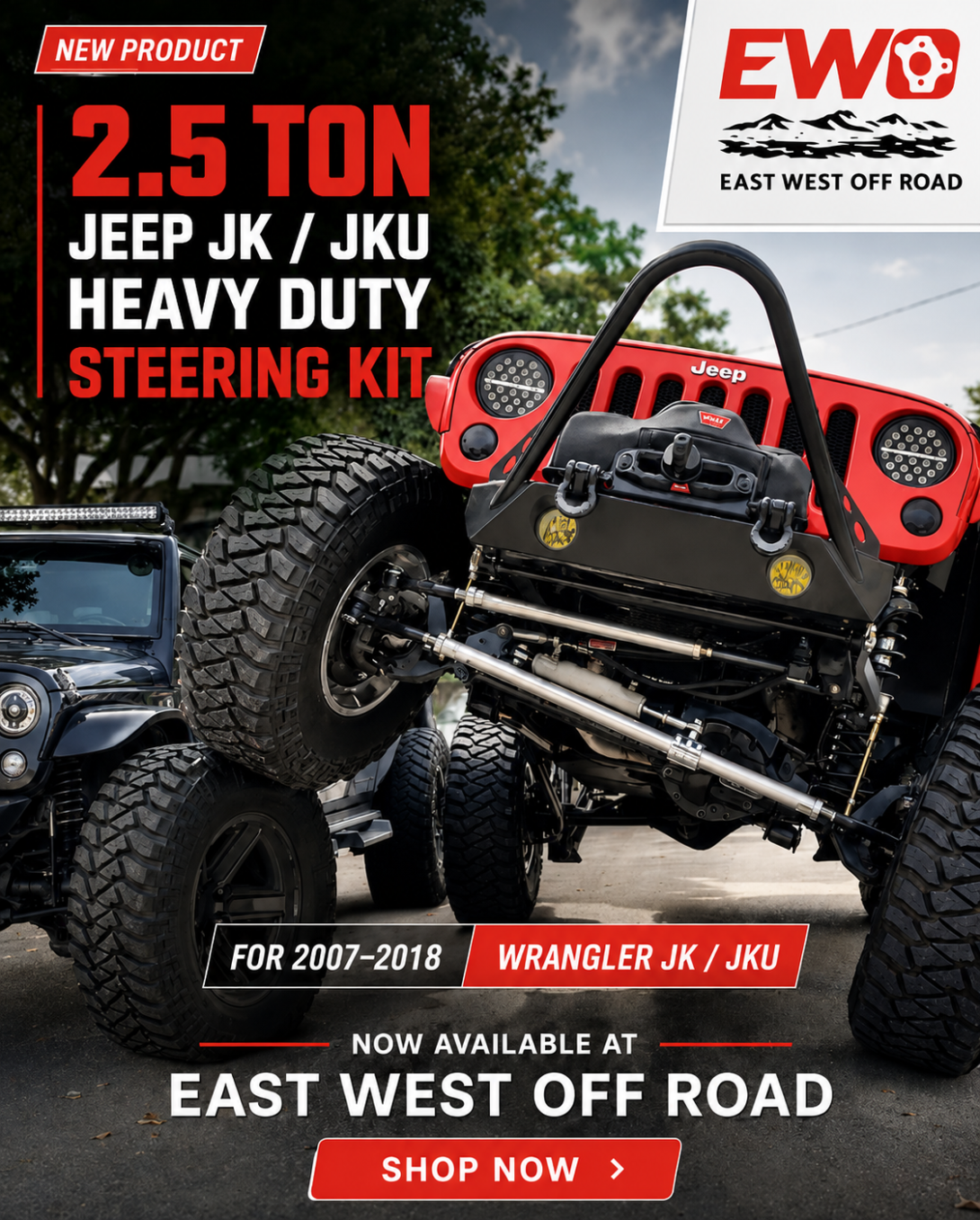
A 2.5 ton Jeep steering kit is designed for Jeep owners looking to move beyond factory-sized steering components on heavily modified JK and JKU builds. Larger tires, suspension lifts, additional vehicle weight, and demanding off-road conditions can place significantly greater loads on the front steering system. A heavy-duty tie rod and drag link combination can provide a stronger foundation while giving builders more options for configuring the steering system around their specific Jeep.
The “2.5 ton” terminology refers to an aftermarket heavy-duty class of steering components, not the weight rating of the Jeep. For the right application, the combination of heavy-duty linkage, properly matched steering ends, and appropriate geometry can make a substantial difference in durability and trail performance.
What Is a 2.5 Ton Jeep Steering Kit?
A 2.5-ton Jeep steering kit typically replaces the factory tie rod and drag link with substantially heavier-duty components.
The tie rod connects the front steering knuckles, while the drag link transfers steering input from the pitman arm to the steering knuckle.
Together, these components form a critical part of the Jeep's steering linkage.
A complete kit allows both links to be upgraded at the same time instead of mixing an aftermarket tie rod with a factory drag link.
What Does “2.5 Ton” Mean?
The term “2.5 ton” is commonly used in the aftermarket to describe a heavy-duty category of steering hardware.
It does not mean:
- The Jeep must weigh 2.5 tons
- The Jeep has a 2.5-ton GVWR
- The steering kit increases the Jeep's payload rating
Instead, it describes the heavy-duty nature and size of the steering components.
Why Upgrade to 2.5 Ton Jeep Steering?
Factory steering components can work well on a stock Jeep, but modifications can change the loads experienced by the steering system.
A Jeep running 35-inch, 37-inch, or larger tires can experience significantly different steering loads than a stock vehicle.
Rock crawling also exposes the steering linkage to impacts and side loads.
A heavy-duty steering system can provide greater resistance to bending and deformation compared with smaller factory-style linkage.
Larger Tires and Steering Loads
Increasing tire size increases the leverage acting on the steering system.
This is one reason a heavy duty tie rod Jeep Wrangler upgrade is commonly considered when moving to larger tires.
However, tire size should not be the only factor used to select steering components.
Vehicle weight, axle configuration, steering assist, suspension lift, wheel dimensions, and driving conditions also matter.
Trail Protection
The tie rod and drag link are positioned near the front axle and can be exposed to rocks and other obstacles.
A properly designed heavy-duty steering system can provide a more robust linkage while the overall configuration can be planned around available axle and wheel clearance.
7075-T6 Aluminum Jeep Steering Kit
One of the major features that differentiates modern heavy-duty steering systems is material selection.
The EWO 2.5 ton Jeep steering kit uses a 7075 aluminum configuration for the tie rod and drag link.
7075-T6 aluminum is a high-strength aluminum alloy known for its strength-to-weight characteristics.
For Jeep builders, that creates an alternative to extremely large steel steering components.
Aluminum Tie Rod Jeep Wrangler
An aluminum tie rod Jeep Wrangler setup can provide a useful combination of strength and reduced weight.
That can be attractive for builders who want to upgrade steering without unnecessarily adding weight to the front axle.
However, aluminum should not be judged in isolation.
The complete steering system depends on:
- Link design
- Diameter
- Construction
- Steering ends
- Thread engagement
- Attachment points
- Suspension geometry
- Vehicle configuration
2.5 Ton Tie Rod and Drag Link Kit
The main advantage of a complete 2.5 ton tie rod and drag link kit is that both major steering links are upgraded together.
Heavy-Duty Tie Rod
The tie rod transfers steering movement between the front knuckles.
A larger and stronger tie rod can provide increased resistance to bending compared with factory-sized linkage.
Heavy-Duty Drag Link
The drag link transfers steering input from the pitman arm to the steering knuckle.
Its geometry is particularly important on lifted Jeeps because changing the drag-link position can affect its relationship with the track bar.
Matched Components
Using a complete system can simplify component selection.
Instead of choosing the tie rod, drag link, and steering ends independently, builders can start with components designed around the same application.
Jeep JK 2.5 Ton Steering Kit
The Jeep JK 2.5 ton steering kit category is particularly relevant to 2007–2018 Wrangler JK builds.
The two-door JK can be modified with:
- Suspension lift
- Larger tires
- Heavy bumpers
- Winches
- Armor
- Aftermarket wheels
- Rock-crawling equipment
These modifications can increase the demands placed on the steering system.
A properly selected heavy-duty steering upgrade can complement the rest of the vehicle's modifications.
Jeep JKU 2.5 Ton Steering Kit
The four-door Wrangler Unlimited JKU is another common application for heavy-duty steering upgrades.
A Jeep JKU 2.5 ton steering kit can be considered for JKU builds running larger tires and additional equipment.
The JKU can carry more weight than a two-door JK, particularly when equipped with bumpers, armor, recovery equipment, and camping gear.
Jeep Wrangler Unlimited Steering Upgrade
A Jeep Wrangler Unlimited steering upgrade should be selected around the complete vehicle.
Consider:
- Tire size
- Wheel backspacing
- Suspension height
- Front axle
- Steering box
- Track bar
- Steering stabilizer
- Intended use
A heavier-duty steering system should complement the rest of the front-end components rather than being treated as a standalone solution.
2.5 Ton Tie Rod vs. Factory Tie Rod
The tie rod is one of the most exposed steering components on a Jeep.
Factory linkage is designed around the original vehicle configuration.
A heavy-duty replacement can use a larger link and stronger steering-end configuration.
When Should You Upgrade?
A 2.5-ton steering upgrade may make sense when a Jeep has:
- Larger-than-stock tires
- Significant suspension lift
- Frequent rock-crawling use
- Repeated tie-rod damage
- Heavy aftermarket equipment
- Increased front-end loads
- A broader heavy-duty steering build
A stock or lightly modified Jeep may not require a 2.5-ton system.
Heavy-Duty Steering Ends for Jeep
The steering ends connect the steering links to the Jeep's knuckles and pitman arm.
This makes them just as important as the main steering tubes or links.
When comparing 1.25 inch tie rod ends Jeep JK applications, check the complete specification.
Important factors include:
- Thread size
- Thread direction
- Taper
- Articulation
- Mounting dimensions
- Steering-end strength
- Compatibility with the selected linkage
Forged Tie Rod Ends Jeep Wrangler
Forged tie rod ends Jeep Wrangler applications can provide a robust connection for demanding steering systems.
However, the correct taper and dimensions remain essential.
A high-strength steering end that does not correctly match the Jeep's knuckle or steering arm is not a suitable installation.
Chromoly Tie Rod Ends Jeep
Chromoly tie rod ends Jeep applications are another option found in heavy-duty aftermarket steering systems.
As with forged components, the material is only one part of the selection process.
Fitment, articulation, thread engagement, and steering geometry should all be verified.
Lifted Jeep Steering: Factory Location vs. Flip
A suspension lift can change the angle and position of the steering linkage.
That makes drag-link configuration an important consideration.
Jeep JK Factory Location Drag Link
A Jeep JK factory location drag link can remain appropriate for certain mildly lifted builds.
A heavy-duty drag link can be installed while retaining the original general mounting arrangement.
This can be a straightforward solution when the existing geometry remains appropriate.
Jeep JK Flip Drag Link Kit
A Jeep JK flip drag link kit changes the axle-side drag-link position.
Moving the drag link higher can help achieve a more suitable angle on some lifted Jeeps.
However, this modification also changes the relationship between the drag link and track bar.
The entire steering geometry should therefore be evaluated before selecting a flip configuration.
Track Bar and Drag Link Geometry
One of the most important considerations with a lifted Jeep is the relationship between the track bar and drag link.
The track bar controls lateral axle movement.
The drag link controls steering movement.
Both components operate through arcs as the suspension cycles.
If the geometry is significantly changed, the relationship between the two components should be evaluated.
Does 2.5 Ton Steering Fix Bump Steer?
No.
A heavy-duty steering kit addresses steering-component strength and durability.
Bump steer is primarily a geometry issue.
A properly designed high-steer or flipped drag-link configuration can help improve steering geometry on some lifted Jeeps, but the complete suspension and steering system must be considered.
Jeep JK Dana 30 and Dana 44 Steering
A Jeep JK Dana 30 steering kit and a Jeep JK Dana 44 steering kit need to be evaluated for the actual axle and knuckle configuration.
Dana 30
Dana 30-equipped JKs are common on two-door and certain four-door models.
Before installing heavy-duty steering components, verify the steering-end mounting and available clearance.
Dana 44
Dana 44-equipped JKs are frequently used in more heavily modified builds.
The heavier axle does not automatically determine the correct steering kit.
The steering knuckles, wheels, tires, drag link, tie rod, and track bar still need to work together.
2 Inch Aluminum Tie Rod Jeep Applications
Some aftermarket steering manufacturers offer very large aluminum links, including a 2 inch aluminum tie rod Jeep configuration.
Large steering links can provide substantial resistance to bending, but they can also create clearance challenges.
Before installing an oversized tie rod, check:
- Wheel clearance
- Tire clearance
- Differential-cover clearance
- Steering-stabilizer clearance
- Axle clearance
- Suspension clearance
The largest available steering link is not necessarily the best choice for every Jeep.
Off-Road 2.5 Ton Jeep Steering Kit
A heavy-duty steering system can be particularly useful for Jeeps that spend significant time off-road.
Rock crawling can expose steering components to impacts that are uncommon during normal road driving.
Rock-Crawling Considerations
For serious trail use, evaluate the entire front end.
Check:
- Steering linkage
- Ball joints
- Unit bearings
- Track bar
- Steering box
- Pitman arm
- Steering stabilizer
- Axle housing
- Steering stops
A heavy-duty tie rod cannot compensate for a worn ball joint or damaged steering box.
Jeep JK Steering Parts Upgrade
A complete Jeep JK steering parts upgrade should include more than just the tie rod and drag link.
The supporting components deserve inspection before installation.
Steering Box
Check the steering box mounting and sector-shaft condition.
Pitman Arm
Confirm that the pitman arm is compatible with the steering box and selected drag-link arrangement.
Track Bar
Inspect the track bar and its mounting points for wear, movement, or damage.
Steering Stabilizer
A steering stabilizer can help control steering movement, but it should not be used to hide worn or damaged steering components.
Installation Checklist for a 2.5 Ton Jeep Steering Kit
Steering components are safety-critical.
Before installation, verify:
- Jeep model and year
- JK or JKU configuration
- Front axle type
- Steering knuckle configuration
- Tire size
- Wheel diameter
- Wheel backspacing
- Suspension lift
- Drag-link configuration
- Track-bar position
- Steering stabilizer clearance
Check Lock-to-Lock Steering
Turn the steering fully in both directions.
Inspect the tie rod and drag link for contact with:
- Wheels
- Tires
- Differential cover
- Track bar
- Axle housing
- Sway bar
- Springs
- Shocks
- Frame
Cycle the Suspension
Check the steering system at ride height, full compression, and full droop.
Clearance can change substantially as the front axle moves.
Check Alignment
Replacing or adjusting steering linkage can affect toe and steering-wheel position.
Verify alignment and steering-wheel centering after installation.
Why Choose an EWO 2.5 Ton Jeep Steering Kit?
For builders who want to upgrade both major steering links together, the East West Off Road steering kit provides a dedicated solution for 2007–2018 Jeep JK and JKU applications.
The EWO 2.5 ton 7075 aluminum tie rod and drag link kit combines the tie rod and drag link into one heavy-duty steering package.
The 7075 aluminum construction offers a high-strength, lightweight alternative for builders comparing different steering materials.
How to Choose the Right 2.5 Ton Jeep Steering Kit
Before buying a heavy-duty steering system, determine exactly how the Jeep is configured.
Ask:
- Is it a JK or JKU?
- What year is the Jeep?
- Does it have a Dana 30 or Dana 44?
- What size tires are installed?
- What wheels and backspacing are being used?
- How much suspension lift does it have?
- Is the drag link factory-location or flipped?
- Has the track bar been modified?
- Is a steering stabilizer installed?
- Is the Jeep primarily street-driven or trail-driven?
Answering these questions helps determine whether a 2.5-ton system is appropriate and which configuration will provide the best overall fit.
Common Mistakes When Installing Heavy-Duty Jeep Steering
Choosing a Kit Based Only on Diameter
A larger steering link does not automatically make it the correct choice.
Ignoring Wheel Backspacing
Large steering components can interfere with wheels depending on wheel dimensions.
Forgetting Track-Bar Geometry
A flipped drag link can change the steering geometry and should be evaluated with the track bar.
Mixing Incompatible Steering Ends
Threads, tapers, and mounting dimensions need to match.
Skipping Suspension-Cycle Testing
Always check the steering system through the full usable suspension travel.
Assuming Stronger Steering Means No Maintenance
Heavy-duty components still require regular inspection for wear, loose hardware, damage, and abnormal movement.
Is a 2.5 Ton Jeep Steering Kit Worth It?
For a heavily modified Jeep, a 2.5-ton steering kit can be a worthwhile upgrade when the factory steering linkage no longer matches the demands of the build.
It can be particularly relevant to Jeeps with larger tires, significant suspension lifts, heavy equipment, and frequent off-road use.
However, the correct steering system is determined by the entire vehicle.
A strong tie rod cannot correct incorrect suspension geometry.
A heavy-duty drag link cannot compensate for a worn steering box.
And a larger steering end is not useful if its taper does not match the knuckle.
The best result comes from treating the tie rod, drag link, steering ends, track bar, pitman arm, steering box, wheels, and suspension as one system.
Frequently Asked Questions (FAQs)
What is a 2.5 ton Jeep steering kit?
A 2.5-ton Jeep steering kit is an aftermarket heavy-duty steering system designed around larger and stronger steering components than typical factory linkage.
Does 2.5 ton mean the Jeep weighs 2.5 tons?
No. It is aftermarket terminology describing the heavy-duty class of the steering components and does not represent the Jeep's vehicle weight rating.
What Jeep models does the EWO kit fit?
The product discussed here is designed for 2007–2018 Jeep Wrangler JK and JKU applications.
What is included in a 2.5 ton steering kit?
The EWO product discussed in this article is a tie rod and drag link steering kit using a heavy-duty 7075 aluminum configuration. Always verify the current product listing for the exact contents and hardware.
Is 7075-T6 aluminum strong enough for Jeep steering?
7075-T6 is a high-strength aluminum alloy with a useful strength-to-weight ratio. Suitability depends on the complete steering design, steering ends, installation, and vehicle configuration.
Is a 2.5 ton tie rod better than a stock tie rod?
For a heavily modified Jeep, a properly selected heavy-duty tie rod can offer greater resistance to bending and deformation than factory-sized linkage. A stock or mildly modified Jeep may not need a 2.5-ton system.
Should I upgrade the tie rod and drag link together?
For a complete steering upgrade, replacing both major steering links provides a more consistent system and avoids leaving one factory component as the weaker link.
Do I need a flip drag link?
Not necessarily. The correct configuration depends on suspension lift, steering geometry, wheel clearance, axle configuration, and the rest of the front suspension.
Does a flipped drag link require a track-bar upgrade?
Depending on the specific configuration, moving the drag link may require corresponding track-bar geometry changes. The two components should be evaluated together.
Can I use a 2.5 ton steering kit with Dana 30?
A compatible steering system can be used on appropriate Dana 30-equipped JKs, but actual fitment should be confirmed for the specific axle, knuckles, steering ends, wheels, and suspension.
Can I use a 2.5 ton steering kit with Dana 44?
Yes, compatible Dana 44-equipped JKs can use heavy-duty steering components, provided the complete steering configuration is compatible.
Will a 2.5 ton steering kit eliminate bump steer?
No. Steering strength and suspension geometry are different issues. Bump steer requires the steering and suspension geometry to be correctly configured.
What should I check after installing heavy-duty steering?
Check all steering connections, steering-wheel position, toe, lock-to-lock movement, wheel and tire clearance, track-bar clearance, suspension travel, steering stops, and fasteners.
Final Thoughts
A 2.5 ton Jeep steering kit can be an effective upgrade path for heavily modified 2007–2018 Jeep Wrangler JK and JKU builds.
The combination of a heavy-duty tie rod and drag link can provide a stronger steering foundation for Jeeps running larger tires, suspension lifts, additional equipment, and demanding off-road conditions.
The EWO 2.5-ton system uses a 7075 aluminum configuration, giving builders a high-strength and lightweight alternative to oversized steel steering components.
But the right steering upgrade is about more than component size. Steering ends, axle configuration, wheel clearance, track-bar geometry, drag-link position, suspension travel, and steering-box compatibility all need to be considered.
For a reliable installation, verify fitment before ordering, follow the manufacturer's installation requirements, inspect the steering system through full suspension and steering travel, and verify alignment before returning the Jeep to regular road or trail use.