

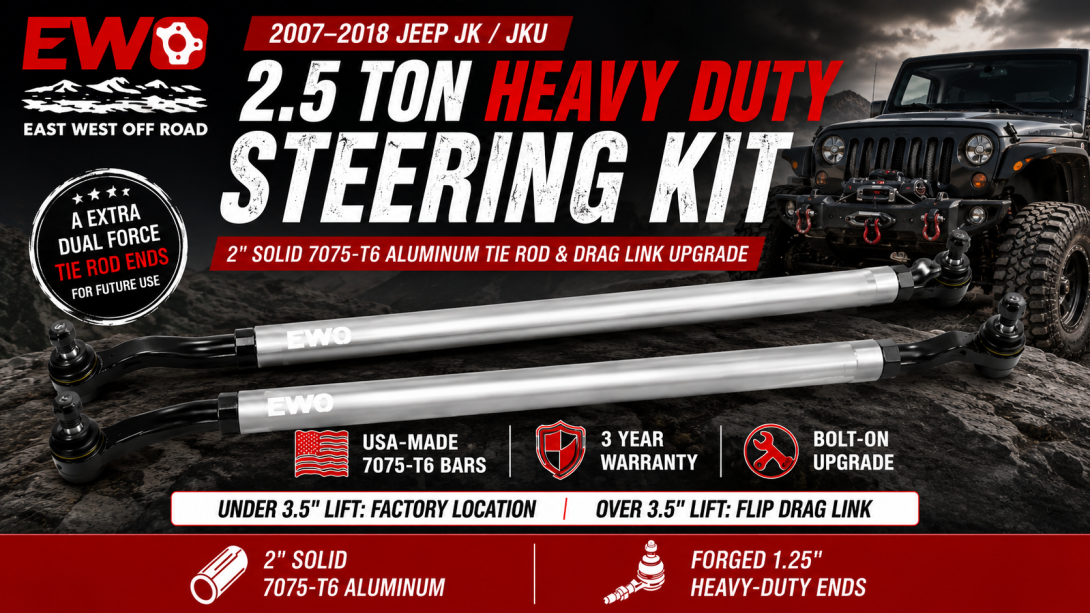
Buy Now: 2.5 Ton Jeep JK / JKU Heavy Duty 7075 Aluminum Tie Rod & Drag Link Steering Kit
A 2.5 ton Jeep steering kit is designed for Jeep owners who need substantially stronger steering components for demanding off-road use. When a Wrangler JK or JKU runs larger tires, heavier wheels, increased suspension lift, and challenging rock-crawling trails, the factory steering linkage can become a limiting point. A properly engineered heavy-duty tie rod and drag link setup provides a stronger foundation for steering control while helping the Jeep handle the increased loads associated with serious trail use.
What Is a 2.5 Ton Jeep Steering Kit?
A 2.5 ton steering kit is an aftermarket heavy-duty steering system built around significantly stronger tie rod and drag link components than typical factory-style replacements.
For a Jeep Wrangler, the term "2.5 ton" generally refers to the heavy-duty class or intended strength of the steering components. It does not mean the Jeep itself becomes a 2.5-ton vehicle.
These kits are commonly considered for:
- Jeep JK and JKU builds
- Large-tire applications
- Rock crawlers
- Lifted Wranglers
- Heavy aftermarket wheels
- Aggressive trail vehicles
- Jeeps with upgraded axles
- High-load off-road applications
The objective is to create steering linkage capable of handling demanding conditions without relying on undersized factory-style components.
Why Upgrade the Factory Jeep Steering?
The steering system experiences significant loads whenever a tire encounters an obstacle.
On pavement, steering forces are relatively predictable. Off road, the situation changes quickly. A tire climbing a rock or dropping into a rut can create forces that travel through the steering knuckle, tie rod, drag link, pitman arm, and steering box.
Common Problems With Factory-Style Steering
A modified Jeep may experience:
- Bent steering components
- Loose steering response
- Damaged tie rod ends
- Excessive steering play
- Increased steering feedback
- Clearance problems with larger tires
- Premature wear of steering joints
A heavy-duty system does not eliminate every possible steering problem, but it can substantially strengthen the components most exposed to trail abuse.
2.5 Ton Tie Rod and Drag Link System
One advantage of upgrading the complete steering linkage is that the tie rod and drag link can be matched as part of one system.
The tie rod connects the steering knuckles and controls the relationship between the front wheels.
The drag link transfers steering input from the pitman arm to the steering knuckle.
Because both components work together, upgrading only one can leave the other as a potential weak point.
A complete 2.5 ton tie rod and drag link kit addresses both primary steering links rather than focusing on a single component.
7075 Aluminum Construction for Jeep Steering
One of the major advantages of a high-end aftermarket steering kit is the use of high-strength aluminum.
7075-T6 aluminum is commonly selected for demanding applications because it provides an excellent strength-to-weight ratio.
A properly designed 7075 aluminum Jeep steering kit can offer substantial material strength while avoiding some of the unnecessary weight associated with oversized steel components.
Why 7075-T6 Aluminum?
7075-T6 aluminum is known for:
- High tensile strength
- Excellent strength-to-weight ratio
- Corrosion resistance
- Lower weight than comparable steel components
- Suitability for demanding mechanical applications
For an off-road Jeep, reducing unnecessary weight can be particularly useful because steering components are part of the vehicle's unsprung or semi-unsprung mass.
Benefits of a Heavy-Duty Jeep Steering Upgrade
A 2.5 ton Jeep steering kit can make sense when a Jeep's intended use goes beyond the factory design envelope.
Better Resistance to Bending
Large-diameter steering bars can provide substantially more material than stock components. This can help resist bending forces generated when the tires encounter obstacles.
Stronger Steering Linkage
A complete heavy-duty system provides stronger components at both the tie rod and drag link positions.
Better Suited to Large Tires
Large tires increase the leverage applied to steering components. The larger the tire and heavier the wheel combination, the more important properly sized steering components become.
Improved Trail Durability
For rock crawling and technical trails, steering components can encounter repeated shock loads. A heavy-duty system is designed with these demanding conditions in mind.
Is a 2.5 Ton Steering Kit Right for Your Jeep?
Not every Jeep needs a 2.5-ton-class steering system.
A mostly stock Wrangler with factory-size tires and mild trail use may not require such a substantial upgrade.
However, consider a heavy-duty steering system if your Jeep has several of the following:
- 35-inch or larger tires
- Heavy beadlock wheels
- Significant suspension lift
- Frequent rock crawling
- Front axle upgrades
- Aggressive trail driving
- Repeated steering component failures
- Heavy aftermarket bumpers and accessories
The steering system should always be matched to the complete vehicle rather than selected based on one specification alone.
2.5 Ton Steering Kit for Jeep JK and JKU
The Jeep Wrangler JK platform covers 2007–2018 model years. Both the two-door JK and four-door JKU can be heavily modified for off-road use.
A suitable Jeep JK heavy duty steering kit should therefore be selected based on the specific vehicle configuration and intended application.
The JKU's longer wheelbase and additional vehicle weight can also make steering-system durability an important consideration on modified builds.
For a dedicated trail Jeep, a complete Jeep JKU steering kit can be a better approach than replacing individual factory components as they fail.
Choosing the Right Tie Rod Diameter
Tie rod diameter is one of the first specifications many Jeep owners look at when comparing steering kits.
However, diameter alone does not determine the overall strength of a steering system.
You should also consider:
- Material
- Manufacturing method
- Thread size
- Tie rod end design
- Joint construction
- Mounting method
- Bar geometry
- Clearance
- Overall system compatibility
A large bar with weak ends is not necessarily a better steering system than a properly engineered assembly with stronger joints and appropriate mounting hardware.
Tie Rod Ends Matter Too
The steering bar is only one part of the assembly.
The tie rod ends transfer loads between the steering links and the steering knuckles. They must withstand repeated articulation and steering forces while maintaining minimal unwanted movement.
When comparing heavy-duty Jeep steering kits, inspect the specifications of the included joints rather than focusing exclusively on the center bar.
A complete kit should provide compatible steering ends designed for the intended application.
Steering Geometry on Lifted Jeeps
Installing a heavy-duty steering system is not simply a matter of making the bars stronger.
Suspension lift changes steering geometry.
As ride height increases, the relationship between the drag link and front suspension components changes. Depending on the lift, this can contribute to bump steer or undesirable steering characteristics.
Check Before Installation
Before installing a lifted Jeep steering kit, check:
- Lift height
- Drag link angle
- Tie rod position
- Front axle movement
- Track bar geometry
- Steering stabilizer location
- Wheel and tire clearance
- Full steering lock
- Full suspension compression
- Full suspension droop
A stronger steering component cannot correct fundamentally incorrect suspension geometry.
Factory Location vs. Drag Link Flip
Some Jeep builds use the drag link in its factory location, while others use a flip-style configuration.
A Jeep JK flip drag link kit can be useful on certain lifted applications, but it is not automatically necessary for every Jeep.
The appropriate setup depends on suspension height and geometry.
A factory-location configuration may be appropriate for a lower lift, while taller builds may benefit from a different steering arrangement.
Always follow the steering manufacturer's installation recommendations and verify clearance throughout the suspension's entire range of motion.
Why a Complete Steering Kit Is Better Than Mixing Components
Mixing unrelated steering components can create compatibility problems.
Different manufacturers may use different:
- Thread sizes
- Taper specifications
- Joint dimensions
- Bar diameters
- Mounting locations
- Adjustment methods
A matched Jeep steering upgrade reduces the risk of combining components that were not designed to work together.
It also makes installation and future maintenance easier because replacement parts can be identified according to the original kit specification.
East West Off Road 2.5 Ton Jeep Steering Kit
For Jeep owners looking for a complete heavy-duty system, East West Off Road offers a 2.5 ton Jeep steering kit designed for 2007–2018 Jeep JK and JKU applications.
The kit combines a heavy-duty 7075 aluminum tie rod and drag link into one steering upgrade, providing a stronger alternative to factory-style linkage.
The 2.5 Ton Jeep JK / JKU Heavy Duty 7075 Aluminum Tie Rod & Drag Link Steering Kit is particularly suited to Jeep builds where stronger steering components are needed for demanding off-road use.
For owners upgrading the complete front steering system, this type of matched assembly can simplify the process compared with sourcing a tie rod and drag link separately.
Installation Considerations
Before installation, inspect the front suspension and steering system for existing wear.
Check the condition of:
- Ball joints
- Unit bearings
- Steering knuckles
- Pitman arm
- Steering box
- Track bar
- Steering stabilizer
- Existing tie rod ends
After installation:
- Verify all fasteners are installed correctly.
- Torque hardware according to manufacturer specifications.
- Check steering clearance at full lock.
- Cycle the suspension through its travel.
- Verify tie rod and drag link clearance.
- Check wheel and tire clearance.
- Verify toe.
- Confirm steering-wheel position.
- Recheck components after initial trail use.
If installation requires modifications to factory steering geometry, professional installation may be appropriate.
2.5 Ton Steering Kit vs. Stock Replacement
A factory replacement generally focuses on restoring the vehicle to its original configuration.
A 2.5 ton Jeep steering kit, on the other hand, is intended for modified vehicles that demand more from their steering components.
Feature
Stock-Style Replacement
2.5 Ton Heavy-Duty Kit
Intended use
Street/light trail
Heavy off-road
Large tire suitability
Limited
Better suited
Heavy-duty linkage
No
Yes
Oversized steering bar
No
Yes
Modified Jeeps
Moderate
Excellent fit
Rock crawling
Limited
Better suited
The correct choice ultimately depends on your Jeep's tire size, suspension, axle configuration, and intended use.
Frequently Asked Questions (FAQs)
What is a 2.5 ton Jeep steering kit?
It is a heavy-duty aftermarket steering system designed to provide substantially stronger steering linkage for modified Jeep applications. The term "2.5 ton" refers to the heavy-duty class of the components rather than the Jeep's actual vehicle weight.
What Jeep models does this steering kit fit?
The East West Off Road kit is designed for 2007–2018 Jeep Wrangler JK and JKU applications. Always confirm fitment for your specific configuration before purchasing.
Is 7075 aluminum strong enough for Jeep steering?
7075-T6 aluminum offers a high strength-to-weight ratio and is widely used in demanding mechanical and motorsport applications. Proper component design and joint construction are also critical to steering-system strength.
Is a 2.5 ton steering kit necessary for 35-inch tires?
Not necessarily. Tire size is only one factor. Wheel weight, axle configuration, lift height, driving style, and trail conditions should all be considered when selecting steering components.
Does a heavier steering kit eliminate bump steer?
No. Bump steer is primarily related to steering and suspension geometry. A stronger tie rod and drag link can improve component durability, but geometry must still be properly configured.
Should I upgrade the tie rod and drag link together?
For a heavily modified Jeep, upgrading both together can provide a more balanced steering system and prevent one original component from becoming the weak point.
Is a drag link flip required with a 2.5 ton steering kit?
Not automatically. The correct drag link configuration depends on your Jeep's lift, axle setup, steering geometry, and the specific kit.
Can a heavy-duty steering kit improve steering feel?
If worn or damaged factory components are contributing to loose steering, replacing them with properly engineered heavy-duty components can improve steering response. However, steering feel also depends on the steering box, ball joints, track bar, wheel bearings, and suspension geometry.
What should I check before buying a 2.5 ton Jeep steering kit?
Verify the Jeep's model year, JK or JKU configuration, tire and wheel combination, lift height, front axle, steering geometry, mounting configuration, and available clearance.
Final Thoughts
A 2.5 ton Jeep steering kit is a serious upgrade for Jeep owners who have pushed their Wrangler beyond stock-duty use. Larger tires, heavier wheels, suspension lifts, axle upgrades, and technical rock crawling can all increase the demands placed on the steering system.
For these builds, choosing a complete heavy-duty tie rod and drag link assembly can provide a more robust foundation than continuing to rely on factory-style components.
The key is to match the steering system to the entire vehicle. Strength, material, joint quality, steering geometry, clearance, and installation all matter. When those factors are addressed together, a properly engineered heavy-duty steering upgrade can help your Jeep stay more dependable when the trail gets difficult.