

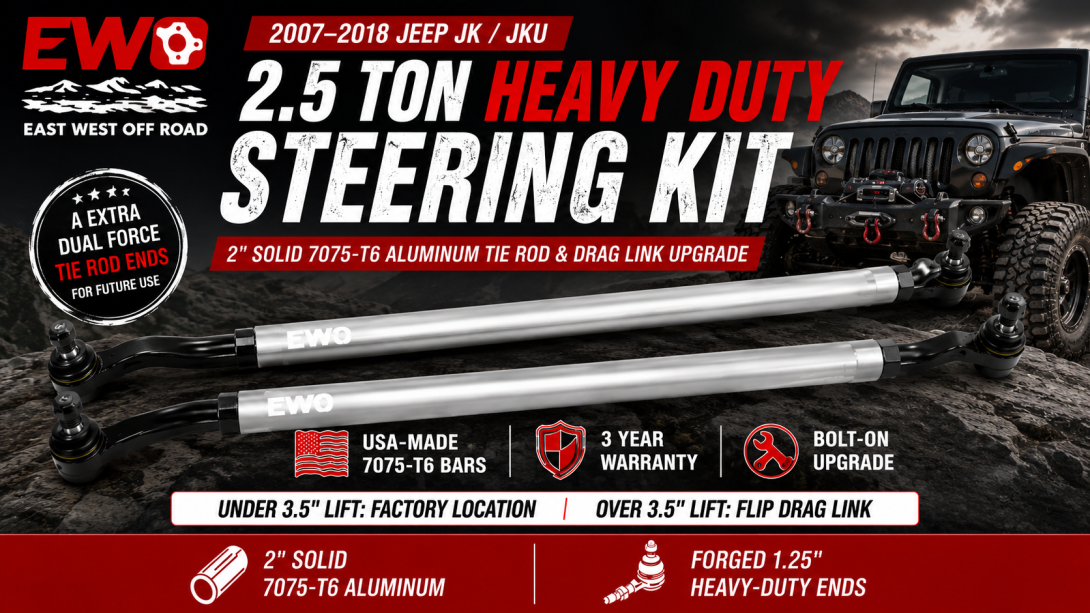
Buy Now: 2.5 Ton Jeep JK / JKU Heavy Duty 7075 Aluminum Tie Rod & Drag Link Steering Kit
A 2.5 ton Jeep steering kit is designed for Jeep JK and JKU owners who want to upgrade the factory steering linkage for demanding off-road use. Larger tires, suspension lifts, heavy accessories, and rock crawling can place substantially greater loads on the tie rod and drag link. A heavy-duty steering system built around large-diameter components and high-strength materials can provide a stronger foundation for a modified Wrangler while maintaining a purpose-built steering configuration.
Why Upgrade to a 2.5 Ton Jeep Steering Kit?
The factory Jeep JK steering system works well for a stock vehicle, but heavily modified Jeeps can place additional demands on the front steering components.
A 2.5 ton steering kit Jeep JK application is generally aimed at builds using larger tires and aggressive off-road equipment.
Common reasons to consider an upgrade include:
- 35-inch, 37-inch, or larger tires
- Suspension lifts
- Heavy beadlock-style wheels
- Winches and bumpers
- Skid plates and armor
- Rock-crawling use
- Frequent trail impacts
- Increased vehicle weight
- Repeated factory steering-component damage
The objective is not simply to install oversized components. The entire steering system needs to work together correctly.
What Is a 2.5 Ton Jeep Steering Kit?
A complete heavy-duty steering system typically replaces the factory tie rod and drag link.
Heavy-Duty Tie Rod
The tie rod connects the steering knuckles across the front axle. Because of its low position, it can be exposed to rocks, ledges, and other trail obstacles.
A stronger tie rod can provide increased resistance to bending and impact compared with the factory component.
Heavy-Duty Drag Link
The drag link transfers steering input from the steering box to the steering knuckle.
Its angle is particularly important on lifted Jeeps because changing suspension height changes the relationship between the axle and steering box.
A properly selected 2.5 ton Jeep steering kit should therefore be matched to the Jeep's suspension and steering configuration.
7075 Aluminum 2.5 Ton Steering System
The choice of material is one of the most important differences between aftermarket steering systems.
The referenced East West Off Road system uses 7075 aluminum for its heavy-duty tie rod and drag link. The kit is designed for 2007–2018 Jeep JK and JKU applications.
Why 7075 Aluminum?
7075 aluminum is known for its high strength-to-weight characteristics. For an off-road Jeep, that combination can be attractive because steering components can be made robust without relying exclusively on heavier steel construction.
However, material alone does not determine steering performance.
Also consider:
- Component diameter
- Joint design
- Thread size
- Jam-nut engagement
- Mounting hardware
- Steering geometry
- Wheel clearance
- Differential clearance
A properly engineered assembly is more important than choosing a material based solely on its name.
2.5 Ton Jeep Steering Kit for JK and JKU
The 2007–2018 Jeep Wrangler JK platform includes both two-door JK and four-door JKU models.
A heavy-duty steering upgrade should be selected according to the actual vehicle and front-end configuration.
The 2.5 ton Jeep JK/JKU heavy-duty 7075 aluminum steering kit is designed specifically around these model years.
JK vs. JKU
The steering architecture is closely related between JK and JKU models, but the vehicle's actual suspension, axle, wheel, and tire configuration should still be checked before installation.
Do not assume that a kit fits simply because the Jeep is called a JK or JKU.
When Does a Jeep Need Heavy-Duty Steering?
A stock Jeep used primarily for commuting generally does not need a 2.5-ton steering system.
The need becomes more apparent when the Jeep is substantially modified.
Larger Tires
Larger tires generally add weight and leverage to the steering system.
A 37-inch tire, for example, can create significantly different steering demands than the original equipment tire.
Rock Crawling
Rock crawling exposes steering components to sudden impacts and unusual loading.
When a tire climbs a rock or becomes wedged between obstacles, forces can be transferred through the wheel, knuckle, tie rod, and drag link.
Suspension Lift
A suspension lift changes steering geometry.
A heavy-duty steering upgrade should therefore be evaluated together with the Jeep's track bar, drag link, pitman arm, and other suspension components.
Lifted Jeep Steering Geometry
Installing stronger steering components does not automatically correct steering geometry.
This is one of the most important points for anyone considering a 2.5 ton Jeep steering kit.
Drag Link Angle
The drag link should operate through an appropriate range of motion without binding.
Excessive angles can contribute to undesirable steering behavior and can complicate suspension movement.
Track Bar Relationship
The track bar and drag link operate in closely related arcs.
If suspension geometry is changed significantly, both systems should be evaluated rather than upgrading the drag link in isolation.
Steering Stabilizer
A steering stabilizer can help damp steering movement, but it should not be used to hide worn or damaged steering components.
A stabilizer is not a substitute for a properly designed tie rod and drag link.
2.5 Ton Tie Rod and Drag Link Kit vs. Factory Steering
The factory steering system is engineered for the original vehicle configuration.
An aftermarket 2.5 ton tie rod and drag link kit is intended to provide a more robust solution for modified Jeeps.
A complete kit can also make component selection easier because the tie rod and drag link are designed as part of the same steering system.
This can be preferable to mixing unrelated aftermarket parts with different dimensions, thread sizes, and joint designs.
Jeep JK Tie Rod Upgrade
The tie rod is one of the most exposed steering components on a JK.
For an off-road Jeep, a Jeep JK tie rod upgrade can help reduce the likelihood of bending the factory linkage during trail use.
However, the best upgrade depends on the complete build.
Before selecting a tie rod, consider:
- Tire size
- Wheel offset
- Front axle
- Differential cover
- Lift height
- Steering configuration
- Intended terrain
- Vehicle weight
Heavy-Duty Drag Link for Jeep JK
The drag link deserves the same attention as the tie rod.
A heavy-duty drag link Jeep JK setup can improve the overall strength of the steering linkage, but it must maintain appropriate clearance and articulation.
This is especially important on lifted vehicles where the drag-link position may change.
Factory-Location Configuration
A factory-location drag link maintains the original general mounting position.
This can be useful for owners seeking a straightforward bolt-on upgrade.
Flip or High-Steer Configuration
A flip configuration moves the drag link to a higher location.
This may be appropriate for certain lifted Jeeps, but it should be evaluated together with track-bar geometry, wheel clearance, and suspension travel.
Jeep JK Dana 30 and Dana 44 Compatibility
JK models can use different front axle configurations.
Depending on the vehicle, you may encounter:
- Dana 30
- Dana 44
- Aftermarket axle assemblies
- Modified knuckles
- Aftermarket steering components
A Jeep JK Dana 30 steering kit and Jeep JK Dana 44 steering kit may have different fitment considerations.
Always verify the exact configuration with the manufacturer before ordering.
Wheel and Differential Clearance
One of the most overlooked aspects of a heavy-duty steering upgrade is clearance.
Larger steering bars and ends can occupy more space than factory components.
Before installation, inspect clearance between the steering system and:
- Wheels
- Tires
- Differential cover
- Axle housing
- Track bar
- Coil springs
- Shock absorbers
- Sway-bar components
Turn the steering from full left to full right and cycle the suspension where practical to identify potential contact points.
2.5 Ton Steering for 35s and 37s
A 2.5 ton Jeep steering kit is often considered by owners running 35-inch and 37-inch tires.
However, tire diameter alone should not determine the upgrade.
Two Jeeps running the same tire size can have very different steering requirements because of differences in:
- Tire construction
- Wheel offset
- Vehicle weight
- Suspension setup
- Driving style
- Trail difficulty
- Axle configuration
The more aggressively the Jeep is used, the more important a complete steering-system evaluation becomes.
Off-Road Jeep Steering Upgrade
A serious off road steering upgrade should be viewed as part of the overall front-end system.
Upgrading the tie rod and drag link while leaving worn ball joints, loose track-bar hardware, or damaged steering-box mounts unresolved can still result in poor steering performance.
Before installing a new kit, inspect the complete front end.
Check for Existing Wear
Look for:
- Loose tie-rod ends
- Damaged drag-link ends
- Bent factory linkage
- Worn ball joints
- Track-bar movement
- Steering-box movement
- Loose mounting hardware
- Abnormal tire wear
- Steering play
Correct existing problems before evaluating the benefits of the new steering system.
East West Off Road 2.5 Ton Jeep Steering Kit
The East West Off Road steering kit referenced here is a heavy-duty tie rod and drag link system for 2007–2018 Jeep JK and JKU models.
The product uses 7075 aluminum construction and is positioned as a substantial upgrade for modified Jeep applications.
You can review the complete 2.5 ton Jeep JK/JKU 7075 aluminum steering kit to check the available configuration for your build.
The product is particularly relevant to Jeep owners looking for a combined tie rod and drag link upgrade rather than replacing only one steering component.
Installation Considerations
Steering components are safety-critical, so installation should be completed carefully and according to the manufacturer's instructions.
Before Installation
Verify:
- Jeep model and year
- JK or JKU configuration
- Front axle
- Tire size
- Wheel specifications
- Lift height
- Drag-link configuration
- Steering-box setup
- Available component clearance
After Installation
Check that:
- Steering moves smoothly from lock to lock.
- Tie rod and drag link do not contact surrounding components.
- Hardware is correctly secured.
- Steering joints articulate correctly.
- Wheels and tires have adequate clearance.
- The steering stabilizer does not bind.
- Steering geometry is appropriate.
- Alignment is checked when required.
After initial road and trail use, inspect the complete system again.
Benefits of a Complete 2.5 Ton Steering Kit
Choosing a complete kit rather than individual components can simplify a heavily modified Jeep build.
Matched Components
A complete system is designed around compatible components rather than requiring the owner to determine whether different brands and sizes will work together.
Stronger Steering Foundation
Replacing both the tie rod and drag link addresses the two primary steering links simultaneously.
Better Fitment Planning
A complete system makes it easier to evaluate wheel clearance, steering configuration, and suspension geometry before installation.
Suitable for Serious Builds
A heavy-duty steering system is particularly relevant to Jeeps that regularly encounter demanding terrain and increased steering loads.
Frequently Asked Questions (FAQs)
What is a 2.5 ton Jeep steering kit?
A 2.5 ton Jeep steering kit is a heavy-duty aftermarket steering system generally consisting of an upgraded tie rod and drag link. It is intended for modified Jeep applications that place greater demands on the factory steering linkage.
Is a 2.5 ton steering kit necessary for 35-inch tires?
Not necessarily. Tire size is only one factor. Vehicle weight, tire construction, wheel offset, lift height, driving style, and terrain all influence steering loads.
Is 7075 aluminum good for Jeep steering?
7075 aluminum offers a high strength-to-weight ratio and can be an effective material for aftermarket steering components when properly engineered for the application.
Does a 2.5 ton steering kit fit a Jeep JKU?
The referenced East West Off Road product is designed for 2007–2018 Jeep JK and JKU models. Exact vehicle and steering configuration should still be verified before purchase.
Can I use a 2.5 ton steering kit with a Dana 30?
Fitment depends on the specific kit and vehicle configuration. Verify the manufacturer's application information for your Dana 30-equipped JK before ordering.
Does a heavy-duty tie rod eliminate steering problems?
No. A stronger tie rod cannot correct worn ball joints, damaged steering boxes, poor suspension geometry, loose track-bar hardware, or other front-end problems.
Should I upgrade the drag link and tie rod together?
For heavily modified Jeeps, upgrading both can provide a more consistent steering system and avoid leaving one factory component as a potential weak point.
Does a steering stabilizer make a Jeep steering system stronger?
No. A steering stabilizer primarily dampens steering movement. It should not be considered a replacement for properly designed and maintained steering components.
What should I check before buying a 2.5 ton Jeep steering kit?
Check your Jeep's year, JK/JKU configuration, front axle, lift height, tire size, wheel specifications, drag-link position, steering-box configuration, and available clearance.
Final Thoughts
A 2.5 ton Jeep steering kit can be a strong choice for Jeep JK and JKU owners who have moved beyond a stock setup. Larger tires, suspension lifts, heavy accessories, and aggressive trail use can increase the demands placed on factory steering components.
The right upgrade should be selected as part of the entire front-end system. Tie rod strength, drag-link design, steering geometry, axle configuration, wheel clearance, and suspension setup all need to work together.
For a 2007–2018 JK or JKU, a 7075 aluminum tie rod and drag link system provides an option for owners looking for a substantial heavy-duty steering upgrade while maintaining a focus on strength and weight.