

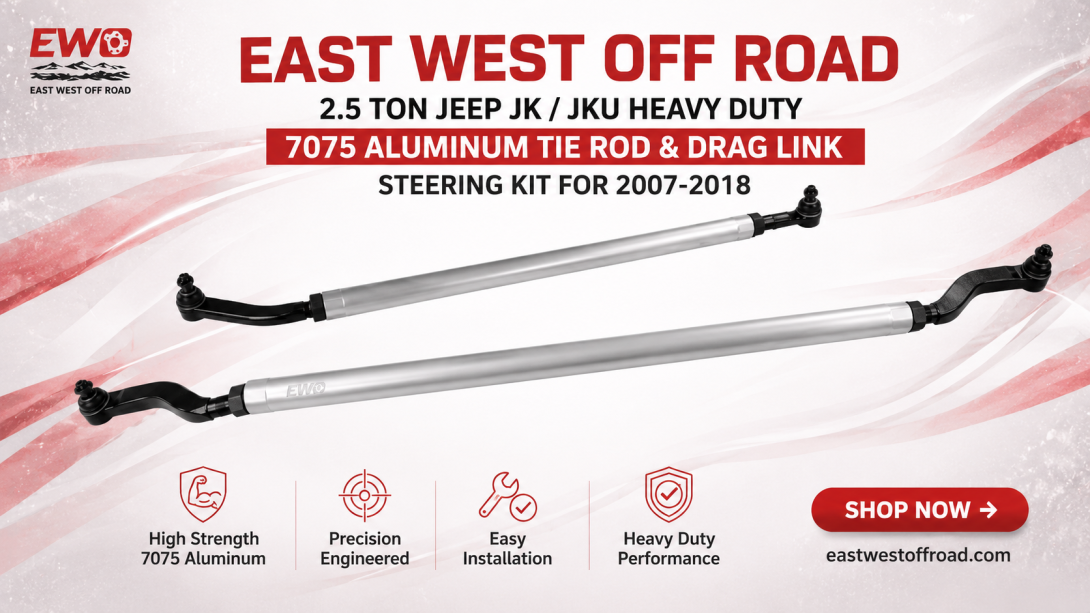
Buy Now: 2.5 Ton Jeep JK / JKU Heavy Duty 7075 Aluminum Tie Rod & Drag Link Steering Kit
A 2.5 ton Jeep steering kit is a heavy-duty steering upgrade designed for Jeep JK and JKU builds running larger tires, suspension lifts, and demanding off-road trails. The factory steering linkage can become more vulnerable to bending and impact damage as tire size and vehicle weight increase. A properly engineered 2.5-ton system upgrades the tie rod and drag link together, providing a stronger steering foundation while maintaining the necessary adjustability and articulation for serious trail use.
What Is a 2.5 Ton Jeep Steering Kit?
A 2.5 ton Jeep steering kit refers to an aftermarket heavy-duty steering system built around substantially stronger steering linkage and high-strength rod ends.
The “2.5 ton” designation is generally an aftermarket strength classification rather than a statement that the Jeep itself weighs 2.5 tons. These kits are intended for applications where standard factory steering components may not provide the desired durability.
For Jeep JK and JKU owners, a complete system can include both the tie rod and drag link, allowing the steering components to work together rather than upgrading only one link.
Why Upgrade the Factory Steering?
Larger tires create greater leverage on the steering system. Rock crawling can also expose the linkage to impacts from rocks, ruts, and uneven terrain.
A heavy-duty steering system can provide:
- Larger steering linkage
- Stronger rod ends
- Improved resistance to bending
- Better durability for demanding trail use
- Increased capacity for modified Jeeps
- A complete tie rod and drag link solution
7075-T6 Aluminum for Heavy-Duty Jeep Steering
One of the major advantages of a modern 2.5 ton Jeep steering kit is the use of high-strength 7075-T6 aluminum.
7075 aluminum is known for its high strength-to-weight ratio. When properly engineered for steering applications, it can provide substantial strength without the weight associated with oversized steel components.
This makes a 7075-T6 aluminum steering kit attractive for Jeep owners who want strong steering components while keeping unnecessary weight off the front axle.
Aluminum Tie Rod and Drag Link
The tie rod connects the steering knuckles across the front axle, while the drag link transfers steering input from the pitman arm to the steering knuckle.
Upgrading both components together creates a more balanced system.
For 2007–2018 Jeep JK and JKU applications, the 2.5 ton Jeep steering kit combines heavy-duty aluminum steering linkage with components designed for a complete steering upgrade.
Why a 2.5 Ton Steering Upgrade Makes Sense for Modified Jeeps
A stock Jeep operates under conditions that are different from a heavily modified trail rig.
Once you add larger tires, a lift, beadlock wheels, armor, bumpers, a winch, and other equipment, the loads experienced by the steering system can increase.
Larger Tires Increase Steering Loads
Larger tires have more leverage against the steering linkage. When the tire contacts an obstacle, the steering components can experience significant side loads.
A stronger tie rod and drag link can help reduce the likelihood of bending under these conditions.
Rock Crawling Adds Impact Loads
Rock crawling is particularly demanding because the front tires may be forced against rocks while the driver is simultaneously applying steering input.
A heavy-duty steering system is designed to better handle this type of demanding environment.
Jeep JK and JKU Compatibility
The product discussed here is designed for 2007–2018 Jeep Wrangler JK and JKU models.
The JK platform includes both two-door and four-door applications, but vehicle configuration should always be verified before purchasing aftermarket steering components.
A proper fitment check should include:
- Model year
- JK or JKU configuration
- Front axle
- Steering knuckle
- Lift height
- Wheel and tire combination
- Existing steering modifications
Jeep Wrangler Unlimited Steering Upgrade
The JKU can carry more equipment and weight than a two-door JK, especially when equipped for overlanding or long-distance trail travel.
A heavy-duty steering upgrade can therefore be useful for a Jeep Wrangler Unlimited running larger tires and additional vehicle equipment.
2.5 Ton Tie Rod and Drag Link Kit
One of the biggest benefits of buying a complete 2.5 ton tie rod and drag link kit is that both major steering links are upgraded together.
Instead of installing a heavy-duty tie rod while leaving an aging factory drag link in place, a complete system provides a more consistent steering package.
The heavy-duty 2.5 ton tie rod and drag link kit is built specifically around this complete-upgrade approach.
Why Upgrade Both Components?
The tie rod and drag link perform different jobs, but both are critical to steering operation.
A complete upgrade can provide:
- Matching components
- Heavy-duty steering ends
- Consistent strength
- Better resistance to trail damage
- Easier component selection
- Simplified installation planning
2.5 Ton Jeep Steering Kit vs. Factory Steering
Factory steering components are designed around the original vehicle configuration.
They can perform well on a stock or lightly modified Jeep, but serious off-road builds place additional demands on the steering system.
A 2.5 ton Jeep steering kit is generally aimed at owners who need greater durability than the original linkage provides.
When Should You Consider an Upgrade?
A heavy-duty steering upgrade may be worth considering if your Jeep has:
- 35-inch or larger tires
- A suspension lift
- Frequent rock-crawling use
- Heavy aftermarket accessories
- Repeated steering linkage damage
- Increased front-end weight
- Aggressive off-road use
The correct upgrade still depends on the complete vehicle setup rather than tire size alone.
Jeep JK Tie Rod Upgrade
A Jeep JK tie rod upgrade is one of the most common steering modifications for owners running larger tires.
The factory tie rod is relatively lightweight compared with many aftermarket options. A larger high-strength replacement can provide additional resistance to bending.
Heavy-Duty Tie Rod Construction
When comparing aftermarket tie rods, consider:
- Material
- Diameter
- Construction
- Rod-end design
- Thread engagement
- Adjustability
- Knuckle compatibility
- Wheel clearance
A larger-looking component is not automatically a better steering component. The complete engineering of the system matters.
Heavy-Duty Rod Ends and Steering Joints
The steering ends are critical connection points.
A heavy-duty steering system should use appropriately sized and properly engineered rod ends capable of handling the loads generated by the intended vehicle.
The rod end must also provide sufficient angular movement for suspension and steering articulation.
Why Rod-End Strength Matters
A steering link is only as strong as its weakest major connection.
For this reason, upgrading the main tie rod while retaining undersized or worn steering ends may limit the benefits of the upgrade.
A complete 2.5 ton system addresses the linkage and steering-end combination as a system.
Lifted Jeep Steering Geometry
Strength is only one part of a successful steering upgrade.
A lifted Jeep can experience changes in steering geometry as suspension height increases. The relationship between the drag link and track bar becomes especially important.
Drag Link and Track Bar Relationship
The drag link and track bar operate through suspension travel.
If their geometry becomes significantly different after a lift, the Jeep may experience undesirable steering behavior.
A heavy-duty steering kit should therefore be selected alongside the suspension setup.
A stronger steering component does not automatically correct geometry-related problems.
Factory vs. Flipped Drag Link
Some JK builds retain the factory drag-link location, while others use a flip configuration.
The correct option depends on:
- Lift height
- Knuckle configuration
- Track-bar location
- Wheel clearance
- Suspension travel
- Intended vehicle use
Do not install a drag-link flip simply because the vehicle has larger tires. The entire front suspension geometry should be considered.
Benefits of a 7075 Aluminum Steering System
A properly designed 7075 aluminum steering system can offer several advantages.
High Strength-to-Weight Ratio
7075-T6 aluminum provides high strength while keeping component weight relatively low.
This can be useful for Jeep builds where the owner wants heavy-duty steering without unnecessarily adding front-end weight.
Off-Road Durability
The steering system must withstand repeated loading from trail conditions.
The combination of high-strength linkage and properly sized steering ends can provide a substantial upgrade over factory components.
Complete System Design
The best results come from evaluating the tie rod, drag link, steering ends, mounting locations, and vehicle geometry together.
Installation Considerations
Steering components are safety-critical and should be installed carefully.
Before installation, verify that the steering kit matches your Jeep's model, year, axle, and steering configuration.
Check Steering Clearance
After installation, inspect the steering system through the full range of movement.
Check clearance around:
- Wheels
- Tires
- Differential cover
- Track bar
- Sway bar
- Axle housing
- Steering stabilizer
- Suspension components
- Frame
The inspection should be performed with the suspension both compressed and extended.
Check Alignment
Replacing steering components can affect toe and steering-wheel position.
After installation, verify the steering wheel is centered and have the front-end alignment checked as necessary.
Always follow the manufacturer's installation and torque specifications.
Is a 2.5 Ton Jeep Steering Kit Worth It?
For a heavily modified Jeep JK or JKU, a 2.5-ton steering upgrade can be a worthwhile investment.
It is especially relevant for owners who regularly run larger tires and challenging trails.
However, steering strength should be considered as part of the complete vehicle system.
Other factors include:
- Axle strength
- Steering box
- Hydraulic assist
- Track-bar design
- Suspension geometry
- Wheel and tire setup
- Vehicle weight
- Driving style
A heavy-duty steering kit cannot prevent every type of trail damage, but it can provide a stronger foundation for a modified Jeep.
Choosing the Right 2.5 Ton Jeep Steering Kit
Before purchasing, compare more than advertised strength.
Look at the complete system and verify:
- Vehicle compatibility
- Axle compatibility
- Material and construction
- Rod-end design
- Tie-rod diameter
- Drag-link configuration
- Steering geometry
- Wheel clearance
- Installation requirements
- Intended off-road use
For JK and JKU owners looking for a complete heavy-duty solution, the East West Off Road 2.5 ton steering upgrade is designed around a 7075 aluminum tie rod and drag link package for 2007–2018 applications.
Frequently Asked Questions (FAQs)
What is a 2.5 ton Jeep steering kit?
A 2.5 ton Jeep steering kit is an aftermarket heavy-duty steering system designed to provide stronger steering linkage and steering ends than typical factory components.
What Jeep models does this kit fit?
The product discussed in this article is designed for 2007–2018 Jeep Wrangler JK and JKU models.
Is 7075 aluminum good for Jeep steering?
Yes. Properly engineered 7075-T6 aluminum offers a high strength-to-weight ratio and can be used effectively in demanding off-road steering applications.
Does a 2.5 ton steering kit include the tie rod and drag link?
The complete kit discussed here is designed as a tie rod and drag link steering system for 2007–2018 Jeep JK and JKU applications.
Is a 2.5 ton steering kit necessary for 35-inch tires?
It is not automatically necessary based only on tire size. However, larger tires increase steering loads, making heavy-duty steering components more attractive for aggressive off-road use.
Does a heavy-duty steering kit fix bump steer?
Not by itself. Bump steer is primarily related to steering and suspension geometry. Correct drag-link and track-bar geometry is required to address geometry-related steering behavior.
Can a 2.5 ton steering kit be used on a lifted Jeep JK?
Yes, but the steering configuration must be compatible with the lift, axle, track bar, drag link position, wheels, and suspension geometry.
Should I upgrade the tie rod and drag link together?
For a complete steering upgrade, upgrading both together is generally preferable because it provides a more consistent system and avoids leaving one original component as the weaker link.
Is aluminum lighter than steel for Jeep steering?
Generally, yes. A properly designed aluminum steering component can provide a high strength-to-weight ratio while reducing weight compared with similarly sized steel components.
What should I check after installing a Jeep steering kit?
Check steering travel, wheel and tire clearance, drag-link and track-bar clearance, suspension movement, steering-wheel position, toe, and all hardware according to the manufacturer's specifications.
Final Thoughts
A 2.5 ton Jeep steering kit is a serious upgrade for Jeep JK and JKU owners who demand more from their steering system. Larger tires, suspension lifts, heavy accessories, and aggressive trails can place substantially greater loads on factory steering components.
A complete tie rod and drag link system built with high-strength 7075-T6 aluminum can provide a strong combination of durability and reduced weight. However, the best steering upgrade is always one that matches the Jeep's axle, suspension geometry, wheel and tire setup, and intended use.
For 2007–2018 JK and JKU builds, upgrading the steering as a complete system can provide a stronger foundation for both trail performance and long-term durability.