

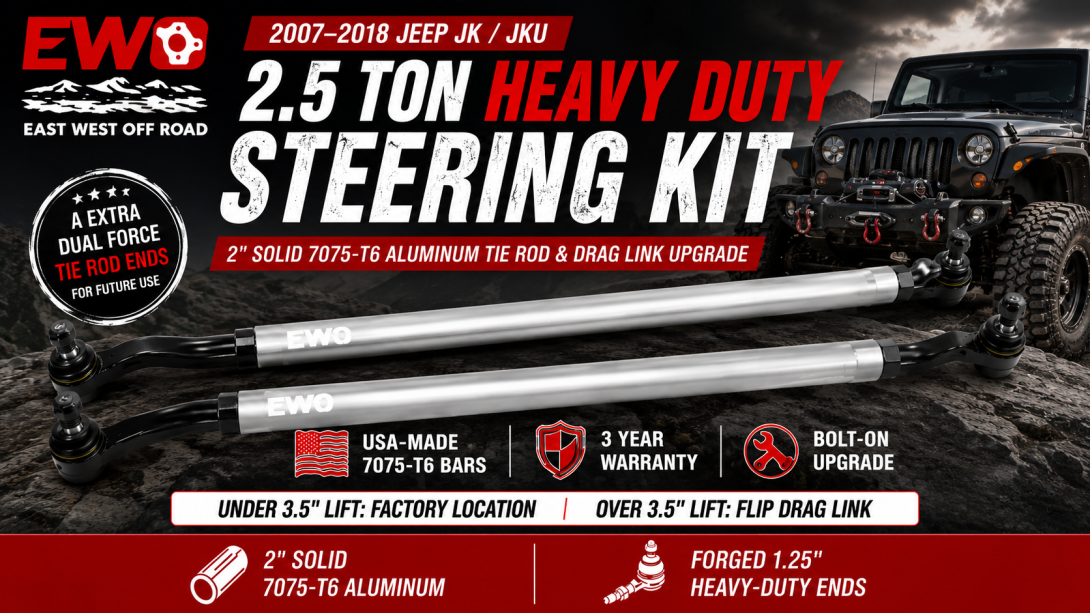
A 2.5 ton Jeep steering kit is designed for Wrangler JK and JKU owners who want to move beyond factory steering linkage for larger tires, lifted suspension, trail use, rock crawling, or a complete front-end build. Instead of upgrading only a single tie rod end or replacing one worn factory link, a heavy-duty system replaces the main tie rod and drag link with components designed for demanding aftermarket applications.
For 2007–2018 Jeep Wrangler JK and Wrangler Unlimited JKU builds, the East West Off Road E35115 system combines 7075 aluminum steering links with different drag-link configurations based on lift height, giving builders a choice between factory-location/under-the-knuckle steering and a flipped over-the-knuckle setup.
What Does “2.5 Ton” Mean in a Jeep Steering Kit?
The first thing to understand is that 2.5 ton is an aftermarket steering-category description.
Installing a 2.5-ton steering kit does not change your Jeep's:
- GVWR
- Payload rating
- Towing capacity
- Front axle rating
Instead, the term is used to distinguish a heavy-duty steering system from lighter factory-style or other aftermarket linkage.
When comparing products, the number alone should never be your only consideration.
A good steering system also depends on:
- Steering-link material
- Tie rod-end design
- Drag-link configuration
- Knuckle compatibility
- Lift height
- Wheel clearance
- Suspension geometry
- Installation quality
Why Jeep JK Owners Upgrade Their Steering
The factory JK steering system was engineered around the vehicle's original:
- Tire size
- Wheel weight
- Suspension height
- Steering geometry
- Intended road and trail use
Once a Wrangler receives major modifications, the loads and clearances can change.
Common reasons owners upgrade include:
- 35-inch or larger tires
- Heavy mud-terrain tires
- Beadlock wheels
- Suspension lifts
- Rock crawling
- Bent factory tie rods
- Worn steering joints
- Heavy trail use
- Added armor and recovery equipment
A modified Jeep may benefit from a steering linkage designed around those new demands.
The Tie Rod and Drag Link Work as a System
The two primary links perform different jobs.
Tie Rod
The tie rod connects the steering knuckles so both front wheels turn together.
Drag Link
The drag link transfers steering-box movement to the passenger-side knuckle.
Together, they form the core mechanical linkage between the steering box and the front wheels.
That is why upgrading both components together can make sense on a heavily modified Jeep.
Why Choose a Complete Tie Rod and Drag Link Upgrade?
Replacing one factory component at a time may be fine when only one part is worn.
A complete system becomes more attractive when:
- Both links are aging
- The Jeep is being lifted
- Larger tires are being installed
- Factory linkage has trail damage
- The Jeep is being prepared for rock crawling
- You want matched heavy-duty components
A complete Jeep JK tie rod and drag link kit gives the builder a coordinated starting point rather than combining unrelated steering components.
Why 7075 Aluminum Is Used for Jeep Steering
7075 aluminum is widely used in premium aftermarket automotive and off-road applications.
For steering linkage, builders often compare it with steel alternatives.
A 7075 aluminum tie rod Jeep JK system can provide a substantial steering link while offering different material behavior from traditional factory linkage.
However, the alloy name alone does not determine whether a steering kit is right for your Jeep.
Also evaluate:
- Bar design
- Threaded connections
- Steering ends
- Adjustment system
- Mounting location
- Clearances
7075 vs. 7075-T6: Know the Difference
The phrases 7075 aluminum and 7075-T6 aluminum should not automatically be treated as interchangeable.
7075 identifies the alloy.
T6 identifies a specific temper condition.
Some competing steering manufacturers specifically advertise 7075-T6 aluminum steering kit construction.
If a particular temper matters to your build, verify that specification with the manufacturer of the exact product.
Do not transfer a competitor's material specification to the EWO kit unless EWO confirms it.
EWO 2.5-Ton Jeep JK / JKU Steering Kit
East West Off Road's current product is listed as:
2.5 Ton Jeep JK / JKU Heavy Duty 7075 Aluminum Tie Rod & Drag Link Steering Kit for 2007–2018
The current product information identifies:
- Jeep Wrangler JK fitment
- Jeep Wrangler Unlimited JKU fitment
- 2007–2018 model years
- 7075 aluminum linkage
- Heavy-duty tie rod
- Heavy-duty drag link
- Under-the-knuckle option
- Over-the-knuckle flip option
This makes it relevant to both daily-driven and serious trail-oriented Wrangler builds.
2007–2018 Jeep Wrangler JK and JKU Fitment
The JK platform covers a wide range of vehicles and configurations.
The EWO system is designed around the 2007–2018 Wrangler JK/JKU generation.
That includes:
- Two-door Wrangler JK
- Four-door Wrangler Unlimited JKU
However, vehicles this old often have significant modifications.
Before ordering, determine whether your Jeep still has:
- Factory front axle
- Factory knuckles
- Factory steering geometry
- Factory wheels
- Original suspension configuration
JK vs. JKU: Does Steering Use Change?
Both platforms share the same overall vehicle generation, but the finished builds can be quite different.
A JKU frequently carries more:
- Cargo
- Camping gear
- Recovery gear
- Armor
- Roof equipment
- Passenger weight
A dedicated two-door JK crawler may experience more frequent rock impacts.
The steering upgrade should therefore match the actual Jeep's use rather than simply whether it has two or four doors.
Factory Location / Under the Knuckle Steering
EWO currently offers a factory-location configuration described as Under the Knuckle.
The published lift guidance is:
3.50 inches of lift or less.
This configuration keeps the drag link closer to its original mounting location.
It is relevant to builders searching for:
- Jeep JK factory location drag link
- Under the knuckle steering kit for Jeep JK
- Factory location drag link for Jeep JK under 3.5 inch lift
- Jeep JK steering upgrade for mild lift
Flip Kit / Over the Knuckle Steering
For taller suspension systems, EWO offers a Flip Kit / Over the Knuckle configuration.
The published guidance is:
Over 3.50 inches of lift.
This moves the drag-link connection above the knuckle.
It is relevant to searches such as:
- Jeep JK flip drag link kit
- Over the knuckle drag link kit Jeep Wrangler JKU
- Buy Jeep JK flip drag link
- Flip drag link kit for Jeep JK with over 3.5 inch lift
Why Drag-Link Position Matters
The drag link does not operate independently.
Its movement is closely related to:
- Front axle movement
- Track bar
- Suspension height
- Steering knuckle
- Steering box
Changing its mounting location changes the steering geometry.
That is why you should not select an over-the-knuckle configuration simply because it appears more heavy duty.
The correct configuration should match the suspension.
Track Bar and Drag Link Geometry
On a solid-front-axle Jeep, the track bar controls side-to-side axle location.
The drag link transfers steering movement.
Their relationship affects how the front axle and steering interact during suspension travel.
Incorrect geometry can contribute to unwanted steering behavior.
A heavy-duty steering kit provides stronger replacement components, but it cannot compensate for poorly planned suspension geometry.
Larger Tires and Jeep Steering Loads
Larger tires can increase leverage through the steering system.
They also frequently weigh much more than factory tires.
Consider the difference between a stock Jeep wheel and tire versus:
- 35-inch mud terrain
- 37-inch tire
- Beadlock wheel
- Heavy steel wheel
Additional rotating and unsprung weight can affect multiple front-end components.
The steering system is only one part of that equation.
Steering for a Jeep Running 35s or 37s
A Steering kit for Jeep JK running larger tires is particularly relevant when the Jeep regularly operates off road.
But the correct steering upgrade should be chosen alongside:
- Ball joints
- Unit bearings
- Brakes
- Axle shafts
- Track bar
- Wheel backspacing
Do not treat a larger steering kit as a substitute for maintaining the rest of the front axle.
Heavy-Duty Steering for Lifted Jeep JK Builds
A Heavy duty steering kit for lifted Jeep JK should be selected according to actual lift height.
Important factors include:
- Suspension lift measurement
- Track-bar position
- Drag-link position
- Wheel offset
- Tire diameter
- Differential cover
- Steering stabilizer
This is why EWO offers separate under-the-knuckle and over-the-knuckle configurations.
Rock Crawling and Steering Linkage
Rock crawling can place substantial loads on steering components.
A front tire can be:
- Wedged against rock
- Fully turned
- Loaded by vehicle weight
- At maximum suspension articulation
The tie rod may also directly contact obstacles.
A 2.5 ton steering kit for Jeep JKU rock crawler should therefore be evaluated for both steering load and physical trail exposure.
Why Tie Rod Location Matters on the Trail
The tie rod sits across the front axle.
Depending on the Jeep's geometry, it can encounter:
- Rocks
- Ledges
- Roots
- Deep ruts
A heavy-duty tie rod can be valuable in these environments, but it should still be inspected after significant impacts.
No steering component should be assumed indestructible.
Daily Driver Plus Weekend Trail Use
Not every upgraded Wrangler is a dedicated crawler.
Many owners need a Steering kit for daily driven and trail used Jeep JKU.
For these vehicles, priorities include:
- Predictable highway steering
- Accurate alignment
- Easy adjustment
- Serviceability
- Trail durability
- Replacement-part availability
Road manners matter just as much as off-road strength.
Jeep JK Dana 30 Steering Kit
Many non-Rubicon JK models use a Dana 30 front axle.
That creates search demand for:
- Jeep JK Dana 30 steering kit
- Jeep JK steering upgrade for stock Dana 30 axle
- Dana 30 Dana 44 steering kit
Before ordering, verify the exact axle and knuckle setup.
Previous owners may have installed:
- Axle swaps
- Different knuckles
- Big-brake kits
- Aftermarket steering
Do not rely only on the Jeep's trim level.
Jeep JK Dana 44 Steering Kit
Rubicon models and swapped Jeeps may use a Dana 44 front axle.
A Jeep JK Dana 44 steering kit still needs to match the actual:
- Knuckles
- Wheel clearance
- Track-bar setup
- Suspension height
- Steering configuration
Dana 44 alone does not confirm every fitment detail.
Heavy-Duty Tie Rod Ends
The steering ends are among the most critical components in the system.
When comparing Heavy duty tie rod ends Jeep JK, evaluate:
- Shank size
- Joint construction
- Ball stud
- Taper
- Threads
- Boot design
- Replacement availability
- Greaseability
Large steering bars are only as useful as the joints connecting them.
Are 1.25-Inch Tie Rod Ends Standard on Every 2.5-Ton Kit?
No.
Searchers often encounter Forged 1.25 inch tie rod ends for Jeep Wrangler JK because some competing kits advertise this specification.
Do not assume every steering system marketed as “2.5 ton” uses identical tie rod ends.
Always verify the exact manufacturer's specifications.
What About 4130 Chromoly Tie Rod Ends?
Some competitors advertise 4130 chromoly tie rod ends for Jeep JK steering.
That material can be a comparison point when shopping.
However, it is a manufacturer-specific claim.
Do not assume the EWO product uses 4130 chromoly unless EWO specifically confirms it.
What About 4340 Hardened Ball Studs?
The phrase 4340 hardened ball stud tie rod ends Jeep Wrangler also appears in this product category.
Again, this is a specification that must come directly from the product manufacturer.
The safest comparison uses verified specs for each individual steering kit.
Bar Diameter and Steering Strength
Some competitor 2.5-ton systems use very large solid aluminum bars.
This can influence:
- Strength
- Flex characteristics
- Weight
- Wheel clearance
- Differential clearance
- Stabilizer mounting
However, bar diameter alone does not determine overall steering-system quality.
Are 2-Inch Aluminum Bars Required?
No universal Jeep JK steering standard requires a 2-inch tie rod.
Some competitors advertise 2 inch solid aluminum steering bars for Jeep JK.
Others use different designs.
A larger bar also takes up more physical space, which can affect wheel and suspension clearance.
Always compare complete product geometry.
Hexed Aluminum Bars for Adjustment
Some aftermarket aluminum steering bars use machined hex sections so the linkage can be rotated with a wrench.
Searchers may encounter terms such as Hexed aluminum tie rod bar for toe adjustment Jeep JK.
Adjustment design matters because the completed system still needs to be aligned.
Whatever design you choose, follow the exact manufacturer's adjustment procedure.
Steering Stabilizer Compatibility
A steering stabilizer may mount directly to the tie rod.
Changing the tie rod can therefore affect:
- Clamp diameter
- Stabilizer position
- Travel
- Differential clearance
After installation, confirm the stabilizer does not:
- Bottom out
- Limit steering travel
- Contact other components
- Become the steering stop
Wheel Backspacing and Steering Clearance
Heavy-duty steering systems can use larger joints than factory linkage.
These may sit close to the inside of the wheel.
Check:
- Wheel backspacing
- Inner barrel
- Tire sidewall
- Tie rod end
- Brake components
Some competitor steering systems specify minimum wheel-backspacing requirements or spacers.
Those requirements should not automatically be applied to EWO unless EWO publishes the same specification.
Differential Cover Clearance
Aftermarket differential covers can be larger than the stock cover.
A heavy-duty tie rod may also have a larger diameter or different shape.
Turn the steering:
- Full left
- Center
- Full right
and inspect the tie rod-to-cover clearance.
Full Suspension Articulation Check
A trail Jeep should not be evaluated only on flat ground.
Inspect steering through:
- Full driver-side compression
- Full passenger-side compression
- Full droop
- Full compression
Watch:
- Tie rod
- Drag link
- Track bar
- Stabilizer
- Differential cover
- Wheels
The steering joints need sufficient articulation throughout suspension travel.
Full-Lock Steering Check
Turn fully left and right.
Look for:
- Tie rod-to-wheel contact
- Tire-to-linkage contact
- Drag-link interference
- Stabilizer binding
- Joint articulation limits
Correct any interference before regular driving.
Will a 2.5-Ton Steering Kit Fix Death Wobble?
Not automatically.
Death wobble can involve multiple factors, including:
- Track bar
- Track-bar bolts
- Ball joints
- Unit bearings
- Steering joints
- Control-arm bushings
- Tire balance
- Caster
- Toe
- Steering box
A steering upgrade may replace worn components, but the source of the problem should be properly diagnosed.
Will It Fix Loose Steering?
Only when the looseness comes from components being replaced.
Other possible sources include:
- Steering box
- Steering shaft
- Track bar
- Ball joints
- Unit bearings
- Suspension bushings
Inspect the complete front end.
Will It Fix Bump Steer?
A heavy-duty steering kit does not automatically fix bump steer.
Bump steer is primarily a geometry issue.
The relationship between the drag link, track bar, and axle movement must be correct.
That is why selecting the appropriate UDK or OTK configuration matters.
Alignment After Installation
A Jeep JK steering kit that requires professional alignment is normal.
Replacing the tie rod and drag link affects steering adjustments.
Toe
The tie rod controls toe.
Steering-Wheel Center
The drag link helps center the steering wheel.
Caster
Lifted Jeeps often need caster evaluated.
Geometry
The track bar and drag link should be inspected as part of the final suspension setup.
A professional alignment is strongly recommended after installation.
Inspect the Front End Before Upgrading
Before installing new steering linkage, inspect:
- Ball joints
- Unit bearings
- Track bar
- Track-bar bolts
- Steering box
- Steering shaft
- Control arms
- Suspension bushings
- Wheels
- Tires
A premium steering kit should not be installed as an attempt to hide other worn components.
How a 2.5-Ton Kit Compares With a Factory Steering System
The biggest difference is not simply size.
A factory steering system is engineered for the original Jeep configuration.
A 2.5-ton aftermarket system is intended for buyers seeking a more substantial steering setup for modified use.
Evaluate the upgrade based on:
- Your tire size
- Lift
- Trail use
- Existing component condition
- Clearance
- Replacement-part availability
1-Ton vs. 2.5-Ton Jeep Steering
A larger number does not automatically mean the system is better for your Jeep.
When comparing 1-ton and 2.5-ton options, check:
- Steering-end size
- Bar design
- Material
- Wheel clearance
- Lift compatibility
- Installation
- Replacement parts
- Intended use
For a heavily modified trail Jeep, a 2.5-ton system may be attractive.
For another build, a smaller system may provide all the steering capacity required.
Buying a 2.5-Ton Steering Kit
When shopping for a 2.5 ton Jeep steering kit, compare the entire package rather than focusing only on one specification.
Check:
- Model-year fitment
- JK/JKU compatibility
- Tie rod material
- Drag link material
- Steering ends
- Lift-height recommendations
- UDK/OTK options
- Wheel clearance
- Steering stabilizer compatibility
- Replacement-parts availability
- Warranty
- Alignment requirements
Jeep JK Steering Upgrade Kit Price
A Jeep JK steering upgrade kit price comparison should include total installation cost.
Potential additional expenses may include:
- Alignment
- Labor
- Steering stabilizer hardware
- Wheel spacers
- Flip hardware
- Replacement joints
- Suspension corrections
The lowest initial price does not always equal the lowest completed-build cost.
Why Consider the EWO E35115 Kit?
The East West Off Road E35115 is targeted specifically at the JK/JKU platform.
Current verified information includes:
- 2007–2018 Jeep Wrangler JK/JKU
- 2.5-ton heavy-duty steering category
- 7075 aluminum tie rod
- 7075 aluminum drag link
- Factory Location / Under the Knuckle option
- Factory-location guidance for 3.50-inch lift or less
- Flip Kit / Over the Knuckle option
- Flip configuration for lifts over 3.50 inches
Current product imagery also advertises four extra Dual Force tie rod ends.
For buyers comparing complete steering packages, those configuration choices make the system especially relevant to lifted JK and JKU builds.
Who Is This Steering Kit Best For?
A heavy-duty 2.5-ton steering package may be worth considering for:
- Lifted JKs
- Lifted JKUs
- Jeeps running larger tires
- Trail rigs
- Rock crawlers
- Overland Wranglers
- Daily-driver/trail combinations
- Jeeps replacing damaged factory linkage
A stock Wrangler with healthy steering may not require the same level of upgrade.
Pre-Purchase Checklist
Before ordering, confirm:
- Jeep is a 2007–2018 JK/JKU
- Front axle type
- Suspension lift height
- Tire size
- Wheel size
- Wheel backspacing
- Track-bar configuration
- Drag-link location
- Differential-cover clearance
- Steering stabilizer setup
- Ball-joint condition
- Unit-bearing condition
- Steering-box condition
- Intended street/trail use
If the Jeep has extensive previous modifications, inspect it physically rather than assuming factory configuration.
Final Thoughts
A 2.5 ton Jeep steering kit can be a logical upgrade for a 2007–2018 Wrangler JK or JKU that has moved well beyond factory tires, suspension height, and trail use.
But the best steering system is not simply the one with the largest bar or biggest advertised rating.
A successful upgrade matches:
- Vehicle year
- Front axle
- Lift height
- Tire size
- Wheel clearance
- Track-bar geometry
- Drag-link position
- Steering-end design
- Intended use
For modified Wrangler JK and JKU builds, the East West Off Road E35115 provides a 7075 aluminum tie rod and drag link package with separate mounting options for mild and taller suspension lifts.
Choose the configuration based on the actual Jeep, inspect the rest of the front end, verify all clearances, and finish the project with a proper alignment before regular road or trail use.
Frequently Asked Questions (FAQs)
What is a 2.5 ton Jeep steering kit?
It is an aftermarket heavy-duty steering category used for upgraded tie rod and drag link systems. It does not change the Jeep's GVWR or payload rating.
What years does the EWO 2.5-ton kit fit?
The current EWO listing specifies 2007–2018 Jeep Wrangler JK and JKU.
Does the EWO system include a tie rod and drag link?
Yes. It is listed as a complete 7075 aluminum tie rod and drag link steering package.
Is the EWO kit made from 7075 aluminum?
Yes. The current listing identifies the primary steering links as 7075 aluminum.
Is the material confirmed as 7075-T6?
The accessible EWO specifications confirm 7075 aluminum but do not explicitly establish T6 temper.
Does it fit a Jeep JKU?
Yes. It is designed for Wrangler JK and Wrangler Unlimited JKU models in the stated model-year range.
What is the under-the-knuckle option?
It keeps the drag link in a factory-location-style mounting position beneath the knuckle.
What lift is the EWO UDK configuration for?
EWO currently recommends Factory Location / Under the Knuckle for 3.50 inches of lift or less.
What is the over-the-knuckle option?
The drag link is flipped above the knuckle.
When does EWO recommend the flip configuration?
The current listing recommends Flip Kit / Over the Knuckle for lifts over 3.50 inches.
Is OTK automatically better?
No. The appropriate drag-link location depends on suspension height and steering geometry.
Does a 2.5-ton kit increase my Jeep's payload?
No. It does not change GVWR, axle rating, towing capacity, or payload.
Is it good for larger tires?
A heavy-duty steering kit is commonly considered for Jeeps with larger tires, but the full front axle and suspension should also be evaluated.
Is it suitable for rock crawling?
It can be appropriate for rock-crawling builds where steering components experience greater loads and trail impacts.
Does it work with a Dana 30?
Confirm the actual axle, knuckles, current steering, and EWO's current fitment information before ordering.
Does it work with a Dana 44?
Likewise, verify the exact Dana 44 configuration and steering components before purchasing.
Does the EWO system use 2-inch solid aluminum bars?
That exact bar-diameter specification is not confirmed by the currently accessible EWO product information.
Does it use 1.25-inch forged tie rod ends?
That exact specification should be verified with EWO and should not be assumed from competing 2.5-ton kits.
Are the tie rod ends 4130 chromoly?
The currently accessible EWO information does not confirm that exact material specification.
Does EWO use 4340 hardened ball studs?
That exact specification is not currently established in the accessible EWO listing.
Does the kit include extra tie rod ends?
Current EWO product imagery advertises four extra Dual Force tie rod ends. Confirm current package contents at purchase.
Will the kit fix death wobble?
Not automatically. Death wobble can involve track bars, ball joints, unit bearings, tires, alignment, bushings, and other components.
Will it eliminate bump steer?
Not automatically. Bump steer depends primarily on steering and suspension geometry.
Does it require an alignment?
Yes. Toe, steering-wheel center, caster, geometry, and component clearance should be checked after installation.
Is it suitable for a daily-driven Jeep?
A correctly selected, installed, inspected, and aligned system can be considered for a daily-driven and trail-used JK/JKU, subject to the vehicle setup and applicable road requirements.
Where can I buy the EWO 2.5-ton Jeep steering kit?
Use the Buy Now link at the top of this guide to view the East West Off Road 2.5-Ton Jeep JK / JKU Heavy Duty 7075 Aluminum Tie Rod & Drag Link Steering Kit for 2007–2018.