

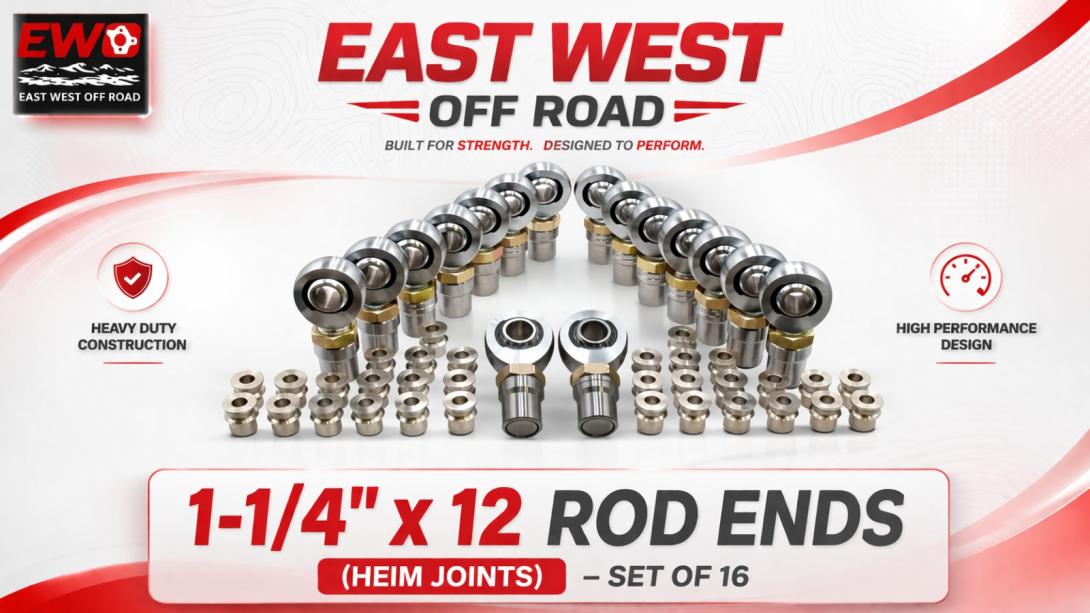
Buy Now: 1-1/4" x 12 Rod Ends (Heim Joints) – Set of 16
When you are building a serious rock crawler, 4x4, race vehicle, or custom suspension system, choosing the right rod end can make a major difference in strength, articulation, and adjustability. 1.25 Rod Ends are designed for demanding suspension and steering applications where smaller spherical joints may not provide the capacity or durability required. A properly engineered 1.25-inch rod end can be used for custom suspension links, 4-link systems, steering link joints, traction bars, and other high-load off-road fabrication projects.
What Are 1.25 Rod Ends?
1.25 Rod Ends, commonly called 1-1/4-inch heim joints, are spherical rod ends designed to allow controlled angular movement between a threaded link and a mounting point. Unlike a conventional rubber or polyurethane bushing, a heim joint provides direct mechanical articulation around its spherical bearing.
This makes a 1.25" Rod End Kit particularly useful for vehicles that need substantial suspension movement without binding.
The 1.25-inch size is popular in serious off-road builds because it combines a large threaded shank with a substantial spherical bearing. Depending on the specific design, these joints can be used in a 4 Link Kit, rock crawler suspension, steering system, race car suspension, or custom fabrication project.
Why Choose 1.25 Rod Ends for Off-Road Builds?
Off-road suspension systems experience forces that are very different from normal street driving. Large tires, heavy axles, suspension articulation, hard landings, and uneven terrain can place substantial loads on suspension links.
A high-strength 1.25 Inch Suspension Joint provides a robust connection between fabricated links and chassis or axle mounting points.
Built for High-Load Applications
Large spherical rod ends are commonly selected for heavy-duty suspension links because their larger construction can withstand demanding loads when correctly sized and installed.
For serious fabrication, a High-Strength Heim Joint can be used in applications such as:
- Rock crawler suspension
- Custom 4-link suspension
- Heavy-duty steering systems
- Traction bars
- Panhard bars
- Adjustable suspension links
- Race car suspension parts
- Off-road steering kits
- Custom axle builds
- 4x4 suspension parts
The correct rod end should always be selected based on the actual loads, mounting geometry, bolt size, material, and intended use.
1.25 Rod Ends for 4-Link Suspension
A major application for large heim joints is a custom 4 Link Kit. Four-link suspension systems require strong, adjustable connections between the axle and chassis.
A Rock Crawler 4 Link Kit can benefit from large rod ends because they allow the suspension links to articulate while maintaining a mechanically controlled connection.
Adjustable Suspension Links
One of the biggest benefits of using threaded rod ends in custom suspension is adjustability. The threaded connection allows builders to fine-tune link length and suspension geometry during fabrication and setup.
Using appropriate right-hand and left-hand threaded joints can make adjustment easier because link length can be changed without completely removing the suspension link.
This is especially useful for Custom 4 Link Suspension, where builders may need to make precise changes during chassis setup.
1-1/4-12 Threaded Rod Ends
Thread specification is one of the most important considerations when purchasing a rod end.
Many heavy-duty 1.25-inch joints use a 1-1/4-12 Right Hand Thread, meaning the shank has a 1.25-inch nominal thread diameter with 12 threads per inch.
The 12 TPI configuration provides a substantial threaded connection for applications where a large joint is required.
Before ordering a 1-1/4-12 Rod End Set, verify:
- Thread diameter
- Threads per inch
- Right-hand or left-hand thread
- Shank length
- Bore diameter
- Mounting width
- Required misalignment spacer size
- Tube adapter dimensions
These details are critical when matching rod ends to fabricated suspension links.
Heim Joints With Misalignment Spacers
Heim Joints with Misalignment Spacers are commonly used when the spherical bearing's internal bore needs to work with a smaller mounting bolt.
For example, a large-bore heim joint may use a misalignment spacer to adapt the joint to a commonly used bolt size while also allowing additional angular movement.
Why Misalignment Spacers Matter
A properly selected spacer can help center the rod end within the mounting bracket and provide the required clearance for suspension articulation.
1.25 Heim Misalignment Spacers should be selected based on the rod end bore, bolt diameter, mounting width, and required misalignment angle.
Using the wrong spacer can create excessive side loading or improper fitment, so the spacer dimensions should always match the joint and mounting hardware.
Materials and Construction
Material selection matters when choosing Chromoly Suspension Parts or other heavy-duty suspension components.
Depending on the manufacturer and design, large rod ends may use heat-treated steel, chromoly steel, hard chrome-plated surfaces, PTFE-lined races, or other specialized materials.
Heat-Treated Construction
A Heat-Treated Chromoly Joint can provide increased strength and durability compared with basic untreated components when manufactured and heat-treated correctly.
For racing, rock crawling, and extreme off-road applications, builders should consider the joint's load rating, material specification, heat treatment, bearing design, and manufacturing quality rather than choosing solely by appearance.
Teflon-Lined Rod Ends
A Teflon Lined Heim Joint uses a low-friction bearing liner designed to provide smooth movement without requiring traditional grease lubrication.
A Teflon Kevlar lined heim joint may also be used in high-performance applications where reduced friction and durable bearing performance are important.
These designs are particularly useful for suspension systems where frequent lubrication is inconvenient.
1.25 Rod Ends and DOM Tubing
Large rod ends are frequently paired with DOM tubing in custom off-road fabrication.
A typical fabricated link may use a DOM Tubing Weld Adapter or weld-in bung that is sized to fit the selected tubing.
Tube Adapter Compatibility
When building a suspension link, check the internal diameter of the DOM tube before selecting the adapter.
A 1.5" Inner Diameter Tube Adapter is commonly used with appropriately sized tubing, while heavy-wall DOM can provide the structural strength required for demanding suspension applications.
Fabricators may also encounter specifications such as:
- 1020 Steel Tube Adapter
- 1045 Steel Tube Adapters
- Weld-In Tube Adapter
- 1.5" Hex Tube Bung
- Weld-In Bung for 1.5 ID
- 1-1/4-12 Thread Adapter
- USA Made Tube Adapter
- Fabrication Tube Adapters
- .120 Wall DOM Tube Adapter
- .250 Wall DOM Tube Adapter
- 1/4 Inch Wall Thickness DOM Tube Adapters
- 1-1/4 Tube Adapters for 2 Inch OD DOM
Always confirm actual tubing dimensions and wall thickness before welding.
Choosing the Correct 1.25 Rod End
Not every 1.25-inch rod end is identical. Two joints can have the same nominal thread size while having different bore diameters, mounting widths, shank lengths, load ratings, or misalignment requirements.
When selecting a Right Hand Rod End, verify that the thread direction matches your fabrication design.
For adjustable links, you may want a Left and Right Heim Joint Kit so the link can be adjusted by rotating the assembly.
Important Specifications to Compare
Before buying, review:
- Thread size and pitch
- Thread direction
- Bore diameter
- Ball width
- Mounting width
- Shank diameter
- Shank length
- Radial load rating
- Bearing liner material
- Misalignment spacer requirements
- Tube adapter compatibility
- Intended suspension or steering application
This prevents compatibility problems during fabrication.
1.25 Rod Ends for Steering Applications
Although 1.25-inch rod ends are commonly associated with suspension fabrication, spherical joints can also be used in certain custom steering applications when the component is specifically designed and rated for that use.
An Off-Road Steering Kit may use large spherical joints to create strong connections between steering links and mounting points.
However, steering is a safety-critical system. Rod ends used for steering should be properly rated for the application, installed according to the manufacturer's requirements, and inspected regularly.
Heavy-Duty Steering Joints
For a custom steering system, Heavy Duty Steering Joints can provide a strong mechanical connection, but the entire steering system must be engineered as a complete assembly.
This includes:
- Steering link diameter
- Rod-end load rating
- Mounting brackets
- Bolt size
- Misalignment spacers
- Steering geometry
- Suspension travel
- Clearance
- Welding quality
A strong rod end cannot compensate for a weak bracket, improperly sized bolt, poor weld, or incorrect steering geometry.
1.25 Rod Ends for Custom Off-Road Fabrication
One reason builders choose large heim joints is flexibility. They can be integrated into many custom fabrication projects instead of being limited to one vehicle-specific application.
Custom Off-Road Fabrication projects may include:
- Rock crawlers
- Tube chassis vehicles
- Trail rigs
- Race cars
- Custom 4x4s
- Baja-style builds
- Custom link suspensions
- Hot rods
- Drag racing vehicles
- Competition trucks
For builders working with DOM tubing, a properly matched Heim Joint Kit for DOM Tubing can simplify the fabrication process.
1.25 Rod Ends vs Smaller Rod Ends
The primary advantage of moving to a larger rod end is the ability to build a stronger joint and link system when the application requires it.
A 1.25-inch joint is substantially larger than common 3/4-inch or 7/8-inch rod ends, but larger does not automatically mean better for every vehicle.
The joint should be selected according to the vehicle's weight, tire size, axle strength, suspension geometry, expected loads, and intended use.
For an extreme rock crawler or heavy-duty 4x4, the additional capacity of a large joint can make sense. For a lightweight street vehicle, a smaller joint may be more appropriate.
Product Highlight: 1-1/4" x 12 Rod Ends
For builders looking for a large threaded rod end for suspension and fabrication applications, the 1-1/4" x 12 Rod Ends (Heim Joints) – Set of 16 provides a solution for projects requiring multiple heavy-duty joints.
The large 1.25-inch threaded format is suited to applications such as custom suspension links, 4-link fabrication, steering link joints, and other high-load off-road projects.
The set is especially useful when fabricating multiple links where consistent joint sizing across the build is important.
For the product option, see the 1-1/4" x 12 rod ends set of 4 and select the configuration that matches your build requirements.
Installation and Fabrication Considerations
Installing large heim joints is more than simply threading them into a tube.
The mounting brackets should provide adequate clearance for the required articulation, while the joint should remain properly supported through its intended mounting width.
Welding Tube Adapters
When using a weld-in tube adapter, ensure that:
- The tube is properly prepared.
- The adapter fits correctly.
- The weld area is clean.
- The joint is positioned correctly.
- The finished weld is suitable for the intended application.
- The link is protected from excessive heat distortion.
MIG or TIG welding may be appropriate depending on the materials and fabrication process.
For critical suspension components, professional fabrication practices and appropriate inspection are strongly recommended.
Maintenance of 1.25 Rod Ends
Even high-quality rod ends should be inspected regularly, especially on vehicles used for extreme off-road driving.
Check for:
- Excessive bearing movement
- Visible wear
- Cracks
- Damaged threads
- Loose jam nuts
- Bent hardware
- Spacer damage
- Corrosion
- Bracket deformation
- Unusual suspension noise
A Teflon-lined or self-lubricating joint should not automatically be treated like a conventional greasable joint. Follow the manufacturer's maintenance recommendations.
Common Applications for 1.25 Rod Ends
The versatility of these joints makes them popular across multiple fabrication categories.
Common applications include:
Rock Crawlers
Large joints can be incorporated into suspension links where articulation and strength are priorities.
4-Link Systems
A 4 Link Kit can use large rod ends for adjustable upper or lower links.
Race Vehicles
Race Car Heim Joints are used in various custom suspension and linkage designs, subject to the specific component's racing suitability.
Custom Steering
Certain heavy-duty steering projects may use large spherical joints where the joint is specifically rated and engineered for steering loads.
Custom Fabrication
Builders can combine rod ends with DOM tubing, weld-in adapters, jam nuts, and misalignment spacers to create custom suspension components.
Frequently Asked Questions (FAQs)
What are 1.25 Rod Ends used for?
1.25 Rod Ends are commonly used for heavy-duty suspension links, 4-link systems, rock crawlers, custom off-road fabrication, traction bars, race vehicles, and certain steering applications.
Are 1.25 Rod Ends stronger than smaller heim joints?
A properly manufactured 1.25-inch rod end can provide greater load capacity than smaller rod ends, but strength depends on the complete joint design, material, bore, load rating, mounting hardware, and application.
What does 1-1/4-12 mean?
1-1/4-12 describes a nominal 1.25-inch thread diameter with 12 threads per inch. Always verify the exact thread specification before matching a rod end to a tube adapter or threaded component.
Do 1.25 Rod Ends need grease?
Some rod ends use self-lubricating bearing liners and do not require conventional grease. Maintenance requirements vary by design, so follow the manufacturer's instructions.
What are misalignment spacers used for?
Misalignment spacers adapt the rod end bore to the desired mounting bolt size and can provide additional articulation and clearance depending on their design.
Can 1.25 Rod Ends be used for a 4-link suspension?
Yes. Large spherical rod ends are commonly used in custom 4-link and suspension fabrication when their load rating and geometry are appropriate for the vehicle.
What size tubing works with a 1.25-inch rod end?
The correct tubing depends on the tube adapter and rod-end configuration. Some systems use adapters designed for 1.5-inch ID tubing or heavy-wall 2-inch OD DOM tubing. Always verify the actual dimensions before fabrication.
Are 1.25 Rod Ends suitable for steering?
They can be used in certain custom steering applications when the specific joint is properly rated and engineered for steering loads. Steering components are safety-critical and should be designed and installed appropriately.
What is the advantage of left- and right-hand rod ends?
Using left- and right-hand threads allows a fabricated suspension link to be adjusted by rotating the link rather than completely removing it, which can make suspension setup and tuning easier.
Are 1.25 Rod Ends good for rock crawling?
They can be an excellent option for serious rock-crawling builds when properly sized for the vehicle and paired with correctly engineered links, brackets, hardware, and spacers.
What should I check before purchasing a 1.25 Rod End Kit?
Check thread size, thread direction, bore diameter, mounting width, shank length, load rating, misalignment spacer dimensions, tube adapter compatibility, and whether the joint is rated for your intended application.
Final Thoughts
A well-selected set of 1.25 Rod Ends can provide the foundation for a strong, adjustable, and highly articulating suspension or fabrication project. From a Rock Crawler 4 Link Kit to custom DOM-tube suspension links and heavy-duty off-road steering applications, the large threaded format gives builders a versatile option for demanding projects.
The key is not simply choosing the biggest joint available. Proper sizing, compatible tube adapters, correct misalignment spacers, appropriate mounting hardware, sound fabrication, and correct suspension geometry all work together to create a reliable system.
For builders who need multiple large rod ends for a custom project, the 1-1/4" x 12 rod ends set is worth considering for high-load off-road suspension and fabrication applications.