

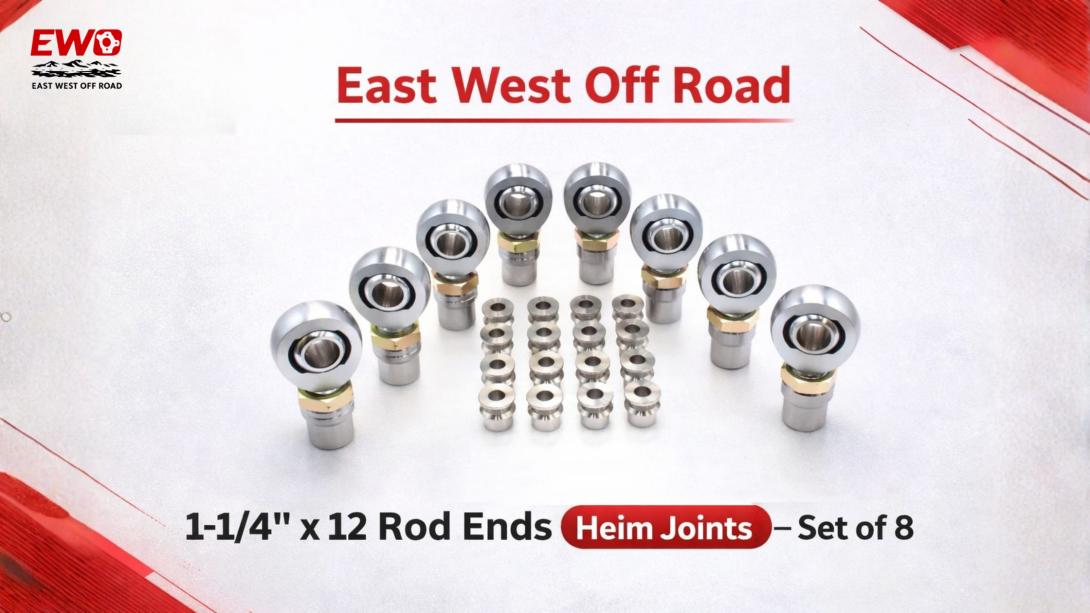
Buy Now: https://www.eastwestoffroad.com/product/1-14%22-x-12-rod-ends-(heim-joints)-set-of-8
1.25 Rod Ends are widely used in heavy-duty custom suspension, 4-link systems, rock crawlers, fabricated 4x4s, and other off-road builds where large spherical rod ends are needed to combine articulation with adjustable link construction. Often referred to as 1-1/4-inch heim joints, these components are commonly paired with 1-1/4"-12 threads, tube adapters, jam nuts, and high-misalignment spacers to create a complete link assembly suited to demanding suspension applications.
East West Off Road currently offers the E63003 1-1/4" x 12 Chromoly Heim Joint Kit as a set of eight with selectable tube-adapter and stainless-steel misalignment configurations.
What Are 1.25 Rod Ends?
1.25 Rod Ends are spherical rod-end joints using a large threaded shank that measures approximately 1-1/4 inches in nominal diameter.
They are commonly called:
- 1.25 heim joints
- 1-1/4 heim joints
- spherical rod ends
- suspension rod ends
- chromoly heims
- heavy-duty heim joints
Inside the body is a spherical bearing that allows angular movement between a suspension link and its mounting point.
That articulation makes them useful in custom suspension systems where the axle and chassis move through different angles.
Understanding the 1-1/4"-12 Specification
The most important part of the size designation is the thread specification.
1-1/4 Inch
This identifies the nominal threaded-shank diameter.
12 TPI
The “12” identifies 12 threads per inch.
Therefore, a 1-1/4"-12 rod end must be matched with compatible threaded components.
Those can include:
- tube adapters
- jam nuts
- suspension-link hardware
Matching only the approximate diameter is not enough.
Thread pitch and direction must also correspond.
Why 1.25-Inch Rod Ends Are Popular Off Road
Heavy off-road vehicles can place substantial loads through their suspension links.
Common factors include:
- Large tires
- Heavy axles
- Increased vehicle weight
- Long suspension travel
- Rock crawling
- High articulation
- Custom chassis geometry
A larger rod-end package gives builders a substantial component platform for suspension systems designed around these conditions.
However, rod-end size should still be chosen according to the complete engineered suspension rather than simply selecting the biggest available joint.
What Is a Heim Joint?
A heim joint is a spherical rod end.
The spherical center allows the link to pivot through different angles while remaining mechanically connected to the suspension mount.
This is useful because an off-road axle rarely moves straight up and down.
During articulation, one side may compress while the opposite side droops.
At the same time, the axle can move through changes in:
- angle
- pinion position
- lateral orientation
- chassis relationship
A spherical rod end accommodates this changing geometry.
Why Spherical Rod Ends Are Used in Custom Suspension
Conventional rubber bushings provide flexibility through material deformation.
A heim joint instead uses a true spherical bearing.
That gives fabricators:
- precise pivot movement
- threaded adjustability
- high articulation potential
- compact suspension-link connections
These characteristics make them common in performance-oriented suspension systems.
1.25 Rod Ends for 4-Link Suspension
One of the most common uses for large rod ends is a heavy-duty 4-link suspension.
A four-link system generally uses:
- two upper suspension links
- two lower suspension links
Those links control axle position relative to the chassis.
Large heim joints may be used at multiple connection points to provide articulation and adjustability.
Why a Set of Eight Makes Sense for Link Suspension
For builds requiring multiple spherical connections, the 1-1/4" x 12 Rod Ends (Heim Joints) – Set of 8 format can simplify component planning.
Using joints from one product family can help maintain consistency in:
- thread specifications
- jam nuts
- adapter selection
- replacement identification
The number of rod ends required still depends on the actual suspension design.
Chromoly Rod Ends
EWO currently identifies E63003 as a chromoly heim-joint kit.
Chromoly steel is widely used in motorsport and off-road components because it can provide high strength when correctly manufactured.
For a suspension rod end, however, material should never be the only buying specification.
Also consider:
- shank thread
- bore
- spherical-bearing design
- spacer configuration
- link geometry
- vehicle weight
- intended suspension use
The complete suspension system determines whether a particular rod end is suitable.
Chromoly vs. Basic Industrial Rod Ends
Not every spherical rod end is designed for the same environment.
Industrial rod ends may be designed for machinery loads and movement patterns that differ substantially from an off-road suspension.
A heavy-duty off-road rod end should be evaluated around the intended vehicle application.
Relevant characteristics can include:
- construction material
- thread dimensions
- bore dimensions
- articulation capability
- replacement hardware availability
Understanding Rod-End Bore Size
The bore is the center opening through the spherical bearing.
The mounting hardware passes through this area, often with a pair of misalignment spacers.
The current EWO E63003 product provides selectable stainless-steel misalignment options based around a 1-inch bore interface.
These currently include:
- 1" to 3/4"
- 1" to 5/8"
- 1" to 9/16"
- without spacers
The correct choice depends on the mounting-bracket and hardware design.
What Are Misalignment Spacers?
Misalignment spacers fit into either side of the spherical bearing.
They can serve two key purposes.
Adapting the Bore
They can reduce the effective mounting-hole size for a smaller suspension bolt.
Increasing Angular Clearance
Their shape can create additional room for the rod end to articulate before surrounding components interfere with movement.
This is particularly useful in high-travel off-road suspension.
Why Misalignment Angle Matters
A suspension joint needs enough articulation for the full intended suspension cycle.
Consider movement through:
- full compression
- full droop
- cross-axle articulation
A rod end should not reach its angular limit before the suspension reaches its designed limit.
That makes misalignment capacity a geometry issue rather than simply an accessory choice.
1" to 3/4" Misalignment Spacers
The current EWO product includes an available 1"-to-3/4" stainless-steel selection.
This configuration reduces the effective mounting interface for a 3/4-inch bolt arrangement.
Whether this is suitable depends on the entire suspension design.
1" to 5/8" Misalignment Spacers
A 1"-to-5/8" stainless-steel option is also currently available.
This provides another mounting configuration for professionally designed suspension systems using 5/8-inch hardware.
1" to 9/16" Misalignment Spacers
EWO currently lists a 1"-to-9/16" option as well.
Again, the correct bolt size should be determined by the suspension designer rather than selected simply because a spacer option exists.
Rod Ends Without Misalignment Spacers
The EWO E63003 product can also currently be selected without spacers.
This can be useful when the fabricator:
- already has appropriate spacers
- requires a different spacer arrangement
- is integrating the rod ends into another custom assembly
Compatibility should still be verified before fabrication.
What Is a Tube Adapter?
A tube adapter creates the threaded connection between the suspension-link tubing and rod end.
It may also be called:
- weld-in bung
- tube insert
- threaded adapter
The rod end threads into the adapter so the completed suspension link can be adjusted and serviced.
Current EWO Tube Adapter Options
The EWO E63003 page currently lists:
- 1.5" I.D. Hex Tube Adapter
- 1.5" I.D. Round Tube Adapter
- No Tube Adapter
This gives builders different options based on the surrounding suspension-link tubing and fabrication plan.
Why Tube Inside Diameter Matters
Tube adapters must physically match the tubing they are designed to fit.
Inside diameter is affected by both:
- outside diameter
- wall thickness
Two suspension tubes with the same outside diameter may have different inside diameters.
That means a fabricator should confirm the actual tubing dimensions rather than assuming compatibility based only on O.D.
Hex vs. Round Tube Adapters
Both styles create the threaded connection for the rod end.
Hex Tube Adapter
The exterior flats may provide convenient surfaces for professional fabrication or service.
Round Tube Adapter
The cylindrical exterior can suit another fabrication preference.
The best choice depends on the suspension-link design and tubing.
Left-Hand and Right-Hand Rod Ends
Adjustable suspension links often use opposing thread directions.
One side may use a right-hand threaded rod end and the other a left-hand threaded rod end.
This arrangement allows the effective link length to be adjusted by rotating the link assembly.
It can be useful during professional suspension setup when adjusting:
- axle position
- wheelbase
- suspension geometry
- pinion relationship
The corresponding jam nuts and adapters must match each thread direction.
Why Left/Right Thread Planning Matters
A left-hand rod end will not correctly mate with a right-hand tube adapter.
Every component needs to match:
- thread diameter
- pitch
- direction
Keeping a build sheet with each suspension component's specification can simplify future maintenance.
Jam Nuts and Rod Ends
Jam nuts secure the chosen threaded adjustment.
They should match:
- 1-1/4-inch thread diameter
- 12-TPI pitch
- left- or right-hand thread direction
They should also remain part of regular suspension inspection.
Why Thread Engagement Matters
Rod ends are adjustable because part of the threaded shank remains inside the tube adapter.
The connection needs enough appropriate thread engagement for the suspension design.
It should never be adjusted solely to maximize link length or appearance.
Safe adjustment limits should follow the specifications of the components and suspension design.
1.25 Rod Ends for Lower Suspension Links
Lower links commonly carry substantial suspension loads.
They may also contact trail obstacles in low-mounted off-road suspensions.
Their joints can experience forces related to:
- acceleration
- braking
- axle movement
- trail impacts
That makes lower-link joint selection an important part of a custom suspension design.
1.25 Rod Ends for Upper Links
Upper links help control axle rotation and pinion behavior.
Their geometry works together with lower links to determine how the axle reacts during acceleration and braking.
A large rod end may be appropriate in heavy-duty upper-link applications when the suspension is engineered around it.
1.25 Rod Ends for 3-Link Suspension
Large spherical rod ends may also appear in custom 3-link designs.
A 3-link layout typically uses three primary suspension links and another method of lateral axle location.
As with 4-link suspension, the joint must have enough strength and articulation for the intended vehicle.
1.25 Rod Ends for Rock Crawlers
Rock crawlers are one of the most common applications for heavy-duty spherical rod ends.
Their suspensions often require:
- significant articulation
- heavy axles
- large tires
- long travel
A quality joint can provide the movement needed at the end of an adjustable suspension link.
1.25 Rod Ends for Custom Trucks
Heavy custom trucks may use large heims in:
- 4-link conversions
- 3-link conversions
- trailing-arm suspension
- custom control arms
Vehicle weight becomes especially important in these applications.
A suspension component appropriate for a lightweight buggy should not automatically be assumed suitable for a much heavier truck.
1.25 Rod Ends for Fabricated Buggies
Fabricated buggies give chassis builders significant freedom over suspension geometry.
The fabricator can design:
- link length
- bracket location
- axle placement
- shock location
- articulation
The rod ends then become part of a complete suspension system designed specifically around that chassis.
1.25 Rod Ends in Steering Applications
Large heims are also used in some custom steering systems.
However, steering and suspension loads are different.
Steering components directly control wheel direction and should be selected specifically for that application.
Rod-end size alone does not establish steering suitability.
Professional design and inspection are particularly important where custom rod ends are used in steering.
Steering Rod Ends vs. Suspension Rod Ends
The same general spherical-joint concept can appear in both applications, but the system requirements differ.
Suspension
The joint helps locate the axle or suspension member while permitting articulation.
Steering
The joint transfers driver input directly to the steering knuckle.
The application should always be considered when selecting the component.
Heim Joints vs. Rubber Bushings
These joint styles behave differently.
Heim Joints
Common characteristics include:
- precise articulation
- threaded adjustability
- limited compliance
- direct suspension feel
Rubber Bushings
Common characteristics include:
- vibration isolation
- quieter operation
- compliance
- OEM-style road behavior
The best option depends on how the vehicle will be used.
Heim Joints vs. Flex Joints
Flex joints are also common in off-road suspension.
They may provide a balance between:
- articulation
- rebuildability
- some isolation
Heim joints typically prioritize precision and articulation.
A street/trail vehicle may therefore use a different joint strategy from a competition crawler.
Why Bigger Is Not Automatically Better
A 1.25-inch rod end is physically substantial, but that does not make it universally appropriate.
The complete suspension still needs to account for:
- link loads
- vehicle weight
- joint angle
- bracket structure
- suspension travel
- mounting hardware
Oversizing one component does not compensate for weaknesses elsewhere.
Bracket Strength Matters
A heavy-duty rod end transfers load into a suspension bracket.
That bracket then transfers load into:
- axle housing
- chassis
- crossmember
A high-strength rod end cannot compensate for inadequate mounting structure.
The complete load path needs to be professionally engineered.
Bracket Width and Misalignment Spacers
The rod end and misalignment spacers determine the installed width between bracket tabs.
Important dimensions include:
- spherical-ball width
- spacer width
- bracket opening
- mounting bolt
These dimensions must work together.
Suspension Travel and Joint Binding
The joint needs to maintain free movement throughout intended suspension travel.
A rod end that binds can create loads elsewhere in the suspension.
Professional inspection should consider movement through:
- compression
- droop
- articulation
The heim should not become the unintended suspension stop.
Radial Load Ratings: What They Do and Do Not Mean
Competitor 1.25-inch rod ends frequently advertise very large radial static-load numbers.
Those ratings can be useful for comparing individual joints tested under specified conditions.
However, a rod-end static rating is not the same as the safe load rating of the complete vehicle suspension.
Actual suspension capability depends on:
- mounting
- brackets
- link tubing
- geometry
- dynamic loads
- vehicle weight
For this reason, competitor load ratings should not automatically be applied to EWO's product unless EWO specifically publishes the same verified specification.
Off-Road Dynamic Loads
Off-road suspension loads are not purely static.
A vehicle can experience rapid changes caused by:
- terrain impacts
- acceleration
- braking
- articulation
- landing forces
Suspension components should therefore be selected as part of a complete engineered system.
Rod-End Wear and Inspection
Spherical rod ends are wear components.
A vehicle should be periodically inspected for:
- joint play
- bearing looseness
- binding
- thread damage
- body damage
- spacer wear
- loose jam nuts
Inspection frequency should reflect vehicle use.
Harsh Environment Considerations
Off-road joints can be exposed to:
- mud
- sand
- water
- dust
- road salt
- rocks
Contamination and corrosion can affect service life.
A hard-used crawler may therefore need more frequent suspension checks than a lightly driven recreational build.
Signs a Rod End Needs Attention
Possible warning signs can include:
- increased joint play
- knocking sounds
- unusual suspension movement
- binding
- visible damage
Any structural suspension component showing abnormal wear should be professionally evaluated before continued driving.
Replacement Parts and Long-Term Service
One advantage of building around standardized rod-end dimensions is easier future identification.
A build record should ideally include:
- thread size
- thread direction
- bore
- spacer dimensions
- adapter dimensions
- jam-nut specification
This can reduce confusion when components eventually need replacement.
East West Off Road E63003
East West Off Road currently lists:
1-1/4" X 12 CHROMOLY HEIM JOINT KIT – SET OF 8 WITH TUBE ADAPTERS & JAM NUTS
Item Number: E63003
Current selectable options include:
Bore Misalignment
- 1"-3/4" Stainless Steel
- 1"-5/8" Stainless Steel
- 1"-9/16" Stainless Steel
- Without Spacers
Tube Adapters
- 1.5" I.D. Hex Tube Adapter
- 1.5" I.D. Round Tube Adapter
- No Tube Adapter
For fabricators sourcing multiple heavy-duty suspension joints together, the chromoly 1.25 rod end kit provides a configurable set of eight rod ends for custom suspension and fabrication projects.
1.25 Rod End Buyer Checklist
Before purchasing a rod-end kit, verify:
Specification
Why It Matters
Thread diameter
Must match tube adapter
Thread pitch
EWO E63003 uses 1-1/4"-12
Thread direction
Must match adapter and jam nut
Bore
Determines mounting interface
Misalignment spacer
Affects bolt fit and articulation
Installed width
Must match brackets
Tube I.D.
Must match tube adapter
Link design
Determines component requirements
Suspension travel
Determines articulation
Vehicle weight
Influences suspension loading
Application
Suspension and steering differ
Quantity
Depends on link configuration
Common Mistake: Calling Every 1.25-Inch Joint the Same
Two rod ends can both use 1-1/4-inch threads while differing in:
- pitch
- bore
- material
- bearing design
- articulation
- load capability
Always compare complete specifications.
Common Mistake: Ignoring Thread Pitch
A 1.25-inch component does not automatically match another 1.25-inch component.
The thread pitch must also match.
EWO E63003 uses a 1-1/4"-12 specification.
Common Mistake: Ignoring Thread Direction
Left-hand and right-hand components need corresponding adapters and jam nuts.
Mixing directions can prevent the suspension link from assembling correctly.
Common Mistake: Selecting Spacers Only by Bolt Size
Misalignment spacers affect both bolt compatibility and joint articulation.
They should be selected according to the complete bracket and suspension geometry.
Common Mistake: Assuming a Set of Eight Is a Complete 4-Link Kit
Eight heim joints can form an important part of a multi-link build, but a complete suspension also needs:
- link tubing
- brackets
- hardware
- spring/damper system
- professionally designed geometry
The rod ends alone do not create a complete suspension system.
Common Mistake: Copying Another Vehicle's Suspension
Two vehicles can have completely different:
- weight
- wheelbase
- center of gravity
- axle position
- suspension travel
Even if both use identical rod ends, their suspension geometry may need to be different.
Professional Design and Fabrication
Custom rod-end suspension directly controls axle location and carries meaningful vehicle loads.
The completed system should be designed, fabricated, or inspected by a qualified automotive chassis professional.
Important areas include:
- joint selection
- bracket integrity
- link design
- appropriate articulation
- mounting hardware
- full suspension movement
- tire and driveline clearance
This is especially important for vehicles that will also be operated at highway speeds.
Frequently Asked Questions (FAQs)
What are 1.25 Rod Ends?
They are large spherical rod ends using approximately 1-1/4-inch threaded-shank architecture for custom suspension and other fabricated linkage applications.
Are 1.25 rod ends the same as 1-1/4 heim joints?
The terms are commonly used interchangeably in the off-road aftermarket when referring to 1-1/4-inch threaded spherical rod ends.
What thread does EWO E63003 use?
The current EWO product is listed as 1-1/4" x 12.
What does 12 mean in 1-1/4"-12?
It means 12 threads per inch.
How many rod ends are included in EWO E63003?
Eight.
Are EWO E63003 rod ends chromoly?
Yes. The current product title identifies them as chromoly.
Does EWO E63003 include jam nuts?
Yes. The current product title states that jam nuts are included.
Does the kit offer tube adapters?
Yes. The current page provides selectable 1.5-inch I.D. hex and round tube adapters, along with a no-adapter option.
What spacer options does EWO currently offer?
1"-to-3/4", 1"-to-5/8", and 1"-to-9/16" stainless-steel selections, plus an option without spacers.
What is a heim joint?
It is a spherical rod end that allows angular movement at the end of a suspension or linkage component.
Why are heim joints used in 4-link suspension?
Their spherical construction allows suspension articulation while providing an adjustable threaded link connection.
Are 1.25 rod ends good for rock crawlers?
They are commonly used in heavy-duty custom crawler suspensions when properly selected for the vehicle and suspension design.
Can 1.25 rod ends be used in a 3-link?
Large rod ends are used in some custom 3-link systems when appropriate to the engineered suspension.
Can they be used on a truck?
They can be used in properly engineered heavy-duty custom truck suspension systems.
Can 1.25 heims be used in steering?
Some custom steering systems use spherical rod ends, but steering is safety-critical and requires application-specific engineering, proper mounting, articulation, and professional inspection.
What is a misalignment spacer?
A spacer that interfaces with the spherical bearing to adapt the mounting configuration and increase available angular clearance.
Why do misalignment spacers reduce the bore?
They can adapt a large rod-end bore to the mounting-bolt size selected for the suspension.
What is a tube adapter?
It is the threaded component that connects the rod end to suspension-link tubing.
Why does tube I.D. matter?
The adapter needs to physically match the tube into which it is designed to fit.
What is the purpose of a jam nut?
It secures the rod end's adjusted threaded position.
Why use left- and right-hand threads?
Opposing threads can make adjustable suspension-link systems easier to set up without removing both rod ends.
Is chromoly good for rod ends?
Chromoly is widely used in heavy-duty motorsport and off-road rod ends, but overall suitability also depends on bearing design, dimensions, mounting, and application.
Is a larger heim joint always better?
No. The correct joint depends on vehicle weight, suspension geometry, loading, articulation, and surrounding components.
What is a 1-inch-bore heim joint?
It is a spherical rod end whose center bearing has a 1-inch nominal bore before any applicable misalignment-spacer reduction.
Does the rod-end load rating equal vehicle suspension capacity?
No. The complete suspension's capability depends on links, brackets, hardware, geometry, dynamic loads, and other components.
Are heim joints maintenance-free?
No. They should be periodically inspected for wear, looseness, binding, corrosion, and damage.
What causes heim-joint wear?
Factors can include repeated loads, contamination, water, mud, dust, corrosion, joint angle, and normal mechanical use.
How do I know when a rod end needs replacement?
Excessive play, binding, visible damage, or abnormal suspension movement should be professionally evaluated.
Is EWO E63003 a complete 4-link suspension kit?
No. It is a rod-end component package. A complete 4-link suspension also needs properly engineered links, brackets, hardware, geometry, and spring/damper components.
Should custom suspension using 1.25 rod ends be professionally fabricated?
Professional chassis design, fabrication, and final inspection are strongly recommended because suspension links locate the axle and carry significant vehicle loads.