

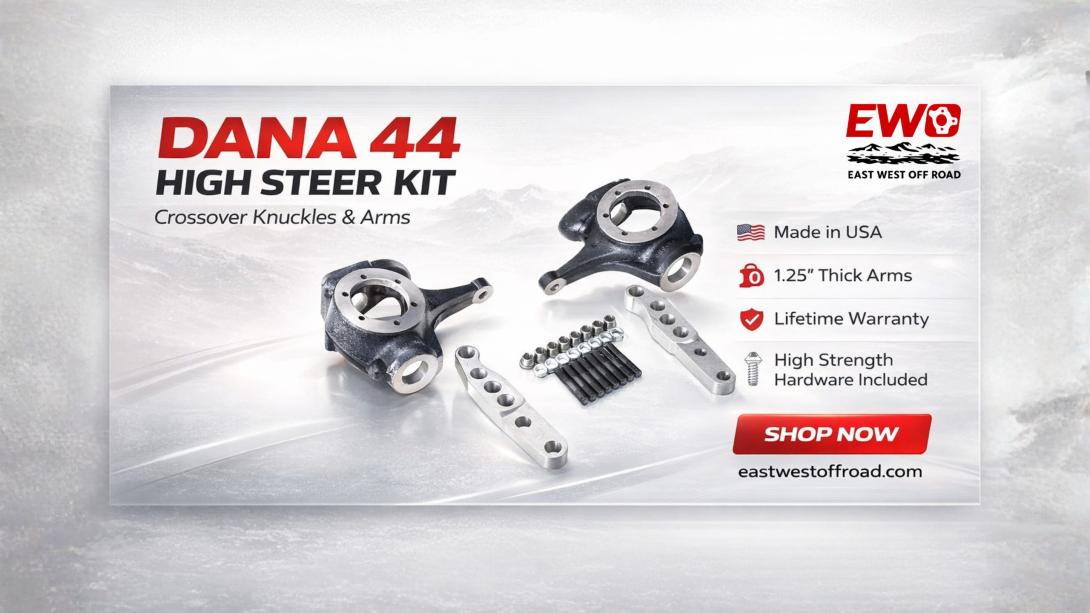
Buy Now: https://www.eastwestoffroad.com/product/dana-44-high-steer-crossover-knuckles-and-arms-kit
If you are upgrading a classic Chevy or GM 4x4 for larger tires, suspension lift, and serious off-road use, 1.25 Inch Billet High Steer Arms can provide an important foundation for a stronger crossover steering system. High-steer arms relocate the steering linkage higher on the front axle, helping improve clearance and create a more suitable steering arrangement for lifted Dana 44 and compatible Chevy 10 Bolt applications.
For K5 Blazer, K10, K20, and other classic GM builds, the right high-steer components need to work together. The knuckles, steering arms, drag link, tie rod, steering box, and pitman arm all influence the final steering geometry. A properly matched system can provide a more durable and purpose-built solution than relying on aging factory steering components.
What Are 1.25 Inch Billet High Steer Arms?
High-steer arms are steering components mounted to compatible flat-top front axle knuckles. Their purpose is to move the steering linkage higher on the axle while providing a strong connection point for the drag link and/or tie rod.
The 1.25-inch dimension refers to the heavy-duty construction specification associated with the steering arm design. Billet construction is commonly selected for custom off-road steering because it allows manufacturers to produce precise mounting surfaces and steering-linkage attachment points.
For a Dana 44 high-steer conversion, the steering arm must be correctly matched to the knuckle and mounting hardware. The complete assembly should be treated as a safety-critical steering system rather than simply an accessory upgrade.
Why Upgrade to High-Steer Arms?
Factory steering systems can work well for stock applications, but modified 4x4s introduce additional demands. Larger tires, increased wheel travel, suspension lifts, and off-road impacts can place substantially more stress on steering components.
High-steer arms can provide several practical advantages.
Higher Steering Linkage Position
Moving the steering linkage above the axle can create additional clearance around the differential housing, springs, and other suspension components.
This can be particularly useful for vehicles that spend time on rocky trails where low-mounted steering components may be exposed to obstacles.
Better Clearance for Lifted Vehicles
A suspension lift changes the relationship between the axle and steering components. A high-steer arrangement gives builders more flexibility when positioning the drag link and tie rod.
The final geometry still needs to be checked carefully, but raising the steering linkage can make it easier to design a clean steering system around a lifted suspension.
Strong Foundation for Crossover Steering
High-steer arms are commonly used with crossover steering systems. Instead of retaining the original steering arrangement, a crossover configuration uses a drag link that connects the steering box side of the vehicle to the opposite steering knuckle.
This can create a more direct steering layout for a solid-axle off-road build.
1.25 Inch Billet High Steer Arms for Dana 44
Dana 44 axles are among the most popular solid front axles used in classic 4x4 builds. Chevy and GM versions are particularly common in older trucks and SUVs.
A Dana 44 High Steer Crossover Knuckles and Arms Kit combines high-steer arms with compatible Dana 44 crossover knuckles, giving builders a complete starting point for a high-steer conversion.
Flat Top Knuckle Compatibility
High-steer arms require compatible knuckles with the appropriate mounting surface. Flat-top knuckles are commonly associated with traditional Dana 44 high-steer conversions because they provide the flat mounting area required for the arm.
Before installation, confirm that the knuckles, arms, studs, and steering ends are compatible with the specific axle configuration.
Four-Hole Billet High Steer Arms
Multi-hole high-steer arms can provide additional flexibility when configuring steering linkage. Different mounting positions can allow the builder to fine-tune the location of the drag link or tie rod according to the vehicle's suspension and axle setup.
However, steering geometry should always determine the final mounting position. The closest or easiest hole is not necessarily the correct one.
Benefits for Lifted Chevy K5 Blazer and K10 Builds
Classic Chevy K5 Blazers, K10s, and K20s are popular platforms for high-steer conversions. Many of these vehicles receive suspension lifts and larger tires that significantly change the original steering geometry.
A properly designed high-steer system can help provide:
- Improved steering component clearance
- Higher drag-link placement
- Better compatibility with lifted suspension
- A stronger foundation for crossover steering
- Improved protection from trail obstacles
- More flexibility for custom steering linkage
- Compatibility with heavy-duty off-road steering components
The exact benefit depends on the complete vehicle setup.
High Steer Arms and Steering Geometry
Installing high-steer arms does not automatically correct every steering problem. Steering geometry depends on multiple components working together.
Drag Link Angle
The drag link should operate through suspension travel without creating excessive changes in steering angle. A poor drag-link angle can contribute to bump steer.
Pitman Arm Selection
The pitman arm connects the steering box to the drag link. Its length and drop affect the position and angle of the steering linkage.
A high-steer conversion may require a different pitman-arm configuration depending on lift height and steering-box location.
Caster and Axle Position
Caster angle and front axle position also influence steering feel and tracking. A high-steer conversion should therefore be installed as part of a complete suspension and steering setup.
Billet High Steer Arms vs. Factory Steering Components
Factory steering components are designed around the original vehicle configuration. They may not be ideal for a heavily modified truck with larger tires and significant suspension changes.
Billet high-steer arms provide a purpose-built mounting solution for a high-steer conversion. When combined with compatible flat-top knuckles and heavy-duty steering linkage, they can create a more robust steering system.
For serious off-road use, the entire system should be evaluated rather than upgrading only one component.
Choosing the Right High Steer Kit
When selecting high-steer arms, several factors should be considered.
Axle Type
First confirm whether the front axle is a Dana 44, compatible Chevy 10 Bolt, or another configuration. Steering components are not universally interchangeable.
Knuckle Design
Verify that the knuckle has the required flat-top mounting surface and correct mounting pattern.
Steering Ends
The steering arm must be compatible with the selected drag-link and tie-rod ends. Taper, thread size, and joint dimensions should be confirmed before installation.
Stud and Hardware Specifications
High-steer arms experience significant steering loads. Proper mounting hardware and correct installation are essential.
Suspension Height
Lift height affects steering geometry. A component combination that works on one vehicle may not produce the same geometry on another vehicle.
Chevy Dana 44 High Steer Upgrade
For a classic GM truck, combining flat-top knuckles with 1.25 Inch Billet High Steer Arms can provide the foundation for a complete Chevy Dana 44 high steer upgrade.
The EWO Dana 44 crossover steering kit is designed around a knuckle-and-arm conversion for Chevy/GM Dana 44 applications.
This approach can be useful for builders who want to replace multiple steering components as a coordinated system instead of sourcing separate parts from different manufacturers.
Installation Considerations
High-steer components should be installed carefully because steering failure can result in loss of vehicle control.
Before installation, inspect the axle, ball joints, wheel bearings, steering box, pitman arm, and existing steering components.
Check Lock-to-Lock Clearance
Turn the steering from full left to full right and inspect for contact between the drag link, tie rod, differential, springs, shocks, wheels, and other components.
Cycle the Suspension
The vehicle should also be checked through its available suspension travel. A steering component that clears at ride height may contact another component when the suspension compresses or articulates.
Verify Fastener Torque
Use the manufacturer's recommended torque specifications for the steering-arm hardware and other critical fasteners. Recheck the system after initial driving and inspect for movement, looseness, or interference.
Can High Steer Arms Reduce Bump Steer?
High-steer arms can help improve the position and angle of steering linkage on lifted vehicles, but they do not independently eliminate bump steer.
Bump steer is caused by the relationship between suspension movement and steering linkage movement. The drag link, pitman arm, axle location, suspension lift, and steering-arm position all contribute to the final result.
For this reason, high-steer arms should be installed as part of a complete geometry plan.
Why Choose a Complete Dana 44 High Steer System?
Sourcing steering arms, knuckles, studs, and linkage separately can create compatibility challenges. A complete system can simplify the process by providing major components designed around the same application.
The USA-made Dana 44 steering kit is designed for Chevy/GM Dana 44 applications and provides a practical option for builders planning a complete crossover steering conversion.
Before ordering, always verify axle compatibility and vehicle-specific requirements.
Frequently Asked Questions (FAQs)
What are 1.25 Inch Billet High Steer Arms?
They are heavy-duty steering arms designed to mount to compatible flat-top steering knuckles and position the steering linkage higher on a solid front axle.
What is the purpose of high-steer arms?
High-steer arms raise the steering linkage above the axle, helping provide additional clearance and supporting crossover steering configurations on compatible vehicles.
Do I need flat-top knuckles for high-steer arms?
Traditional Dana 44 high-steer installations generally require compatible flat-top knuckles because the arms mount to the flat upper surface.
Are billet high-steer arms good for off-road vehicles?
They can be an excellent foundation for heavy-duty off-road steering when properly matched to the axle, knuckles, steering ends, and vehicle geometry.
Can high-steer arms be used on a Chevy 10 Bolt?
Certain Chevy/GM 10 Bolt applications can use compatible Dana 44-style high-steer components. Exact axle and knuckle compatibility should be confirmed before installation.
Do high-steer arms eliminate bump steer?
Not automatically. They can help improve steering-linkage geometry on a lifted vehicle, but bump steer depends on the complete suspension and steering configuration.
Are high-steer arms suitable for a lifted K5 Blazer?
They are commonly used in high-steer conversions for lifted K5 Blazer builds. The complete steering system must be designed around the lift height, axle, pitman arm, and suspension geometry.
What should I inspect before installing high-steer arms?
Inspect the flat-top knuckles, ball joints, steering box, pitman arm, steering linkage, wheel bearings, and suspension. Also check steering clearance throughout suspension and steering travel.
Are 1.25-inch high-steer arms suitable for large tires?
A properly engineered high-steer system can be better suited to larger-tire off-road applications than worn factory components. However, tire size, axle strength, steering box capacity, and vehicle weight should all be considered.
Final Thoughts
1.25 Inch Billet High Steer Arms can be an important upgrade for a classic Chevy or GM 4x4 that is being built for lifted suspension, larger tires, and serious off-road use. When paired with compatible flat-top Dana 44 knuckles, heavy-duty steering ends, and correctly designed crossover linkage, they provide a strong foundation for a purpose-built steering system.
The most important consideration is not the steering arm alone. The knuckles, arms, drag link, tie rod, pitman arm, steering box, and suspension geometry all need to work together. A properly matched high-steer system can provide improved clearance and a stronger steering layout while giving your classic GM 4x4 the capability needed for demanding trail use.