

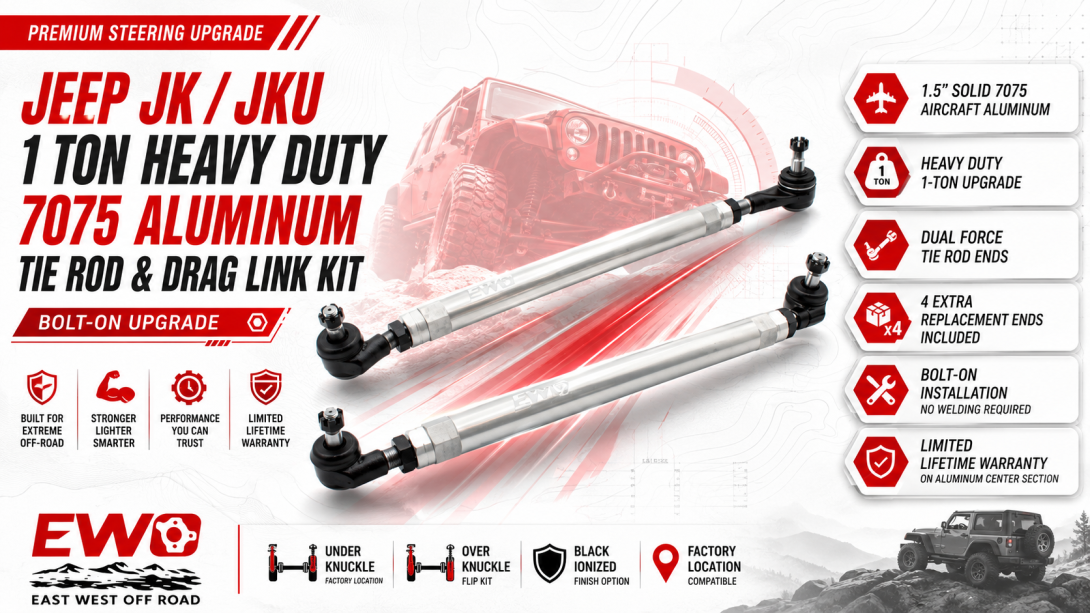
A 1 ton steering kit JK is a heavy-duty steering upgrade designed for Jeep Wrangler JK and JKU owners who have moved beyond the demands of a stock steering system. Larger tires, suspension lifts, heavier wheels, rock crawling, overlanding, and repeated trail use can place substantially greater loads on the tie rod, drag link, and steering joints. Replacing those components with a complete 7075 aluminum tie rod and drag link system using heavy-duty 1-ton steering ends gives modified Jeep owners a stronger, more comprehensive approach to steering than replacing factory-style components one at a time.
The East West Off Road E30112 1 Ton Heavy Duty 7075 Aluminum Tie Rod & Drag Link Steering Kit is designed for 2007–2018 Jeep Wrangler JK and JKU applications, with both factory-location and over-the-knuckle steering configurations available.
What Is a 1 Ton Steering Kit for a Jeep JK?
The phrase “1-ton steering” does not mean the Wrangler becomes a one-ton truck.
Instead, it generally describes a steering system built around larger heavy-duty steering links and 1 ton tie rod ends that are substantially more robust than typical factory JK steering components.
A complete system commonly upgrades both:
- Tie rod
- Drag link
- Steering ends
- Adjustment hardware
- Stabilizer mounting provisions
The tie rod connects the two front steering knuckles, while the drag link transfers movement from the steering box and pitman arm to the steering knuckle.
Together, these parts form the primary linkage responsible for directing the front tires.
For that reason, a complete 1 ton steering kit JK addresses more of the steering system than upgrading only the tie rod or only the drag link.
Why Jeep JK Owners Upgrade to 1-Ton Steering
The factory JK steering system was engineered around the original vehicle configuration.
Modified Jeeps can create much different steering demands.
Common modifications include:
- 35-inch or larger tires
- Heavier aftermarket wheels
- Suspension lifts
- Steel bumpers
- Winches
- Axle upgrades
- Rock-crawling equipment
- Overlanding gear
Larger tires create more leverage through steering components, particularly during low-speed turns on rocks or uneven terrain.
A heavier wheel and tire package also adds rotating and unsprung mass.
These changes are why Jeep Wrangler heavy duty steering upgrades are common on trail-oriented JK and JKU builds.
Factory Jeep Steering vs. 1-Ton Steering
Factory steering components are appropriate for the vehicle's original design parameters.
A heavy-duty aftermarket system changes several parts of that equation.
Factory-Style Steering
Typical characteristics include:
- Smaller steering links
- Factory-sized steering ends
- OEM wheel-clearance priorities
- Factory steering geometry
- Components sized around stock vehicle configuration
1-Ton Steering
A heavy-duty setup commonly emphasizes:
- Larger steering joints
- More substantial tie rod
- Heavy-duty drag link
- Trail-impact durability
- Compatibility with larger tires
- Serviceability for modified vehicles
A 1-ton system should still be correctly matched to the Jeep rather than treated as a universal upgrade for every JK.
Why Upgrade the Tie Rod?
The tie rod runs across the front axle and connects both steering knuckles.
Its location also places it relatively close to rocks and trail obstacles.
A hard impact can load the tie rod directly.
A Jeep JK tie rod upgrade replaces this vulnerable factory steering link with a heavier-duty component designed for modified-vehicle use.
A heavy duty tie rod Jeep Wrangler upgrade can be particularly relevant for Jeeps used for:
- Rock crawling
- Trail riding
- Overlanding
- Larger-tire builds
- Custom axle setups
The tie rod also controls toe, making its condition important for alignment and tire wear.
Why Upgrade the Drag Link Too?
The drag link connects steering-box movement to the steering knuckle.
A Jeep JK drag link upgrade complements the tie rod because the two links operate together every time the Jeep changes direction.
Upgrading only the tie rod can leave a factory drag link as the lighter component in an otherwise heavy-duty system.
A complete Jeep JKU drag link kit and tie rod package creates a more coordinated upgrade using similar material, steering-end sizing, and adjustment philosophy.
That is particularly useful for a Jeep being built around larger tires and suspension changes.
Why 7075 Aluminum Is Popular in Jeep Steering
A major feature of many premium JK steering systems is the use of 7075 aluminum.
7075 is a high-strength aluminum alloy used in applications requiring a high strength-to-weight ratio.
In aftermarket Jeep steering, it is especially popular because it can behave differently from conventional steel when subjected to some trail impacts.
7075 Aluminum Tie Rod Advantages
A properly engineered 7075 aluminum tie rod can elastically deflect under certain loads and return toward its original shape rather than necessarily remaining permanently bent.
This property has made 7075 particularly popular among rock crawlers.
Potential advantages include:
- High strength-to-weight ratio
- Corrosion resistance
- Solid-link construction in many aftermarket systems
- Useful elastic behavior under some trail impacts
- Reduced need for paint or powder coating on raw aluminum
No steering material is indestructible.
Any tie rod or drag link should be inspected after a major impact.
7075 Aluminum vs. Steel Steering
Both materials are widely used in the off-road aftermarket.
7075 Aluminum Steering
Often chosen for:
- High strength
- Reduced weight
- Corrosion resistance
- Trail-impact flex characteristics
Heavy-Duty Steel Steering
Often chosen for:
- Very high structural strength
- Familiar material behavior
- Broad fabrication options
- Long history in off-road steering systems
The better choice depends on the actual component design, not material name alone.
Diameter, rod-end size, machining, threaded sections, mounting arrangement, and intended use all matter.
What Does Aircraft Grade Aluminum Steering Kit Mean?
The phrase aircraft grade aluminum steering kit is frequently used to describe 7075 steering components.
For buyers, the actual alloy specification matters more than the marketing term.
When comparing steering kits, look at:
- Material
- Link diameter
- Tie rod ends
- Drag link ends
- Vehicle fitment
- Configuration
- Wheel-clearance requirements
- Replacement-part availability
A properly engineered steering system should be evaluated as a complete assembly.
Why Use 1-Ton Tie Rod Ends?
Larger steering joints are one of the defining characteristics of many 1 ton steering kit JK packages.
A modified Wrangler on larger tires can transmit significant loads through its steering pivots.
This is especially true when turning a tire while it is:
- Against a rock
- Wedged in uneven terrain
- Partially unloaded during articulation
- Running low trail pressure
Larger 1 ton tie rod ends provide heavy-duty steering pivot points for this type of application.
1-Ton Rod Ends vs. Factory JK Ends
The primary advantage is increased size and heavy-duty construction.
However, larger joints also create fitment considerations.
They can require more clearance around:
- Wheels
- Tires
- Steering knuckles
- Suspension brackets
This is why wheel backspacing is one of the most important details to check before purchasing 1-ton steering.
Complete Tie Rod and Drag Link Kit vs. Individual Upgrades
Some Jeep owners replace their steering components individually.
Others choose a complete steering kit.
A complete system has several advantages.
Coordinated Components
The tie rod, drag link, and ends are designed around one system.
Consistent Strength
You avoid pairing a heavy-duty tie rod with an aging factory drag link.
Easier Future Service
Replacement ends and adjustment procedures can be standardized.
One Steering Upgrade
Owners planning larger tires or major suspension changes can upgrade both primary links during the same project.
EWO E30112 Jeep JK/JKU Steering Kit
The East West Off Road steering product is currently identified as:
E30112 – 07-18 Jeep JK / JKU 1 Ton Heavy Duty 7075 Aluminum Tie Rod & Drag Link Steering Kit | Bolt-On Upgrade
The current configuration options include:
- Aluminum Finish – Under the Knuckle / Factory Location
- Aluminum Finish – Over the Knuckle / Flip Kit
- Black Anodized – Under the Knuckle / Factory Location
- Black Anodized – Over the Knuckle / Flip Kit
This gives builders the ability to choose between a factory-style steering position and a flipped drag-link configuration.
Under-the-Knuckle Steering Explained
An under-the-knuckle configuration keeps the steering linkage near the original JK steering location.
This approach may be attractive for owners looking for a bolt on steering kit JK without significantly changing the drag-link mounting height.
Potential advantages include:
- Factory-style steering position
- Simpler upgrade path
- Fewer geometry changes
- Heavy-duty linkage without automatically converting to a flip setup
Existing Jeep modifications still need to be checked for compatibility.
Over-the-Knuckle Steering Explained
Over-the-knuckle steering moves the relevant drag-link attachment above the steering knuckle.
It is often described as:
- OTK steering
- Drag link flip
- Flipped steering
- High-steer-style JK configuration
A Jeep JK flip kit can raise the drag link and change the geometry of the steering system.
This is different from simply installing a stronger drag link.
Why Use a Drag Link Flip?
A flipped drag link may be considered on lifted JKs because it changes the operating angle and position of the link.
Potential benefits can include:
- Higher drag-link position
- Additional obstacle clearance
- Improved steering-link angle on properly configured lifted Jeeps
However, the drag link cannot be considered independently of the track bar.
Drag Link and Track Bar Geometry
The drag link transfers steering force.
The track bar controls lateral axle movement.
For predictable steering behavior, their geometry needs to work together.
If a Jeep receives a substantial lift or drag-link flip without considering track-bar position, steering behavior can change as the axle moves through suspension travel.
For this reason, an over-the-knuckle configuration should be planned as part of the complete suspension system.
Is Over-the-Knuckle Steering Better?
Not automatically.
An under-knuckle setup can be appropriate for one Jeep while an over-knuckle configuration makes more sense for another.
Factors include:
- Lift height
- Track-bar position
- Tire size
- Wheel backspacing
- Intended use
- Steering stabilizer
- Front axle
- Existing suspension brackets
The correct configuration is the one that produces appropriate geometry and clearance for the specific Jeep.
Jeep JK Crossover Steering Kit Terminology
Some owners search for a JK crossover steering kit while shopping for upgraded linkage.
Terminology varies considerably across the Jeep aftermarket.
For the buyer, it is more useful to determine:
- How the tie rod is mounted
- How the drag link is mounted
- Whether the drag link is flipped
- What rod ends are used
- What modifications are required
Actual geometry matters more than the label used to describe it.
Wheel Backspacing and 1-Ton Steering
Larger steering ends can create wheel-clearance challenges.
Current competing 7075 1-ton JK kits frequently specify aftermarket-wheel or backspacing requirements because factory 17-inch wheels can position the inner wheel surface too close to larger rod ends.
Before purchasing a Jeep Wrangler JKU steering kit, verify:
- Wheel diameter
- Backspacing
- Offset
- Rod-end clearance
- Full-lock clearance
- Tire clearance
Do not assume that a 17-inch wheel automatically clears every 1-ton steering system.
Why Factory Wheels Can Be a Challenge
The issue is often not wheel diameter by itself.
Backspacing controls how far the wheel extends inward toward the steering components.
More backspacing generally places more of the wheel inward.
Heavy-duty steering ends may therefore need:
- Less wheel backspacing
- A compatible aftermarket wheel
- Another approved clearance solution
The exact requirements depend on the chosen steering configuration.
Steering Stabilizer Compatibility
A Jeep JKU steering stabilizer kit attaches to the steering linkage, so tie rod diameter directly affects the stabilizer mounting system.
A larger heavy-duty tie rod may require a different clamp.
The EWO listing currently offers an optional Heavy Duty 1.50-inch ID Tie Rod Clamp.
This is worth considering before installation rather than discovering afterward that the existing clamp no longer fits.
Steering Stabilizer Clearance
In addition to clamp diameter, check:
- Stabilizer body position
- Axle mount
- Tie rod mount
- Drag link clearance
- Track-bar clearance
- Full left/right steering travel
- Suspension compression
- Suspension droop
The stabilizer should not become a mechanical stop for the steering system.
Does a Steering Stabilizer Fix Weak Steering?
No.
A stabilizer can damp rapid steering movements, but it does not replace worn mechanical components.
A Jeep with worn tie rod ends, ball joints, track-bar bushings, or wheel bearings needs those problems addressed directly.
A stabilizer should complement a properly functioning steering system.
Does 1-Ton Steering Fix Death Wobble?
Not automatically.
A Jeep JK steering upgrade can replace worn steering joints or vulnerable factory linkage, but death wobble and severe front-end oscillation can involve several components.
Common inspection areas include:
- Track bar
- Track-bar bolts and mounts
- Ball joints
- Wheel bearings
- Tie rod ends
- Drag link ends
- Control arms
- Caster
- Toe
- Wheels
- Tires
The actual mechanical cause should be diagnosed rather than simply installing progressively heavier parts.
Larger Tires and Steering Load
Tire size is one of the main reasons JK owners move toward heavier steering components.
Larger tires increase leverage through the steering system.
They may also be substantially heavier than the factory wheel-and-tire package.
That increased load reaches:
- Tie rod
- Drag link
- Rod ends
- Steering box
- Ball joints
- Wheel bearings
- Track bar
A Jeep Wrangler heavy duty steering system addresses only part of this chain, so the rest of the front end should remain part of regular inspection.
Steering Upgrades for 35-Inch Tires
A JK on 35-inch tires is one of the most common modified Wrangler configurations.
For a mostly street-driven Jeep, steering needs may be different from those of a rock crawler running the same tire diameter.
Consider:
- Vehicle weight
- Trail frequency
- Wheel offset
- Suspension lift
- Existing component wear
The intended use matters as much as tire size.
Steering Upgrades for 37-Inch and Larger Tires
As tire size continues to increase, steering loads generally become more significant.
Large tires are frequently paired with axle, suspension, and brake upgrades.
At this stage, offroad Jeep steering components often become part of a larger front-end build rather than an isolated modification.
A complete inspection of the axle, knuckles, ball joints, steering box, track bar, and wheel bearings is especially important.
Rock Crawling With 1-Ton Steering
Rock crawling creates some of the most demanding conditions for steering components.
The tires may be loaded heavily while moving at very low speed.
The tie rod can also contact obstacles directly.
A heavy-duty off road steering upgrade is therefore common on rock-crawling JKs.
After a significant steering impact, inspect:
- Tie rod
- Drag link
- Rod ends
- Steering knuckles
- Pitman arm connection
- Stabilizer
- Alignment
Even high-strength steering components require inspection.
Overlanding and 1-Ton Steering
Overland JK and JKU builds can become much heavier than stock.
Added equipment may include:
- Winch
- Steel bumpers
- Roof rack
- Cargo systems
- Recovery equipment
- Water
- Tools
- Larger spare tire
These vehicles also cover long highway distances.
That means the steering system needs both off-road durability and predictable road behavior.
Daily Driving With Heavy-Duty Steering
A heavy-duty steering kit can still be appropriate for a daily-driven Jeep when properly installed and aligned.
Important considerations include:
- Wheel clearance
- Steering geometry
- Toe setting
- Steering-wheel centering
- Joint condition
- Fastener security
The finished Jeep should steer predictably across normal road speeds.
Toe Adjustment After Tie Rod Installation
The tie rod controls the relationship between the left and right steering knuckles and therefore affects toe.
After installation, toe should be checked and set to the appropriate specification for the vehicle.
Incorrect toe can contribute to:
- Rapid tire wear
- Poor tracking
- Unstable steering feel
Professional alignment is recommended.
Drag Link Adjustment After Installation
Drag-link length influences steering-wheel centering.
After steering work, the wheel should be centered while the steering gear and front wheels are in the appropriate straight-ahead position.
A steering-wheel position problem should not be corrected by randomly changing toe.
Tie rod and drag link adjustments serve different purposes.
EWO Reaming Option
The current EWO E30112 listing includes an optional:
7 Degrees 1.50-inch Per Foot Reamer
A tapered reamer may be required for certain steering attachment configurations depending on how the selected steering setup is installed.
Reaming steering-knuckle or pitman-arm locations alters safety-critical components.
The work should be performed by someone experienced with the exact steering system and required taper.
Aluminum Finish vs. Black Anodized
EWO currently offers both aluminum-finish and black-anodized steering configurations.
Aluminum Finish
Highlights the natural appearance of the 7075 links.
Black Anodized
Provides a darker exterior finish for owners looking for a more subdued steering appearance.
The underlying steering configuration—factory location or flip—is a separate decision from finish.
Extra Tie Rod Ends and Trail Preparedness
The current EWO listing highlights four extra dual-force tie rod ends with the steering package.
Replacement steering ends can be particularly valuable for off-road owners who travel far from easy parts access.
Even with a heavy-duty system, rod ends remain wear components and should be inspected for:
- Boot damage
- Play
- Impact damage
- Grease condition
- Loose hardware
Having compatible replacements available can simplify future maintenance.
Greasing Heavy-Duty Tie Rod Ends
Greaseable steering joints should be serviced according to the component manufacturer's recommendations.
Over-greasing can damage some dust boots, while insufficient lubrication can contribute to premature joint wear.
Inspect the boot while servicing each end and stop if grease application begins to distort or damage the seal.
What to Compare When Shopping for a 1-Ton JK Steering Kit
Not all kits use the same design.
Compare the actual specifications.
Feature
Why It Matters
JK/JKU model years
Determines basic vehicle compatibility
Link material
Affects strength, weight, corrosion, and impact behavior
Tie rod included
Determines whether the kit upgrades both primary links
Drag link included
Required for a complete steering system
1-ton ends
Defines heavy-duty joint architecture
Factory-location option
Useful for simpler configurations
Flip option
Changes drag-link height and geometry
Wheel clearance
Larger joints may interfere with stock wheels
Stabilizer mounting
Larger tie rods may need another clamp
Reaming/drilling requirement
Changes installation complexity
Replacement ends
Important for long-term servicing
Finish options
Allows appearance/corrosion preferences
Bolt-On vs. Modified Installation
Some JK steering kits install in factory-style locations without drilling.
Other systems require:
- Drilling
- Reaming
- Tapered inserts
- Track-bar relocation
- Additional brackets
Neither approach is automatically superior.
A bolt-on system can make installation simpler, while a modified over-the-knuckle arrangement can provide geometry advantages for the right lifted vehicle.
The Jeep's actual configuration should determine the choice.
Why Choose the EWO 1-Ton JK Steering Kit?
The EWO E30112 package is designed around the needs of modified JK and JKU owners looking for a full steering-linkage upgrade.
Current product features include:
- 2007–2018 JK/JKU application
- 7075 aluminum tie rod and drag link positioning
- Heavy-duty 1-ton steering architecture
- Complete tie rod and drag link package
- Under-knuckle/factory-location configuration
- Over-knuckle/flip configuration
- Aluminum-finish option
- Black-anodized option
- Optional 7° reamer
- Optional 1.50-inch ID tie rod clamp
- Four extra dual-force tie rod ends highlighted with the product
- Made-in-USA positioning in current product tags
For owners already investing in larger tires, lifts, stronger axles, and off-road equipment, upgrading both primary steering links at once can create a more comprehensive front-end build.
What to Check Before Ordering
Before buying a 1-ton steering kit for a JK or JKU, verify:
- Model year
- JK or JKU configuration
- Front axle
- Tire size
- Wheel diameter
- Wheel backspacing
- Suspension lift height
- Track-bar configuration
- Steering stabilizer
- Under-knuckle or over-knuckle preference
- Existing aftermarket suspension brackets
- Knuckle and pitman-arm configuration
- Current steering-component condition
These checks are especially important on Jeeps that have already received several generations of aftermarket modifications.
Installation and Alignment
Tie rods and drag links directly affect vehicle control.
After installation, verify:
- Every steering fastener
- Tie rod end seating
- Wheel clearance
- Tire clearance
- Stabilizer clearance
- Drag-link clearance
- Full steering travel
- Suspension-travel clearance
- Toe
- Steering-wheel centering
A professional alignment and inspection are strongly recommended before regular road use.
Frequently Asked Questions (FAQs)
What is a 1 ton steering kit JK?
A 1 ton steering kit JK is a heavy-duty steering system for a Jeep Wrangler JK or JKU that typically uses upgraded tie rod and drag link components with larger 1-ton-style steering ends.
Why is it called 1-ton steering?
The term refers to the heavy-duty steering-end architecture commonly associated with larger truck steering applications. It does not mean the Jeep becomes a one-ton vehicle.
What years does the EWO 1-ton steering kit fit?
The current EWO E30112 product is listed for 2007–2018 Jeep Wrangler JK and JKU models.
What is EWO E30112?
E30112 is East West Off Road's 1 Ton Heavy Duty 7075 Aluminum Tie Rod & Drag Link Steering Kit for the Jeep JK/JKU platform.
Does the kit replace both the tie rod and drag link?
Yes. The current EWO product is a complete tie rod and drag link steering package.
Is the steering kit made from 7075 aluminum?
Yes. The EWO product is listed as a 7075 aluminum steering kit.
Why is 7075 aluminum used for steering?
7075 provides high strength and can elastically flex under certain loads, making it popular for heavy-duty off-road steering links.
Is 7075 aluminum better than steel?
Neither material is universally better. The complete design, link dimensions, steering ends, fitment, and intended use are more important than material name alone.
Are 1-ton tie rod ends stronger than factory JK ends?
They are larger heavy-duty steering joints commonly selected for upgraded off-road systems. Overall steering strength still depends on the entire component design.
Is the EWO system bolt-on?
The current EWO product is marketed as a bolt-on upgrade and offers both factory-location and flip configurations. Exact installation requirements depend on the selected configuration and existing Jeep modifications.
What is under-the-knuckle steering?
It keeps the drag-link connection near its original factory-style location below the steering knuckle.
What is over-the-knuckle steering?
It relocates the relevant drag-link connection above the knuckle, changing its position and steering geometry.
What is a Jeep JK flip kit?
A flip kit converts the drag-link mounting position from below the steering knuckle to above it in a compatible setup.
Should every lifted JK use a drag link flip?
No. The need for a flip depends on lift height, track-bar geometry, steering configuration, and the complete suspension setup.
Does a drag link flip require track-bar changes?
It can. Drag-link and track-bar geometry should be evaluated together when changing steering height.
Will factory JK wheels fit 1-ton steering?
Not always. Larger 1-ton rod ends can create clearance problems with wheels that have substantial backspacing. Exact wheel fitment should be checked before purchasing.
Do I need aftermarket wheels?
That depends on the wheel's diameter, offset, backspacing, and the steering kit design. Larger steering ends frequently require more inner-wheel clearance than the factory system.
Can I keep my steering stabilizer?
Possibly. Clamp diameter, mounting location, and linkage clearance must be verified. EWO currently offers an optional 1.50-inch ID tie rod clamp.
Does 1-ton steering fix death wobble?
Not automatically. Death wobble can involve the track bar, ball joints, wheel bearings, steering joints, control arms, alignment, wheels, tires, and other front-end components.
Is 1-ton steering useful for 35-inch tires?
It can be relevant for Jeeps running larger tires, particularly when combined with regular off-road use. The entire steering and suspension system should be considered.
What about 37-inch or larger tires?
Larger tires increase steering loads and commonly lead owners toward heavier steering, stronger axles, and other front-end upgrades. Component compatibility remains essential.
Is a 1-ton steering kit good for rock crawling?
Heavy-duty 7075 steering systems are commonly used in rock-crawling builds where steering links experience increased loads and possible trail impacts.
Is it suitable for overlanding?
It can be useful for overland JK/JKU builds carrying additional weight and running larger tires, provided road alignment and overall steering geometry remain correct.
Do I need an alignment after installation?
Yes. Toe, steering-wheel centering, clearance, and overall front-end geometry should be checked after replacing major steering linkage.
Should the kit be professionally installed?
Professional installation or at least final inspection and alignment are recommended because tie rods and drag links are safety-critical steering components.