

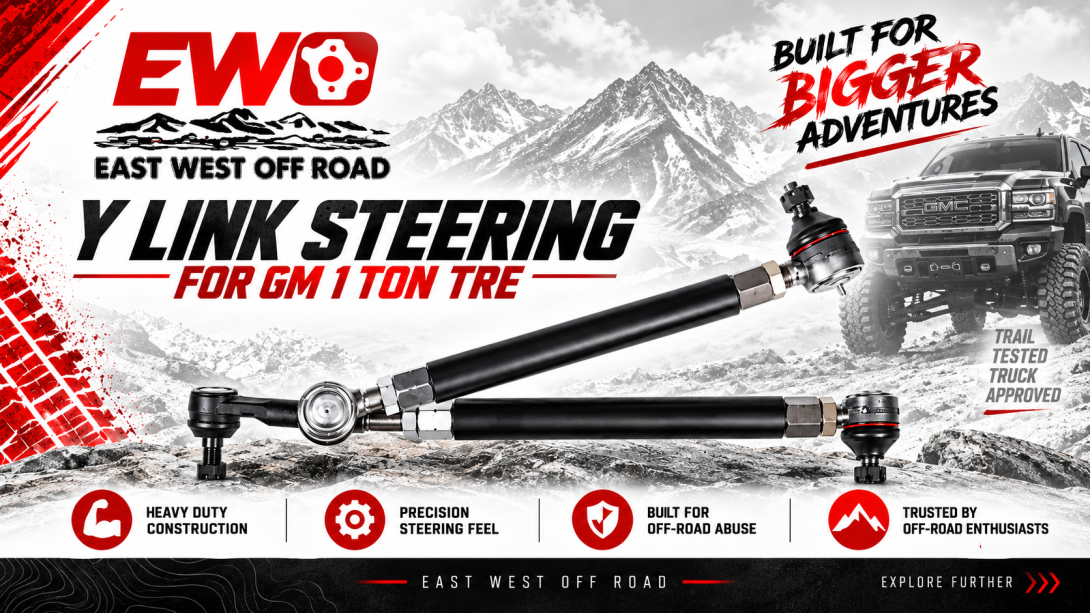
Buy Now: https://www.eastwestoffroad.com/product/y-link-steering-for-gm-1-ton-tre
A 1 ton steering kit is a common upgrade category for custom trucks, Jeeps, solid-axle swaps, trail rigs, and rock crawlers that need a steering system built around larger GM-style steering ends. The phrase “1 ton” can sound like a simple strength rating, but choosing the right system involves much more than buying larger tie rod ends. Steering architecture, axle type, knuckles, over-the-knuckle or under-the-knuckle positioning, joint articulation, thread direction, wheel clearance, suspension packaging, and future replacement-part availability all matter.
East West Off Road currently lists E90065 as Y LINK STEERING FOR GM 1 TON TRE, making it particularly relevant to buyers who want a GM 1-ton-based Y-link steering layout rather than a conventional crossover configuration. East West Off Road
What Is a 1 Ton Steering Kit?
In the off-road aftermarket, a 1 ton steering kit generally refers to a steering system using larger heavy-duty steering components associated with GM 1-ton-style tie rod ends.
The system may include or be designed around:
- Tie rod
- Drag link
- GM-style tie rod ends
- High-angle steering ends
- Y-link-specific steering ends
- Tube adapters
- Jam nuts
- Steering links
Exact contents vary significantly from one manufacturer to another.
That distinction matters because there is no single universal “1 ton steering kit specification.”
TMR currently sells multiple different 1-ton systems—including Y-link, crossover, and Jeep JK configurations—with different linkage materials, ends, dimensions, and installation requirements. TMR Customs
What Does “1 Ton” Actually Mean?
“1 ton” is aftermarket steering terminology.
It should not be interpreted as meaning that the steering kit:
- Increases GVWR
- Adds 2,000 pounds of payload
- Increases axle capacity
- Raises towing capacity
- Changes the vehicle’s certified weight ratings
Those ratings belong to the vehicle and drivetrain.
In steering discussions, “1 ton” generally identifies the component family or aftermarket product class.
That is why two products marketed as 1-ton steering can look completely different.
GM 1-Ton TRE Steering Systems
GM-style 1-ton tie rod ends are widely used in heavy-duty custom steering.
Current Y-link products from manufacturers such as TMR use Chevy 1-ton TRE terminology and combine different steering ends according to their position in the system. TMR Customs
This is an important detail.
A complete steering system may need:
- Standard steering end
- Y-link-specific end
- High-angle drag-link end
- Right-hand threaded component
- Left-hand threaded component
They should not all be treated as interchangeable simply because they belong to the same broader GM 1-ton family.
Why 7/8-18 Appears So Often
One common thread specification in this category is 7/8"-18.
TMR’s current Y-link system uses 7/8"-18 RH and LH tube adapters and jam nuts, while EWO currently lists its individual ES2234R GM-style steering end with a 7/8"-18 threaded configuration. TMR Customs
This explains why buyers frequently search:
- 7/8-18 tie rod ends
- GM 1 ton steering
- 1 ton TRE kit
- Heavy duty GM steering ends
But thread size alone does not establish compatibility.
Why 7/8-18 Does Not Guarantee Fitment
Two components can share a 7/8"-18 thread and still differ in important ways.
You still need to consider:
- Right-hand vs. left-hand thread
- Steering-end taper or interface
- Articulation
- Standard vs. high-angle design
- Y-link-specific configuration
- Position in the steering system
The thread specification tells you about the threaded shank.
It does not tell you the whole steering application.
Y-Link vs. Crossover 1-Ton Steering
This is one of the most important decisions in a custom steering build.
Y-Link Steering
In a Y-link system, the drag link connects into the tie rod assembly.
This creates the characteristic Y-shaped arrangement.
Crossover Steering
In a conventional crossover setup, the drag link generally crosses the axle and connects independently toward the opposite steering knuckle.
Current TMR listings separate its Heavy Duty 1 Ton Steering – Y Link from its Heavy Duty 1 Ton Steering – Crossover product, confirming that these are distinct steering architectures rather than different names for the same setup. TMR Customs
Why Choose Y-Link Steering?
Y-link can be useful when a conventional crossover layout is difficult to package around the suspension.
Potential considerations include:
- Leaf springs
- Suspension brackets
- Available steering-arm positions
- Existing axle layout
- Limited component clearance
This is why Y-link designs appear frequently in custom off-road applications.
For a buyer considering a Y link steering kit, the key question is whether that architecture makes sense for the actual vehicle rather than whether Y-link is universally “better.”
When Crossover Steering May Make More Sense
A crossover layout can make sense when the axle, knuckles, steering arms, suspension, and steering box are already configured around that architecture.
Current EWO search results show separate Dana 44 crossover/high-steer products within the same general 1-ton steering market, illustrating how one manufacturer can support multiple steering layouts depending on the axle and application. East West Off Road
This is why “1 ton steering” does not automatically mean Y-link.
Y-Link vs. Crossover Comparison
Feature
Y-Link
Crossover
Drag-link relationship
Connects into tie rod
Typically independent to knuckle
Common use
Custom packaging / limited space
Crossover/high-steer builds
Leaf-spring packaging
Can be advantageous in some builds
Depends on full configuration
GM 1-ton TRE use
Common
Common
Dana axle use
Application-specific
Application-specific
OTK/UTK options
Available in market
Available in market
Universal fit?
No
No
The correct layout depends on the complete vehicle.
Heavy Duty Steering Kit Does Not Mean One Standard Design
The phrase heavy duty steering kit is useful for shopping, but it has no single standardized component definition.
Compare current products:
TMR’s Y-link kit uses Chevy 1-ton TREs and offers optional DOM links. TMR Customs
TMR’s Jeep JK-specific 1-ton kit uses 7075 aluminum links with chromoly rod ends instead of duplicating its GM TRE Y-link configuration. TMR Customs USA
CavFab currently offers its own Jeep JK/JKU 1-ton system using 7075 aluminum links and a separate combination of offset and straight heavy-duty 1-ton TREs. CavFab
All can fall under the broader “1 ton steering” search intent, yet they are materially different products.
DOM vs. Aluminum 1-Ton Steering
Current search results also show multiple link-material approaches.
DOM-Based Steering
DOM tubing is common in custom-builder steering systems.
TMR currently offers 1.5-inch O.D. × .250-inch-wall DOM as an option on its own Y-link package. TMR Customs
7075 Aluminum Steering
TMR’s Jeep JK 1-ton kit instead uses solid 7075 aluminum links. TMR Customs USA
CavFab also currently sells a JK/JKU 1-ton steering system using 7075 aluminum. CavFab
These specifications describe those specific products.
EWO E90065’s currently indexed page does not publish an exact tubing material or dimension, so competitor link specifications should not be assigned to E90065. East West Off Road
Over the Knuckle Steering Kit
An over the knuckle steering kit, often shortened to OTK, positions the relevant steering connection above the steering knuckle.
Moving linkage higher can be attractive on some off-road builds where additional steering-link clearance is desirable.
However, OTK is not simply a cosmetic upgrade.
The completed system has to remain compatible with:
- Knuckles
- Suspension
- Wheels
- Other steering components
- Manufacturer requirements
Current TMR Y-link documentation identifies its own kit as configured for OTK steering and provides separate product-specific requirements when changing its orientation. TMR Customs
Those instructions apply to TMR—not automatically to EWO.
Under the Knuckle Steering Kit
An under the knuckle steering kit, or UTK, retains the relevant steering attachment below the knuckle.
UTK can be the appropriate layout for some vehicles depending on:
- Knuckle design
- Suspension
- Steering geometry
- Wheel clearance
- Existing steering configuration
Neither OTK nor UTK should be called universally superior.
The correct choice is vehicle- and product-specific.
OTK vs. UTK: What Should Buyers Compare?
Before choosing, evaluate:
Question
Why It Matters
What knuckles are installed?
Determines steering interface
What suspension is installed?
Controls available space
What wheels are installed?
Large steering ends require clearance
What steering architecture is used?
Y-link and crossover package differently
What does the kit manufacturer specify?
Product requirements vary
Has the axle been swapped?
Original vehicle specs may no longer apply
These checks are more useful than choosing OTK simply because it places the steering higher.
1 Ton Y Link Steering
1 ton Y link steering combines GM 1-ton-style steering components with the Y-link architecture.
That combination is well represented in current aftermarket search results.
TMR currently markets Heavy Duty 1 Ton Steering – Y Link separately from its crossover systems. TMR Customs
EWO likewise currently lists E90065 specifically as Y LINK STEERING FOR GM 1 TON TRE. East West Off Road
This makes the EWO product particularly relevant to buyers who already know they want the Y-link layout.
What EWO E90065 Currently Verifies
The live EWO target page currently confirms:
Product Information
EWO E90065
Product
Y LINK STEERING FOR GM 1 TON TRE
Item Number
E90065
Category
Steering Kits
Options selector
Yes
Reviews displayed
1
Current availability
In Stock
Current displayed sale price
$267.48
Price and inventory can change, so buyers should use the live listing at checkout. East West Off Road
What the Current EWO Page Does Not Verify
The currently indexed E90065 page does not expose a detailed component list.
Therefore, do not automatically advertise an exact:
- TRE quantity
- ES-series combination
- RH/LH split
- Tube-adapter count
- Jam-nut count
- DOM size
- DOM wall thickness
- Tube length
- OTK configuration
- UTK configuration
- Universal Dana 44 compatibility
- Universal Dana 60 compatibility
unless EWO publishes additional current documentation confirming those details. East West Off Road
Dana 44 and 1-Ton Steering
Dana 44 axles are common in off-road steering searches.
EWO currently has separate Dana 44 crossover/high-steer products categorized around 1-ton steering, demonstrating that GM 1-ton steering components are used within specific Dana 44 applications. East West Off Road
However, Dana 44 is not one universal steering configuration.
Dana 44 variants have appeared under:
- Chevy trucks
- Jeeps
- Fords
- Dodges
- Custom swaps
Knuckles and steering interfaces can vary.
Therefore, a Dana 44 Y link steering kit should be matched to the exact axle rather than the Dana 44 name alone.
Dana 60 and 1-Ton Steering
Dana 60 steering is another major search category.
GM 1-ton-style steering ends also appear in Dana 60 high-steer and custom steering systems.
That does not mean every Dana 60 accepts every 1-ton steering kit.
A Dana 60 Y link steering kit needs to account for:
- Kingpin vs. other knuckle architecture where relevant
- Steering arms
- Tie-rod position
- Drag-link position
- Suspension
- Wheel clearance
Axle identification comes before parts ordering.
Dana 44 vs. Dana 60 Steering
The two axle families can both appear in heavy-duty steering searches but should not be treated as interchangeable.
A useful buyer comparison is:
Dana 44
Often found in lighter-duty classic truck, Jeep, and custom solid-axle applications.
Dana 60
Common in heavier-duty axle builds and serious off-road conversions.
What matters for steering is not a general “which axle is stronger?” comparison.
The useful question is:
Which steering interfaces are actually present on this axle?
Why Axle Swaps Complicate Steering Shopping
Older off-road vehicles frequently no longer use the front axle they originally came with.
A vehicle may now have:
- Dana 44 swap
- Dana 60 swap
- Different knuckles
- Aftermarket steering arms
- Modified suspension
That means shopping only by vehicle model can lead to incorrect assumptions.
Inspect the actual front axle.
Standard, Y-Link-Specific and High-Angle Ends
One reason GM 1-ton steering systems can seem confusing is that one system may use more than one steering-end style.
Current TMR Y-link documentation lists:
- Standard GM-style end
- Dedicated Y-link end
- High-angle drag-link end
within that manufacturer’s own configuration. TMR Customs
This illustrates an important buying rule:
Do not assume every steering end in a 1-ton kit is identical.
Why High-Angle Ends Exist
Different steering positions require different ranges of articulation.
The drag-link side may need more movement than a conventional tie-rod location.
That is why some steering systems use a high-angle end in a particular position.
Exact articulation requirements should come from the manufacturer’s design for the specific system.
Replacement-Part Serviceability
Serviceability is a major reason to document a custom steering build carefully.
Keep records of:
- Manufacturer
- Kit number
- TRE part numbers
- RH/LH thread
- OTK/UTK arrangement
- Y-link or crossover architecture
Years later, that information makes replacement-part identification much easier.
Why Buying by Visual Appearance Is Risky
Two GM-style steering ends may look nearly identical.
They can still have different:
- Threads
- Tapers
- Articulation
- Handedness
- Intended position
Use documented component identification instead.
Wheel Clearance With 1-Ton Steering
Larger steering ends may require more room inside the wheel.
Important wheel dimensions include:
- Diameter
- Width
- Offset
- Backspacing
- Inner-barrel profile
Current Jeep-specific 1-ton kits publish very specific wheel requirements for their own products, demonstrating how component clearance can vary. TMR’s JK kit, for example, has its own wheel and backspacing requirements. TMR Customs USA
Those specifications should not be applied to EWO E90065 unless EWO confirms the same requirement.
Differential-Cover Clearance
A heavy-duty tie rod can run close to the differential cover.
Aftermarket covers may be:
- Deeper
- More heavily ribbed
- Thicker than stock
Clearance should be evaluated using the actual axle and cover.
Leaf-Spring and Suspension Clearance
Y-link steering is often attractive where suspension packaging makes crossover steering more difficult.
Potential interference areas can include:
- Leaf springs
- Control-arm brackets
- Track-bar hardware
- Sway-bar components
The completed steering needs sufficient clearance throughout its intended movement.
Heavy-Duty Steering for Larger Tires
Larger tires can increase the loads seen by steering components because they can add:
- Tire mass
- Wheel mass
- Steering leverage
That is one reason a heavy-duty steering system becomes attractive on larger-tire off-road builds.
However, tire size alone does not determine whether the vehicle needs:
- Y-link
- Crossover
- OTK
- UTK
- Dana 44-specific components
- Dana 60-specific components
The full build matters.
1-Ton Steering for Daily and Trail Use
A heavy-duty steering system can be used on vehicles that see both road and trail use when correctly designed and fitted.
Daily-driver priorities include:
- Predictable steering
- Correct component compatibility
- Adequate wheel clearance
- Serviceable joints
- Proper professional alignment
Trail strength should not replace correct road-oriented setup.
Does a 1-Ton Steering Kit Fix Loose Steering?
Not automatically.
Loose steering can also involve:
- Ball joints
- Wheel bearings
- Steering box
- Track bar
- Other steering joints
- Worn suspension components
A heavy-duty kit only addresses the components it replaces.
Will a 1-Ton Kit Fix Bump Steer?
Not automatically.
Bump steer can involve the relationship between:
- Drag link
- Suspension movement
- Track-bar geometry where applicable
- Steering position
- Lift configuration
A larger steering end or thicker link does not guarantee correct geometry.
Is a 1-Ton Kit Automatically Stronger Than Every Factory System?
“1 ton” is a category term rather than a standardized strength certification.
Actual strength depends on:
- Material
- Joint construction
- Link dimensions
- Manufacturing
- Application
Do not use the label alone to make engineering comparisons.
Off-Road Steering Kit Purchase Planning
When shopping for an off road steering kit, start with architecture and fitment rather than price or appearance.
Confirm:
- Axle type
- Knuckle type
- Y-link vs. crossover
- OTK vs. UTK
- Steering-end family
- Wheels
- Differential cover
- Suspension
- Existing modifications
A properly matched system is more important than choosing the kit with the biggest advertised components.
Why Professional Fitment Matters
Steering directly controls vehicle direction.
Custom steering should receive professional fitment verification and final inspection.
Any required:
- Machining
- Taper modification
- Welding
- Fabrication
should follow the exact manufacturer’s documentation and be completed by qualified professionals.
After substantial steering work, professional alignment is strongly recommended.
1-Ton Steering Kit Buyer Checklist
Before ordering a GM 1 ton steering kit, verify:
Check
Key Question
Axle
Dana 44, Dana 60 or another axle?
Knuckles
What steering interface is installed?
Architecture
Y-link or crossover?
Position
OTK or UTK?
Steering ends
Standard, Y-link-specific or high-angle?
Threads
Correct RH/LH configuration?
Wheels
Enough steering-end clearance?
Suspension
Any linkage interference?
Differential cover
Adequate tie-rod clearance?
Existing modifications
Has the steering already been altered?
Replacement parts
Are component numbers documented?
Final setup
Professional inspection/alignment planned?
Common 1-Ton Steering Shopping Mistakes
Assuming “1 Ton” Means a Vehicle Capacity Rating
It does not.
Assuming Every GM TRE Is Identical
Standard, high-angle and Y-link-specific parts can differ.
Matching Parts by 7/8-18 Thread Alone
Thread size is only one compatibility factor.
Assuming Every Dana 44 Uses the Same Steering
Dana 44 variants differ across applications.
Assuming Every Dana 60 Uses the Same Steering
Dana 60 configurations also vary.
Choosing OTK Just Because It Sits Higher
The complete steering and suspension system must support that configuration.
Copying Competitor Tubing Specifications to EWO
TMR’s current DOM dimensions apply to TMR’s product, not automatically to E90065. TMR Customs
Expecting Heavy-Duty Steering to Cure Every Handling Problem
Diagnose the complete front end first.
Frequently Asked Questions (FAQs)
What is a 1 ton steering kit?
A 1 ton steering kit is an aftermarket heavy-duty steering system generally built around larger GM-style steering components or equivalent heavy-duty rod ends. Exact construction varies by manufacturer.
Does EWO offer a 1 ton steering kit?
EWO currently lists E90065 as Y LINK STEERING FOR GM 1 TON TRE. East West Off Road
What is the EWO product number?
The current item number is E90065. East West Off Road
Is E90065 currently in stock?
At verification, EWO’s live product page showed E90065 as In Stock. Inventory can change. East West Off Road
What is the current E90065 price?
At verification, the page displayed $267.48 against a displayed $356.62 original price. Prices and promotions can change. East West Off Road
What does “1 ton” mean in steering?
It is aftermarket terminology describing a heavy-duty steering-component category. It does not increase GVWR, payload, towing or axle ratings.
What is GM 1-ton steering?
It generally refers to steering systems built around larger GM-style tie rod ends commonly used in custom off-road steering.
Is 1-ton steering the same as Y-link steering?
No. “1 ton” describes the steering-component category, while “Y-link” describes the steering architecture.
What is Y-link steering?
In a Y-link layout, the drag link connects into the tie rod rather than operating as a completely independent crossover link.
Is Y-link the same as crossover steering?
No. Current manufacturers such as TMR sell separate Y-link and crossover 1-ton steering systems. TMR Customs
What is an over-the-knuckle steering kit?
OTK positions the relevant steering connection above the knuckle. It requires a vehicle- and product-compatible setup.
What is an under-the-knuckle steering kit?
UTK keeps the relevant connection below the knuckle and can be appropriate for applications designed around that layout.
Is OTK better than UTK?
Not universally. The correct option depends on axle, knuckles, suspension, wheels and manufacturer requirements.
Are GM 1-ton tie rod ends usually 7/8-18?
7/8"-18 is common in this market, including current TMR Y-link components, but this thread size alone does not establish full compatibility. TMR Customs
Does 7/8-18 mean all tie rod ends interchange?
No. RH/LH threads, taper, articulation and steering position can differ.
Does E90065 use DOM tubing?
The currently indexed EWO page does not provide an itemized specification confirming exact tubing material or dimensions. East West Off Road
What DOM size do competitors use?
For its own Y-link product, TMR currently offers 1.5-inch O.D. × .250-inch-wall DOM links. That is a TMR specification, not an EWO specification. TMR Customs
Does E90065 fit a Dana 44?
The currently indexed target page does not explicitly state universal Dana 44 fitment. Confirm the specific axle configuration before ordering. East West Off Road
Does E90065 fit a Dana 60?
The current EWO target page likewise does not explicitly state universal Dana 60 fitment. East West Off Road
Can 1-ton steering be used on Dana 44 axles?
Yes, specific Dana 44 1-ton steering products exist in the market, including EWO’s separate Dana 44 crossover/high-steer products. East West Off Road
Can 1-ton steering be used on Dana 60 axles?
Yes, GM-style 1-ton steering components are used in some Dana 60 steering systems, but exact compatibility depends on the axle and components.
Do 1-ton steering kits use different tie rod ends in different positions?
They can. Current TMR Y-link systems use distinct standard, Y-link-specific and high-angle steering-end roles. TMR Customs
Why would a drag link need a high-angle end?
Some drag-link positions require a greater range of articulation than a conventional tie-rod location. Exact requirements are system-specific.
Does wheel clearance matter?
Yes. Larger steering ends may need more inner-wheel clearance, depending on wheel width, backspacing, offset and barrel profile.
Does differential-cover clearance matter?
Yes. Large aftermarket covers can occupy additional space near steering links.
Is a 1-ton steering kit good for larger tires?
Heavy-duty steering is commonly considered on larger-tire off-road builds, but tire size alone does not determine the correct steering architecture or kit.
Will 1-ton steering fix loose steering?
Only if the components being replaced are contributing to the looseness. Other front-end components may also be involved.
Will a 1-ton steering kit fix bump steer?
Not automatically. Bump steer depends on the complete steering and suspension geometry.
Is a 1-ton steering kit suitable for street use?
A correctly designed, compatible and professionally inspected steering system can be used on vehicles that see road and trail use, subject to the exact vehicle configuration.
Should custom 1-ton steering be professionally installed?
Professional fitment verification, any required fabrication, final inspection and alignment are strongly recommended because steering is safety-critical.