

Buy Now: https://www.eastwestoffroad.com/product/dana-44-dana-60-standard-and-offset-tre
1 ton offset tie rod ends are designed for heavy-duty steering systems where a standard straight tie rod end does not position the steering link where the build needs it. They are especially relevant to Dana 44 and Dana 60 crossover steering, high-steer systems, rock crawlers, solid axle swaps, and custom off-road rigs where a differential cover, steering arm, suspension bracket, track bar, or other front-end component reduces available tie rod clearance.
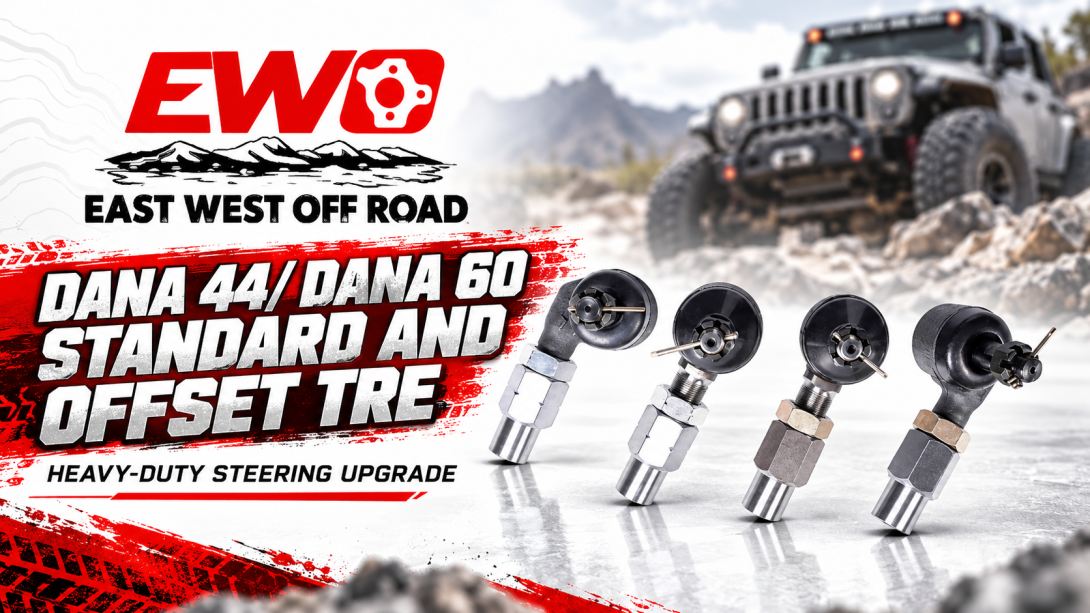
East West Off Road currently offers E90063 as a Dana 44/Dana 60 standard and offset TRE product, making it especially relevant for builders who need different steering-end geometry at different locations instead of assuming every connection should use an identical end.
What Are 1 Ton Offset Tie Rod Ends?
A conventional tie rod end places its threaded shank relatively close to the centerline of the joint body.
An offset tie rod end changes that relationship.
By moving the threaded portion away from the joint's normal centerline, the steering tube can sit in a different position relative to nearby components.
This can help create clearance around:
- Differential covers
- Steering arms
- Suspension brackets
- Track bars
- Other axle components
Offset geometry should be selected to solve a genuine fitment need rather than because an offset end simply appears more heavy duty.
What Does “1 Ton” Mean in This Steering Category?
“1 ton” is common aftermarket terminology for a family of larger GM-style steering components widely used in custom off-road steering.
You will frequently see the category associated with:
- GM/Chevy steering
- Dana 44 steering
- Dana 60 steering
- Crossover steering
- High steer
- Rock crawlers
- Solid axle swaps
The term does not mean every 1-ton tie rod end is identical.
Products can differ by:
- Standard vs. offset design
- Right- vs. left-hand thread
- Taper
- Articulation
- Shank geometry
- Intended steering position
This is why exact component identification matters.
Why Use an Offset Tie Rod End?
Clearance is usually the primary reason.
A modified front axle can become crowded after adding components such as:
- Heavy-duty differential cover
- Larger steering links
- High-steer arms
- Track-bar brackets
- Suspension links
A properly matched offset end can move the steering link away from one of those interference points.
EWO’s current individual RH offset TRE description specifically states that its 1-inch offset is intended to move an oversized tie rod away from the differential cover in a crossover steering setup. East West Off Road
Standard vs. Offset Tie Rod Ends
One of the most important buying decisions is whether the steering position actually needs an offset.
Standard Tie Rod End
A standard end can make sense where:
- Differential-cover clearance is already sufficient
- Steering-link position is appropriate
- Suspension components do not interfere
- Existing steering was designed for a straight end
Offset Tie Rod End
An offset end may be useful where:
- Tie rod sits too close to the differential cover
- Steering link needs repositioning for component clearance
- Existing steering system specifically calls for an offset end
Neither style is automatically better.
The correct part is the one that matches the steering design.
Why a Steering System May Use Both Styles
Custom steering does not necessarily have identical clearance conditions at every connection.
One steering position might have plenty of room.
Another might sit close to:
- Differential housing
- Differential cover
- Suspension bracket
That makes a combination of standard and offset tie rod ends logical in some steering layouts.
EWO E90063 directly reflects this search intent by combining both “standard” and “offset” in the current product name. East West Off Road
GM 1 Ton Offset Tie Rod Ends
The broader GM 1 ton offset tie rod ends category is popular because GM-style 1-ton TREs are widely supported in the custom steering aftermarket.
Current Barnes products, for example, separate LH and RH offset GM-style ends and publish a 7/8"-18 thread size for its own products. Barnes 4WD
EWO likewise sells individual offset 1-ton TREs in addition to the E90063 package.
For builders comparing 1 ton offset tie rod ends, the important point is to compare the entire steering-end specification, not simply the GM 1-ton label.
7/8-18 Tie Rod Ends Explained
The specification 7/8-18 refers to the steering end's threaded shank:
- 7/8-inch nominal diameter
- 18 threads per inch
This specification is widely represented in heavy-duty GM-style steering.
EWO’s individual RH offset end currently specifies a 7/8"-18 TPI threaded shank, and its product description also identifies the end as using the standard GM 1-ton taper. East West Off Road
Why 7/8-18 Alone Is Not Enough
Two tie rod ends can share the same thread size and still be completely different parts.
You may also need to identify:
- RH vs. LH thread
- Standard vs. offset design
- Offset amount
- Taper
- Joint movement
- Steering position
Therefore, “7/8-18 tie rod ends” should be treated as one specification—not a complete fitment guarantee.
Right-Hand vs. Left-Hand Threads
Adjustable steering links often use opposing thread directions.
This means one end may be:
- Right-hand thread
while the other is:
- Left-hand thread
The steering end needs to match its corresponding:
- Tube adapter
- Jam nut
- Link
Barnes currently markets separate OS2234R and OS2234L versions, while EWO separately lists RH and LH offset steering ends in its catalog. Barnes 4WD
Why Thread Direction Matters for Replacement Parts
A worn tie rod end may look almost identical to another component from the same steering family.
But an LH replacement will not simply substitute for an RH-threaded steering location.
Before ordering, identify:
- Part number
- Thread direction
- Thread size
- Offset or standard configuration
- Steering position
This becomes especially important when maintaining an older custom steering system.
Replacement Part vs. New Steering Build
Buyers searching for 1 ton offset tie rod ends usually fall into one of two groups.
Replacement Buyer
The steering system is already installed.
The goal is to replace:
- A worn joint
- A damaged steering end
This buyer needs an exact match.
New-Build Buyer
The steering system is being designed or significantly modified.
This buyer must consider:
- Axle
- Knuckles
- Suspension
- Tie rod location
- Differential cover
- Wheels
- Steering architecture
The purchase process is much broader.
Why Part Numbers Matter
“1 ton offset tie rod end” is useful search language.
It is not always enough for servicing an existing system.
Different manufacturers may publish different:
- Offset dimensions
- Tapers
- Thread directions
- Replacement part numbers
Keep the exact component number with the vehicle's service records whenever possible.
Dana 44 Tie Rod Ends
Dana 44 steering is one of the major markets for heavy-duty 1-ton TREs.
Dana 44 axles have appeared in:
- Chevy/GM trucks
- Jeeps
- Fords
- Dodges
- Custom swaps
But Dana 44 is an axle family—not one universal steering configuration.
When shopping Dana 44 tie rod ends, buyers should also identify:
- Knuckle style
- Steering configuration
- Suspension
- Differential cover
- Existing steering-end interface
Chevy Dana 44 Steering
Older GM/Chevy Dana 44 applications are strongly represented in the 1-ton steering aftermarket.
These vehicles are frequently modified with:
- Crossover steering
- High steer
- Larger tie rods
- Larger differential covers
That combination can create the exact type of packaging issue where an offset TRE becomes relevant.
Jeep Dana 44 Steering
A Jeep Dana 44 may use different:
- Knuckles
- Suspension
- Steering architecture
than an older GM Dana 44.
Therefore, an offset steering end sold for one Dana 44 application should not automatically be assumed compatible with another.
The axle name alone does not establish fitment.
Dana 60 Tie Rod Ends
Dana 60 tie rod ends are another major heavy-duty steering category.
Dana 60 front axles are common in:
- Heavy 4x4 trucks
- Rock crawlers
- Competition builds
- Solid axle swaps
EWO's E90063 product title specifically identifies both Dana 44 and Dana 60. East West Off Road
Why Dana 60 Fitment Still Varies
Dana 60 axles can differ by:
- Manufacturer
- Generation
- Knuckle configuration
- Steering arms
- Suspension architecture
- Vehicle application
A steering end should therefore be matched to the actual axle and steering design.
Dana 44 vs. Dana 60 Steering Considerations
Both can use heavy-duty steering components, but surrounding packaging can differ.
Fitment Area
Why It Matters
Knuckle configuration
Determines steering-end interface
Differential cover
Can affect tie rod clearance
Suspension
Controls available link space
Steering arms
Affect tie rod position
Wheel package
Can affect TRE clearance
Existing linkage
Determines replacement compatibility
The complete steering system matters more than the axle name alone.
Differential Cover Clearance
Differential-cover clearance is one of the most important reasons offset TREs exist.
EWO’s current RH offset TRE description says its 1-inch offset allows an oversized tie rod to move away from the cover in crossover steering. East West Off Road
Large aftermarket covers may have:
- Added thickness
- Reinforcement ribs
- Different exterior profiles
Those differences can reduce available steering-link clearance.
Why a Large Differential Cover Changes Steering Packaging
A factory tie rod may have been designed around the original differential cover.
Replacing the cover with a larger unit can change the available space.
This does not necessarily mean an offset TRE is automatically required.
It means the steering and cover should be evaluated together.
Offset Amount Is Product-Specific
Not every 1-ton offset TRE moves the tie rod the same distance.
EWO’s current RH listing specifies a 1-inch offset. East West Off Road
Other manufacturers may use different dimensions.
That means buyers should not replace one offset steering end with another merely because both are described as “offset.”
Is More Offset Better?
No.
The goal is not to move the tie rod as far as possible.
The goal is to achieve correct component clearance while maintaining the steering system’s intended configuration.
Excess or incorrect offset can reposition the link in a way the steering system was not designed around.
Offset Tie Rod End Kit
An offset tie rod end kit can make sense when several steering ends need replacement or when the steering design uses a combination of standard and offset ends.
A kit-oriented buyer should confirm:
- Number of ends
- Standard vs. offset mix
- RH/LH arrangement
- Thread specification
- Intended steering application
The E90063 indexed product page confirms the standard-and-offset concept but does not currently expose a detailed part-by-part breakdown. East West Off Road
Individual TRE vs. Complete Kit
Buy an Individual TRE When
- Only one joint needs replacement
- Exact part is already identified
- Remaining steering components are serviceable
Consider a Kit When
- Multiple joints need replacement
- Steering system uses more than one TRE style
- A broader steering refresh is being planned
Always compare the actual package contents.
Heavy Duty Tie Rod Ends
The phrase heavy duty tie rod ends is frequently used across off-road steering listings.
However, “heavy duty” is not one standardized technical specification.
Products can differ in:
- Housing construction
- Stud geometry
- Boot
- Greaseability
- Thread dimensions
- Taper
- Offset
Exact manufacturer specifications remain more useful than the label alone.
Offset vs. High-Angle Steering Ends
These terms describe different characteristics.
Offset Tie Rod End
Changes the shank-to-joint relationship to reposition the steering link.
High-Angle Steering End
Provides additional articulation for steering positions requiring greater joint movement.
An offset end should not automatically be assumed to be a high-angle end.
Offset vs. Y-Link Steering Ends
Y-link steering ends also serve a different function.
A Y-link-specific joint is designed for a particular connection within the Y-link architecture.
Offset refers to geometry for component placement.
Again, product role matters.
Offset Ends in Crossover Steering
Crossover steering commonly uses heavy-duty GM-style components.
In this arrangement, the tie rod and drag link can run near:
- Differential cover
- Suspension
- Steering arms
An offset tie rod end may be useful where the particular crossover layout needs additional tie-rod clearance.
Offset Ends in High-Steer Systems
High steer generally relocates steering connections higher through compatible knuckles and steering arms.
This can change the relationship between:
- Tie rod
- Differential cover
- Suspension
Offset ends can still be relevant in a high-steer system, depending on the design.
High Steer Does Not Automatically Eliminate Clearance Issues
Moving steering links upward may solve one packaging issue but create or expose another.
Always evaluate:
- Steering-arm location
- Differential cover
- Wheels
- Suspension hardware
as one system.
Straight Linkage vs. Bent Steering Links
EWO’s current individual RH offset end page includes an important application note: it says its offset ends are intended for straight linkage and are not recommended for tubing with bends. East West Off Road
That is a product-specific fitment condition worth checking before buying.
Do not assume an offset end intended for straight steering linkage is appropriate for a differently shaped custom steering link.
Why Product-Specific Warnings Matter
Two parts may share:
- 7/8"-18 threads
- GM 1-ton category
- Similar appearance
while being intended for different steering architectures.
Manufacturer-specific application notes should therefore take priority over generic steering advice.
Steering Tube Compatibility
EWO's current individual RH offset TRE description also says EWO sells the ends as part of a complete setup using 1 1/2" × .25" wall DOM tubing for that specific product family. East West Off Road
That does not mean every offset TRE or every E90063 configuration should automatically be described with the same tubing unless the applicable kit documentation confirms it.
Why DOM Tubing Specs Matter
A steering system's tubing affects:
- Link dimensions
- Tube-adapter compatibility
- Component packaging
Different manufacturers may choose different sizes.
Keep tubing specifications tied to the exact product.
Tube Adapters
Fabricated heavy-duty steering links often use threaded tube adapters.
The adapter needs to match:
- Thread size
- Thread direction
- Steering tube
A 7/8"-18 RH TRE requires a compatible RH threaded interface.
Jam Nuts
Jam nuts are commonly used to secure adjustable steering-end positions.
EWO's current RH offset product specifically states that it comes with a 7/8-18 RH jam nut. East West Off Road
The correct jam nut still needs to match the particular steering end.
Suspension Clearance
The differential cover is not the only potential interference point.
Custom steering can also sit close to:
- Track bar
- Leaf spring
- Control-arm brackets
- Sway-bar mounts
- Frame components
Offset steering ends should therefore be evaluated as part of the entire front suspension.
Track-Bar Clearance
Linked solid-front-axle suspensions commonly use a track bar.
The steering system and track bar must both have adequate clearance within the vehicle's intended suspension movement.
An offset TRE can reposition the tie rod, but it does not automatically solve poor steering/suspension packaging.
Leaf-Spring Applications
Older solid axles often use leaf-spring suspension.
Leaf springs can limit steering-link space, particularly in custom crossover or high-steer configurations.
Again, the entire axle/suspension package needs to be considered.
Wheel Clearance
Large heavy-duty TREs may occupy more room near the inside of the wheel than factory-sized steering joints.
Consider:
- Wheel diameter
- Width
- Offset
- Backspacing
- Inner barrel profile
Two wheels with the same diameter can provide very different steering clearance.
Larger Tires and Steering Load
Larger tires are a common reason off-road owners begin upgrading steering.
A larger/heavier tire and wheel package can increase:
- Steering leverage
- Tire mass
- Loads through steering components
Heavy-duty steering may therefore become more relevant.
But tire size alone does not determine whether an offset end is required.
Offset is primarily a fitment and clearance decision.
Rock-Crawling Applications
Rock crawlers often combine:
- Large tires
- Dana 44 or Dana 60 axles
- Heavy differential covers
- High steer or crossover steering
That makes offset TREs especially relevant to some builds.
However, steering components can still wear or be damaged.
Regular inspection is important after major trail impacts.
Trail Truck Applications
A trail vehicle that also drives on pavement needs steering that works reliably in both environments.
Important priorities include:
- Correct fitment
- Adequate clearance
- Identifiable replacement parts
- Professional final alignment
An offset TRE should solve a specific steering-packaging issue rather than introduce unnecessary geometry changes.
Solid Axle Swap Applications
Solid axle swaps frequently create complex steering packaging because they may combine:
- Frame from one vehicle
- Axle from another
- Custom suspension
- Different steering box
- Aftermarket steering links
GM 1-ton steering components are popular in these builds because of their broad aftermarket availability.
But the steering must still be engineered around the complete swap.
Offset TREs Do Not Fix Steering Geometry
Offset steering ends change component placement.
They do not automatically correct:
- Bump steer
- Poor drag-link relationship
- Steering wander
- Alignment issues
- Worn suspension components
Those problems need separate diagnosis.
Offset TREs Do Not Increase Axle Capacity
Installing 1-ton steering ends does not increase:
- Dana 44 axle rating
- Dana 60 axle rating
- Axle-shaft capacity
- Wheel-bearing rating
- Payload
- GVWR
- Towing capacity
Steering components and vehicle weight ratings are separate systems.
Serviceability Matters
For a custom steering vehicle, record:
- TRE part number
- RH/LH thread
- Standard or offset type
- Offset amount
- Steering position
- Manufacturer
This will make future replacement significantly easier.
Why “Looks the Same” Is Not Enough
A replacement component should never be selected based only on appearance.
Similar-looking ends can differ in:
- Thread
- Taper
- Offset
- Intended position
Use part identification and manufacturer documentation.
Current EWO E90063 Verification
The live EWO target page currently confirms:
Product Detail
Current EWO Information
Product Name
DANA 44/ DANA 60 STANDARD AND OFFSET TRE
Item Number
E90063
Axles named
Dana 44 / Dana 60
TRE types named
Standard and Offset
Current status
In Stock
Reviews currently shown
13
EWO currently shows pricing on the page as well, but price and stock can change, so the live listing should be used for checkout information. East West Off Road
Current EWO Individual RH Offset TRE Verification
EWO's individual RH page currently states:
- 1-inch offset
- GM 1-ton taper
- 7/8"-18 TPI threaded shank
- Sold in left- and right-hand configurations
- Complete-kit availability within that product family
- Straight-linkage application note
- 7/8-18 RH jam nut with the RH end
for that specific individual EWO component. East West Off Road
Current EWO LH Offset TRE Verification
EWO's current LH page identifies the product as:
OFFSET GM 1 TON TIE ROD END ES2234L LEFT HAND – 1" OFFSET STEERING TRE WITH 7/8"-18 THREADS
and tags it for Dana 44/Dana 60 and heavy-duty off-road steering context. East West Off Road
This helps confirm EWO's broader RH/LH offset TRE ecosystem.
What Should Not Be Assumed About E90063
The E90063 indexed page does not currently expose an exact detailed kit breakdown.
Therefore, do not automatically claim:
- Exact number of standard ends
- Exact number of offset ends
- Exact RH/LH split
- Exact ES-series combination
- Exact jam-nut quantity
- Exact adapter quantity
- Universal Dana 44 compatibility
- Universal Dana 60 compatibility
without additional product-specific confirmation.
Why Barnes Specifications Should Not Be Copied to EWO
Barnes currently publishes its own:
- 1-inch offset
- 7/8"-18 shank
- taper specification
- individual-sale configuration
for OS2234R. Barnes 4WD
Those are Barnes specifications.
Where EWO publishes the same measurement independently, it can be stated as an EWO feature—but one brand's listing should never be used as proof for another.
1 Ton Offset TRE Buyer Checklist
Before purchasing, verify:
Check
Why It Matters
Existing part number
Best replacement reference
Standard vs. offset
Changes steering-link position
Offset amount
Varies by product
RH or LH thread
Must match steering link
Thread size
Needed for adapter compatibility
Steering-end taper
Must fit intended interface
Dana axle version
Dana 44/60 vary
Differential cover
Main clearance consideration
Suspension hardware
May reduce link clearance
Steering link shape
Product may have application restrictions
Wheels
Heavy-duty ends require clearance
Steering layout
Crossover/high steer affect position
Professional fitment
Steering is safety-critical
Common Mistake: Buying Only by the “1 Ton” Label
There are multiple types of 1-ton steering ends.
Identify the specific part your steering system requires.
Common Mistake: Assuming Every Offset End Has the Same Geometry
Offset dimensions can vary between manufacturers.
Check the product specification.
Common Mistake: Ignoring RH vs. LH Thread
Thread direction must match the steering-link assembly.
Common Mistake: Assuming 7/8-18 Equals Direct Fit
It does not.
Taper, offset, application, and joint configuration still matter.
Common Mistake: Assuming Offset Means Stronger
Offset describes steering-end geometry.
It is not a universal strength rating.
Common Mistake: Installing Offset Ends Where Standard Ends Belong
A steering system may intentionally use different end types at different positions.
Match the intended design.
Common Mistake: Ignoring the Steering Link Shape
EWO’s individual offset product specifically warns that its offset ends are intended for straight linkage, not bent tubing. East West Off Road
Product-specific application notes matter.
Common Mistake: Assuming Every Dana 44 Fits
Dana 44 axles vary by application, knuckle, and suspension.
Verify the exact setup.
Common Mistake: Assuming Every Dana 60 Fits
Dana 60 axles also have multiple configurations.
Do not buy based only on axle family.
Common Mistake: Ignoring Differential-Cover Clearance
One of the primary reasons to use offset steering ends is to address a genuine clearance requirement.
Inspect the actual front axle configuration.
Common Mistake: Expecting Offset Ends to Fix Bump Steer
Offset ends reposition components.
Bump steer can involve the complete steering and suspension relationship and is not automatically corrected by changing TRE geometry.
Common Mistake: Expecting Heavy-Duty TREs to Fix Loose Steering
Loose steering may come from:
- Other tie rod ends
- Drag link
- Ball joints
- Wheel bearings
- Steering box
- Suspension joints
Diagnose the problem before purchasing parts.
Professional Fitment and Final Inspection
Tie rod ends directly affect vehicle steering and are safety-critical components.
Professional fitment, installation, final inspection, and alignment are strongly recommended for custom steering.
The completed system should be checked for:
- Correct standard/offset positions
- Correct RH/LH ends
- Compatible steering interfaces
- Differential-cover clearance
- Suspension clearance
- Wheel clearance
- Normal steering-link movement
- Appropriate alignment
Any machining or modification of steering knuckles, arms, pitman arms, or other steering interfaces should follow the applicable manufacturer requirements and be performed by a qualified professional.
Frequently Asked Questions (FAQs)
What are 1 ton offset tie rod ends?
They are heavy-duty 1-ton-style steering ends that position the threaded shank away from the joint centerline to alter steering-link placement.
Why are offset tie rod ends used?
They are commonly used to create additional clearance around differential covers and other front-end components.
Are 1-ton offset TREs only for GM trucks?
No. GM-style 1-ton steering components are commonly adapted to Dana axle and custom off-road steering systems on several vehicle platforms.
What is the difference between standard and offset tie rod ends?
A standard end keeps the threaded shank relatively centered, while an offset end moves it away from the joint centerline.
Does EWO sell standard and offset TREs together?
Yes. EWO currently lists E90063 as DANA 44/ DANA 60 STANDARD AND OFFSET TRE. East West Off Road
What is the EWO E90063 item number?
The item number is E90063. East West Off Road
Is EWO E90063 currently in stock?
At the latest verification, the live page showed it in stock. Availability can change. East West Off Road
Does EWO list Dana 44 for E90063?
Yes. Dana 44 appears in the current product name. East West Off Road
Does EWO list Dana 60?
Yes. Dana 60 also appears in the current product name. East West Off Road
Does that mean every Dana 44 is compatible?
No. Dana 44 applications vary by vehicle, knuckles, steering architecture, and suspension.
Does every Dana 60 fit?
No. Dana 60 configurations also vary.
What thread size does EWO's individual offset TRE use?
The current EWO RH offset listing specifies a 7/8"-18 TPI threaded shank. East West Off Road
What offset does EWO publish on that product?
EWO currently publishes a 1-inch offset for its individual RH offset TRE. East West Off Road
Does EWO sell right- and left-hand offset ends?
EWO's individual product information says the offset ends are sold as lefts and rights, and separate LH/RH listings currently exist. East West Off Road
Why do RH and LH threads matter?
The steering end must match the corresponding threaded adapter, jam nut, and steering link.
Are all 7/8-18 tie rod ends interchangeable?
No. Thread direction, taper, offset, articulation, and application can still differ.
Can I replace a standard TRE with an offset TRE?
Only when the steering system is designed for the resulting link position.
Can I replace an offset TRE with a standard TRE?
Do not assume so. Doing that may remove necessary component clearance.
Are offset TREs useful for oversized differential covers?
They can be when the steering design requires more clearance around the cover.
Does an offset end guarantee differential-cover clearance?
No. The entire steering system still needs clearance verification.
Are offset TREs used in crossover steering?
Yes. EWO's current individual RH listing specifically describes use in a crossover steering setup. East West Off Road
Can offset TREs be used in high-steer systems?
They can be used where the specific high-steer system is designed around them.
Is offset the same as high angle?
No. Offset describes steering-end geometry, while high angle describes articulation capability.
Does steering-link shape matter?
Yes. EWO’s current individual offset listing says its offset ends are for straight linkage and are not recommended for tubing with bends. East West Off Road
Does EWO mention DOM tubing with its offset end?
EWO's current RH individual listing states that it also sells these ends as a complete kit with 1.5-inch × .25-inch-wall DOM tubing for that product family. East West Off Road
Does that automatically mean E90063 contains that exact tubing?
No. E90063’s current indexed page does not expose a detailed parts breakdown, so its exact kit contents should be confirmed separately.
Does wheel clearance matter?
Yes. Heavy-duty steering ends may need more space around the inner wheel.
Can suspension components interfere with the tie rod?
Yes. Track bars, brackets, links, and other front-end components may affect clearance.
Do larger tires make 1-ton steering more relevant?
They can increase steering demands, but larger tires alone do not determine whether an offset TRE is required.
Do offset tie rod ends increase Dana 44 or Dana 60 capacity?
No. They do not increase axle, GVWR, payload, towing, or wheel-bearing ratings.
Can offset TREs fix bump steer?
Not automatically. Bump steer may involve the complete steering and suspension geometry.
Will heavy-duty offset TREs fix loose steering?
Only if worn TREs are actually the source. Other front-end components can cause similar problems.
Should custom offset steering components be professionally installed?
Yes. Steering is safety-critical, so professional fitment, installation, final inspection, and alignment are strongly recommended.