

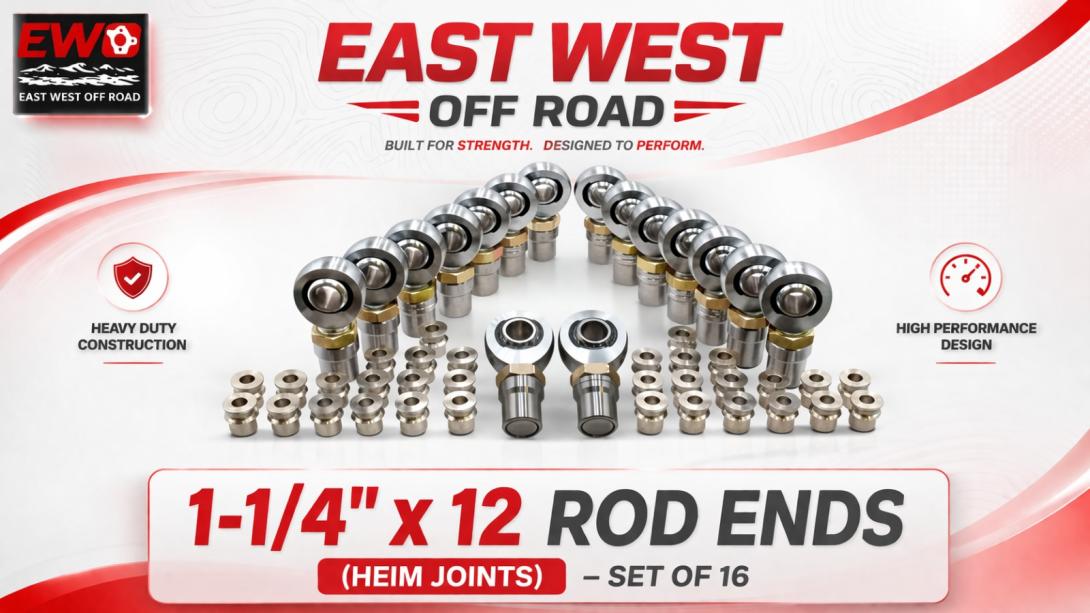
Buy Now: https://www.eastwestoffroad.com/product/1-14%22-x-12-rod-ends-(heim-joints)-set-of-16
A 1-1/4 Heim Joint Kit is a popular choice for builders who need heavy-duty spherical rod ends for custom 4-link suspension, rock crawlers, race vehicles, off-road steering systems, and fabricated suspension links. The larger 1-1/4-inch thread size gives fabricators a substantial connection point for demanding builds, while left- and right-hand thread combinations can make link adjustment much easier during suspension setup.
For serious custom fabrication, the rod end itself is only part of the equation. Tube adapters, jam nuts, misalignment spacers, tubing diameter, wall thickness, thread direction, articulation requirements, and the intended load path all need to be considered before assembling a suspension or steering system.
What Is a 1-1/4 Heim Joint Kit?
A heim joint, also called a spherical rod end, provides a pivoting connection between a suspension or steering link and the component it attaches to.
A 1-1/4-12 Rod End Set uses a 1-1/4-inch threaded shank with 12 threads per inch. Compared with smaller rod ends, this size is commonly selected for applications where builders want a substantial threaded connection and a large spherical bearing.
The EWO 16-piece kit is currently listed as a 1-1/4" x 12 Chromoly Heim Joints Set of 16 with Tube Adapters & Jam Nuts, Item E63010. The product page also provides choices for stainless-steel bore misalignment spacers and 1.5-inch-ID hex or round tube adapters.
Why Use 1.25 Rod Ends for Off-Road Suspension?
A custom suspension link has to accommodate movement while maintaining a controlled connection between two mounting points.
That is where spherical rod ends become useful.
A properly selected 1.25 Rod End Kit can provide:
- Adjustable link length
- Significant articulation
- Replaceable wear components
- Left- and right-hand thread adjustment
- Compatibility with fabricated suspension links
- Flexible mounting options
- A practical solution for custom 4-link construction
They are especially popular in applications where the suspension geometry is being designed rather than simply replacing factory components.
4130 Chromoly Heim Joints for Heavy-Duty Builds
Material selection is important when choosing Chromoly Heim Joints.
4130 chromoly steel is commonly used for high-performance rod ends because of its strength characteristics and suitability for demanding mechanical applications.
The EWO 1-1/4-inch rod-end product family is marketed around chromoly construction and heavy-duty off-road fabrication.
For a custom build, however, the material of the rod end should never be considered in isolation. The tube, weld-in adapter, bolt, spacer, mounting bracket, and surrounding structure all contribute to the strength of the finished assembly.
Understanding the 1-1/4-12 Thread
The “1-1/4-12” designation describes the thread size and pitch.
- 1-1/4-inch nominal thread diameter
- 12 threads per inch
- Available in right-hand and left-hand configurations depending on the specific rod end
A 1-1/4-12 Right Hand Thread rod end tightens in the conventional direction. A left-hand version uses the opposite thread direction.
Using both thread directions in a link assembly can allow the finished link to be adjusted without completely removing it from the vehicle.
Why Left and Right-Hand Heim Joints Matter
One of the advantages of a properly configured Left and Right Heim Joint Kit is adjustment.
For example, a custom suspension link can use a right-hand threaded end on one side and a left-hand threaded end on the other.
With the appropriate jam nuts, rotating the link can change its effective length while the rod ends remain installed.
This can be useful when setting:
- Pinion angle
- Axle position
- Caster
- Suspension link length
- Wheelbase
- Anti-squat geometry
- Four-link geometry
The exact adjustment procedure depends on the suspension design and should follow the fabricator's setup process.
1-1/4 Heim Joints with Misalignment Spacers
A spherical rod end does not automatically provide the amount of angular movement required by every suspension design.
This is where Heim Joints with Misalignment Spacers come into play.
Misalignment spacers fit into the rod-end bore and change the effective mounting arrangement. They can allow the joint to articulate through a useful range while reducing the mounting bolt diameter to the size required by the application.
EWO currently lists 1-inch bore misalignment options including 3/4-inch, 5/8-inch, and 9/16-inch stainless-steel spacers for its 1-1/4-inch chromoly heim-joint kits.
The correct spacer should always be selected according to the actual mounting bolt, bracket width, required articulation, and manufacturer's specifications.
1.25 Heim Misalignment Spacers: What to Check
Before selecting 1.25 Heim Misalignment Spacers, verify:
Bore Size
A 1-inch bore heim requires the appropriate spacer configuration if the mounting bolt is smaller than the bearing bore.
Bolt Diameter
The spacer must properly support the intended mounting bolt.
Mounting Width
The finished spacer arrangement must fit the suspension bracket without creating excessive side loading.
Articulation
The spacer geometry should provide the required angular movement without allowing the joint to bind against the bracket.
Hardware Strength
Use appropriate high-strength mounting hardware for the application.
A spacer is not merely an accessory. It affects how the rod end transfers load into the suspension bracket.
Teflon Lined Heim Joint for Smooth Operation
A Teflon Lined Heim Joint uses a low-friction liner between the spherical ball and race.
Some high-performance rod ends use reinforced PTFE or Teflon/Kevlar-style liners to reduce friction and provide smooth movement without conventional grease lubrication.
Product listings for EWO's 1-1/4-inch kits describe Teflon/Kevlar-lined rod ends and position them for off-road, racing, and custom suspension applications.
The liner does not make the joint maintenance-free forever. Dirt, water, mud, impact loads, misalignment, and general wear can eventually affect any spherical rod end.
1-3/8 Inch Ball Width and Mounting Considerations
The spherical ball and mounting width are important when designing the bracket around a rod end.
A larger rod end does not necessarily mean that every bracket should simply be made wider.
The fabricator should verify:
- Ball width
- Spacer width
- Bracket thickness
- Bolt diameter
- Bolt grip length
- Required articulation
- Side-load conditions
Current product listings for comparable 1-1/4-inch chromoly rod ends commonly specify a 1-inch bore and approximately 1-3/8-inch ball width.
Always verify the final dimensions for the exact rod-end configuration being purchased.
Tube Adapters for 1.5 ID Tubing
A rod end needs a secure connection to the suspension link.
This is where a Tube Adapter for 1.5 ID Tubing becomes important.
The tube adapter is welded into the suspension tube and provides the threaded connection for the heim joint.
EWO's current 16-piece kit offers a choice of 1.5-inch-ID hex tube adapters or round tube adapters.
The adapter must be correctly matched to the tubing dimensions and the rod-end thread.
Hex Head Tube Adapter vs. Round Tube Adapter
Both styles can be useful in custom fabrication.
Hex Head Tube Adapter
A Hex Head Tube Adapter provides external flats that can make installation and adjustment easier.
This can be particularly useful when setting link length during fabrication.
Round Tube Adapter
A round adapter provides a conventional cylindrical profile and can be appropriate when the tube and fabrication design are built around a round insert.
The choice depends on the link design, tooling, adjustment requirements, and fabricator preference.
1020 Steel Tube Adapter vs. 1045 Steel
Tube adapters are available in different steel grades.
Terms such as 1020 Steel Tube Adapter and 1045 steel tube adapters refer to the material used for the adapter.
The specific grade matters because mechanical properties, machining characteristics, and intended application can differ.
Current EWO product listings for related 1-1/4-inch rod-end kits identify 1045 steel for certain tube adapters.
Do not substitute one adapter simply because the outside dimensions appear similar. Verify thread size, tube ID, insert length, weld area, and material requirements.
DOM Tubing and Weld-In Tube Adapters
For custom suspension fabrication, DOM tubing is frequently selected for link construction.
A DOM Tubing Weld Adapter or Weld-In Tube Adapter creates the threaded connection inside the link tube.
Common considerations include:
- Tube outside diameter
- Tube inside diameter
- Wall thickness
- Adapter outside diameter
- Insert depth
- Weld preparation
- Thread size
- Link length
Some product configurations are designed around 2-inch OD DOM tubing with 1/4-inch wall thickness, but the exact tube-adapter specification should always be confirmed for the particular kit being purchased.
4 Link Kit Applications
A 4 Link Kit is one of the most common applications for large spherical rod ends.
Four-link suspension uses multiple adjustable links to control axle movement and suspension geometry.
A properly designed system can allow the builder to tune:
- Axle location
- Pinion angle
- Anti-squat
- Link separation
- Roll axis
- Suspension travel
A Rock Crawler 4 Link Kit may use large heim joints because the vehicle can experience significant articulation and impact loads.
However, rod-end selection should always be based on the complete suspension design rather than thread size alone.
Building a Custom 4 Link Suspension
A Custom 4 Link Suspension requires careful geometry planning before fabrication begins.
Before welding the first adapter, establish:
- Axle centerline
- Chassis mounting points
- Link lengths
- Vertical separation
- Horizontal separation
- Desired ride height
- Suspension travel
- Pinion-angle requirements
- Driveshaft clearance
- Tire and wheel clearance
The rod ends should then be selected around the required link dimensions and articulation.
This prevents a common fabrication problem: choosing the rod ends first and discovering later that the suspension geometry does not provide enough adjustment or travel.
1-1/4 Heim Joint Kit for Steering Applications
Large rod ends can also be used in certain Off-Road Steering Kit and fabricated steering-link applications.
However, steering is safety-critical, so the requirements are different from a typical suspension link.
For steering components, the builder needs to consider:
- Joint load direction
- Bending loads
- Steering-arm geometry
- Tapered connections
- Mounting hardware
- Clearance
- Steering stops
- Joint articulation
- Inspection access
A Heavy Duty Steering Joints application should use components specifically appropriate for the intended steering configuration rather than assuming a suspension rod end is automatically suitable for every steering use.
Heavy Duty Tie Rod Ends vs. Heim Joints
A Heavy Duty Tie Rod End and a heim joint are not interchangeable simply because both are spherical-style joints.
Tie-rod ends typically use tapered studs designed to seat into steering knuckles or steering arms.
Heim joints generally use a bolt through the spherical bearing and may require misalignment spacers.
Choose the joint based on the mounting design, not just the advertised load rating.
1 Inch Bore Heim Joint
Many 1-1/4-inch rod ends use a 1-inch bore.
That means the large 1-1/4-inch dimension refers to the threaded shank, while the spherical bearing's mounting bore is smaller.
A 1 Inch Bore Heim Joint can therefore be used with different mounting-bolt arrangements through the appropriate misalignment spacers.
Always verify the actual bore diameter for the specific rod end.
1.25x1 Right Hand Heim
A 1.25x1 Right Hand Heim generally describes a 1-1/4-inch thread with a 1-inch bore and right-hand thread direction.
This configuration is common for fabricated suspension and linkage applications.
When ordering, confirm all three dimensions:
- Thread diameter
- Thread pitch
- Bore diameter
For this product family, the thread is 1-1/4"-12.
1-1/4 Heim Jam Nuts
Jam nuts lock the rod end against the tube adapter or threaded link after adjustment.
A 1.25 Heim Jam Nuts setup should match the rod-end thread direction.
For a left-hand rod end, the corresponding jam nut must use the correct left-hand thread.
For a right-hand rod end, use the matching right-hand thread.
This is especially important when building adjustable links with left- and right-hand rod ends.
76,200 lb vs. 76,800 lb Radial Load Ratings
Load ratings deserve careful attention because different manufacturers and rod-end configurations can publish different values.
Some current 1-1/4-inch rod-end listings advertise radial ratings around 76,200 or 76,800 pounds, while other premium rod ends have substantially different published ratings.
A radial-load rating should never be treated as a direct statement of how much weight a complete suspension link can safely carry.
The finished assembly also depends on:
- Tube strength
- Weld quality
- Bolt strength
- Bracket design
- Load direction
- Misalignment
- Fatigue
- Impact loading
- Installation quality
Use the manufacturer's published specifications for the exact rod end being installed.
Race Car Heim Joints and Off-Road Rod Ends
Large spherical rod ends are used in both racing and off-road fabrication.
Race Car Suspension Parts may prioritize precise adjustment and controlled articulation, while off-road suspension components often need to tolerate mud, rocks, impacts, articulation and environmental contamination.
That means the ideal rod end depends on the application.
For an off-road build, consider the liner, bearing construction, corrosion protection, load direction, maintenance requirements and expected articulation rather than choosing based solely on racing terminology.
Choosing the Right 1.25 Rod End Kit
Before purchasing a 1.25" Rod End Kit, check these specifications:
Thread
Confirm 1-1/4"-12 if that is what your link design requires.
Thread Direction
Determine whether you need:
- Right-hand
- Left-hand
- Left and right combination
Bore
Confirm whether you need a 1-inch bore or another mounting size.
Ball Width
Verify the mounting width before designing the bracket.
Misalignment
Determine whether you need 3/4-inch, 5/8-inch, 9/16-inch, or another spacer arrangement.
Tube Adapter
Confirm the adapter matches your tube ID.
Wall Thickness
Make sure the adapter is appropriate for the selected tubing wall.
Intended Use
Different requirements apply to:
- 4-link suspension
- Traction bars
- Panhard bars
- Steering
- Race cars
- Rock crawlers
- Custom fabricated links
Why a Complete 16-Piece Kit Can Make Sense
For a full custom suspension project, buying individual components can quickly become complicated.
A complete 1-1/4 x 12 rod ends set of 4 may be suitable for a smaller project, while a larger fabrication project may require a 16-piece package.
EWO's current E63010 product is a 16-piece 1-1/4"-12 chromoly kit with tube-adapter and misalignment-spacer options.
A larger kit can be useful for fabricators building multiple links or a complete custom suspension system because the rod ends, jam nuts and tube adapters can be planned as one package.
Installation and Fabrication Best Practices
Prepare the Tube Correctly
The adapter should be positioned squarely inside the tube with adequate engagement and weld area.
Protect the Threads
Keep weld spatter and debris away from the rod-end threads.
Confirm Thread Engagement
Do not rely on a few exposed threads for a heavily loaded suspension connection.
Use Correct Weld Procedure
The adapter and tube material should be compatible with the chosen welding process and filler material.
Check Adjustment Range
Before final welding, verify that the link can achieve the required adjustment range.
Cycle the Suspension
After assembly, move the suspension through its usable range to check for binding or interference.
Recheck Hardware
Inspect jam nuts, mounting bolts, spacers and brackets after initial use.
Maintenance of Heavy Duty Rod Ends
Even a High-Strength Heim Joint requires inspection.
Regularly check for:
- Excessive play
- Liner wear
- Cracks
- Corrosion
- Damaged threads
- Bent hardware
- Loose jam nuts
- Spacer damage
- Bracket deformation
A Teflon-lined joint may not require conventional grease, but it still needs inspection and cleaning.
If a rod end develops noticeable play or damage, replace it rather than attempting to compensate by over-tightening the surrounding hardware.
Common Mistakes When Building With Heim Joints
Choosing the Largest Joint Without Checking Geometry
A larger rod end is not automatically the right rod end.
Ignoring Misalignment
Insufficient articulation can cause the joint to bind during suspension movement.
Using the Wrong Thread Direction
A left-hand rod end requires compatible left-hand hardware.
Choosing the Wrong Tube Adapter
The adapter must match the tube ID and rod-end thread.
Underestimating Bracket Strength
A strong rod end cannot compensate for a weak suspension bracket.
Ignoring Weld Quality
The connection between the adapter and tube is part of the load path.
Treating Load Rating as the Complete System Rating
Rod-end load capacity does not automatically equal complete-link capacity.
Is a 1-1/4 Heim Joint Kit Right for Your Build?
A 1-1/4-inch heim kit can be a strong option for builders creating custom suspension links, rock crawlers, fabricated steering systems, race vehicles, traction bars, and other high-performance applications.
It is particularly useful when you need:
- Large threaded adjustment
- Spherical articulation
- Left/right-hand adjustment
- Heavy-duty link construction
- Weld-in tube adapters
- Replaceable rod ends
- Custom suspension geometry
If your project uses a smaller suspension link or does not require extensive articulation, a smaller rod end may be more appropriate.
The correct size should always be determined from the suspension design, load path, bracket dimensions and intended use.
Final Thoughts
A 1-1/4 Heim Joint Kit gives off-road fabricators a versatile foundation for building custom suspension and linkage systems. With 1-1/4"-12 threads, spherical articulation, optional misalignment spacers, jam nuts, and tube-adapter configurations, this size is well suited to many demanding fabrication projects.
For a complete custom setup, pay attention to the details that are easy to overlook: thread direction, bore size, spacer thickness, tube ID, DOM wall thickness, weld preparation, bracket design, and suspension geometry.
For builders planning a larger project, the 1-1/4-12 Rod End Set from East West Off Road provides a 16-piece configuration with chromoly heim joints, jam nuts, and selectable tube-adapter and misalignment-spacer options.
The key is to treat the rod end as one part of a complete mechanical system. Properly matched components, sound fabrication, correct installation, and regular inspection are what turn a collection of parts into a reliable off-road suspension or steering assembly.
Frequently Asked Questions (FAQs)
What is a 1-1/4 Heim Joint Kit used for?
A 1-1/4 Heim Joint Kit is commonly used for custom 4-link suspension, rock crawlers, fabricated suspension links, traction bars, racing applications, and selected off-road steering systems.
What does 1-1/4-12 mean on a heim joint?
It means the rod end has a nominal 1-1/4-inch thread diameter with 12 threads per inch.
What is a 1-inch bore heim joint?
A 1-inch bore refers to the diameter of the hole through the spherical bearing. It is separate from the 1-1/4-inch threaded shank specification.
Are 1-1/4 heim joints good for a 4-link suspension?
They can be well suited to custom 4-link systems when their load capacity, articulation, mounting arrangement and tubing are correctly matched to the suspension design.
What are heim joints with misalignment spacers?
They are spherical rod ends fitted with spacers that reduce the effective mounting-bolt size and provide the desired mounting width and articulation.
Do I need left- and right-hand heim joints?
Using both thread directions can make adjustable suspension links easier to tune because the link length can be changed without completely removing the rod ends.
What tubing works with 1-1/4 heim joints?
The correct tubing depends on the tube adapter selected. Some current EWO configurations use adapters designed around 1.5-inch ID tubing, while other configurations can be built around different tubing dimensions. Always verify the exact adapter specification.
Are Teflon-lined heim joints self-lubricating?
A PTFE/Teflon-lined rod end generally does not require conventional grease lubrication, but it still needs regular inspection for contamination, liner wear and excessive play.
What is a tube adapter for a heim joint?
A tube adapter is a threaded insert that is welded into a suspension tube, allowing the heim joint to screw into the fabricated link.
Are chromoly heim joints suitable for steering?
Some rod ends may be designed for steering applications, but suspension and steering requirements are not identical. Always use a rod end specifically appropriate for the intended steering application and verify the complete steering-system design.
What should I check before buying a 1.25 rod end kit?
Check thread size and direction, bore diameter, ball width, misalignment requirements, tube-adapter dimensions, tubing ID and wall thickness, intended application, and manufacturer specifications.
How often should heim joints be inspected?
Inspect them regularly, especially after hard off-road use. Check for play, liner wear, damaged threads, corrosion, loose hardware and bracket deformation.