

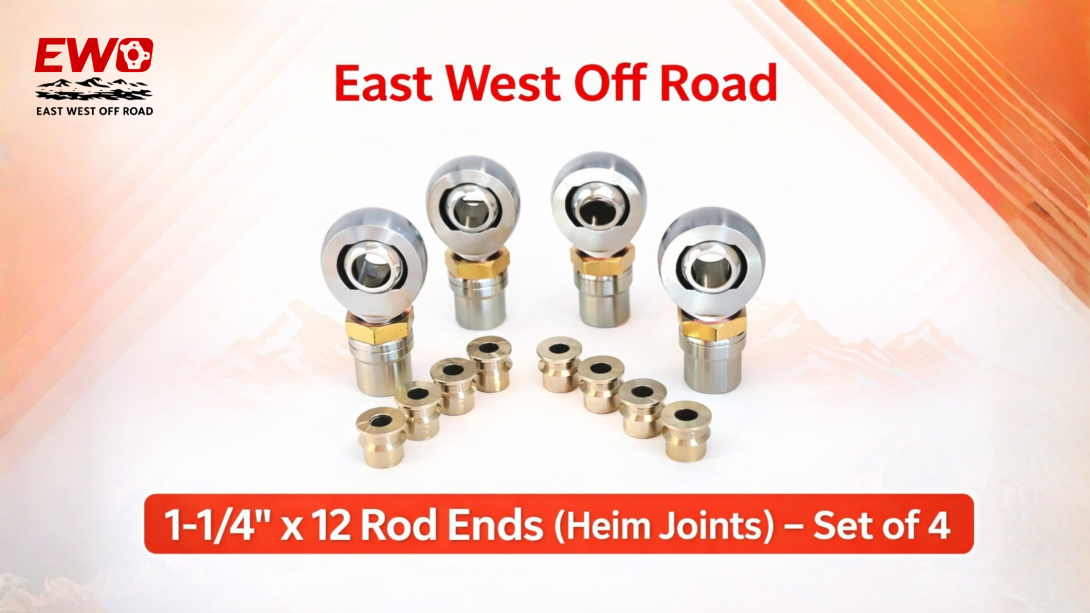
Buy Now: https://www.eastwestoffroad.com/product/1-14%22-x-12-rod-ends-(heim-joints)-set-of-4
A 1-1/4 Heim Joint Kit is an important component choice for fabricators building adjustable suspension links, custom control arms, and heavy-duty off-road suspension systems. Whether you are working on a rock crawler, trail truck, custom 4x4, or fabricated suspension project, selecting the right rod ends can make a significant difference in fitment, articulation, serviceability, and overall mechanical reliability.
For many builders, the challenge is not finding large heim joints. It is making sure the joint threads, tube adapters, jam nuts, mounting hardware, and misalignment spacers work together in the intended suspension design.
A rod end with the correct thread diameter can still be unsuitable if its ball bore, mounting width, or articulation range does not match the brackets and suspension geometry.
That is why buying a set of four requires more planning than simply selecting a product labeled heavy duty.
This guide explains how 1-1/4"-12 chromoly heim joints work, what makes a four-piece package useful, how to select compatible components, and what to verify before purchasing from East West Off Road.
What Is a 1-1/4 Heim Joint Kit?
A heim joint, also called a spherical rod end, is a mechanical joint designed to allow angular movement between connected components.
It typically consists of a threaded housing containing a spherical bearing assembly.
In custom off-road suspension applications, rod ends can provide articulation at link mounting points while allowing builders to establish and adjust link lengths.
A 1-1/4-inch heim joint is generally identified by the nominal diameter of its threaded shank.
However, thread diameter is only one part of the specification.
The joint must also have the correct thread pitch, thread direction, ball bore, mounting width, articulation capability, and compatibility with the intended application.
Why Are Heim Joints Used in Off-Road Suspension?
Custom off-road vehicles often use suspension links to help locate and control axle movement.
As the suspension compresses, extends, and articulates, the mounting points move relative to one another.
A spherical rod end accommodates angular movement within its designed operating range.
This makes heim joints a familiar choice for certain custom link suspensions, race-oriented builds, and fabricated off-road projects.
Their suitability still depends on proper suspension engineering, joint selection, mounting geometry, and installation.
Understanding the 1-1/4"-12 Rod End Specification
Before selecting a heim joint package, understand what the numbers in its description mean.
The designation 1-1/4"-12 describes the threaded shank.
What Does 1-1/4 Inch Mean?
The 1-1/4-inch measurement identifies the nominal major diameter of the threaded portion.
It is also commonly written as 1.25 inches.
This is not automatically the size of the spherical bearing bore, mounting bolt, or suspension tubing.
Those dimensions are separate.
What Does 12 Mean?
The number 12 indicates 12 threads per inch (TPI).
A 1-1/4"-12 rod end requires a compatible threaded connection with the correct pitch and direction.
A tube adapter made for a different thread size will not provide the correct fit.
Why Thread Direction Matters
Many adjustable suspension links use a combination of right-hand and left-hand threads.
When a compatible link has opposing thread directions at its two ends, rotating the link can change its effective length without disconnecting both ends.
This depends on the exact adjuster arrangement and available clearance.
However, not every set of rod ends contains the same quantity of left-hand and right-hand threaded components.
Confirm the thread configuration included in the package before planning fabrication.
Why Chromoly Heim Joints Are Popular for Custom Builds
Chromoly steel is frequently used in aftermarket rod ends intended for demanding mechanical applications.
The term generally refers to alloy steels containing chromium and molybdenum.
Depending on the manufacturer, chromoly rod ends may use different material grades, manufacturing methods, heat treatments, liners, and ball constructions.
These details affect the actual joint characteristics.
Material Selection Matters
A heavy-duty joint should be evaluated according to its complete design rather than the material name alone.
The housing, spherical ball, bearing liner, threaded shank, and mounting hardware all contribute to the finished assembly.
Even joints with similar external dimensions may be designed for different loads or operating conditions.
Heat Treatment and Joint Construction
Some manufacturers use heat treatment to obtain specific material properties.
Others emphasize forged housings, bearing materials, or protective finishes.
These characteristics should be verified against the exact product specifications.
A chromoly product description alone does not establish a particular steel grade, load rating, liner construction, or manufacturing process.
What About Joint Maintenance?
Maintenance requirements depend on the bearing and liner design.
Some rod ends are intended to operate with specific lubrication practices, while others use liners that have different service requirements.
Follow the instructions for the actual joint rather than assuming all chromoly heims require identical maintenance.
East West Off Road 1-1/4" x 12 Chromoly Heim Joint Kit: Set of 4
East West Off Road offers a product listed as:
1-1/4" X 12 Chromoly Heim Joint Kit – Set of 4 with Tube Adapters & Jam Nuts
Product SKU: E63002
This package is designed for shoppers seeking four chromoly rod ends for custom fabrication or suspension-link applications.
Its product page provides selectable configurations for misalignment spacers and tube adapters.
Rather than assuming every buyer needs the same hardware combination, the listing allows different options to be considered.
Available Misalignment-Spacer Choices
The current product listing shows these selectable options:
- 1" to 3/4" stainless steel
- 1" to 5/8" stainless steel
- 1" to 9/16" stainless steel
- Without spacers
These choices should be matched to the actual joint bore, mounting bolt, bracket width, and articulation requirements.
Available Tube-Adapter Choices
The listing also shows:
- 1.5" I.D. hex tube adapter
- 1.5" I.D. round tube adapter
- No tube adapter
These selections matter because the tube adapter must match both the rod-end threads and the inside diameter of the tubing used for the project.
If you're looking for a 1-1/4-inch chromoly heim joint kit, the East West Off Road E63002 listing is a starting point for reviewing the available configurations.
Confirm the exact quantity and thread direction of each included component before ordering.
When Does a Set of 4 Heim Joints Make Sense?
Not every suspension project requires eight, twelve, or sixteen rod ends.
A set of four can be a practical option for a smaller fabrication job, a partial linkage replacement, or a project requiring two adjustable links with a spherical joint at each end.
For example, consider a custom suspension project with two links.
If each link uses one rod end at each end, the total requirement is four rod ends.
In that scenario, a four-piece package may match the required joint quantity.
However, a different design may use one spherical joint and one bushing-style connection per link.
The required quantity must always be determined by the engineering of the specific suspension system.
Is a Set of 4 Enough for a Complete 4-Link Suspension?
Usually not when every link uses spherical rod ends at both ends.
A four-link suspension has four primary links.
If each of those four links requires two heim joints, the project would need eight rod ends.
That does not mean every four-link design must use eight heims.
Some systems combine spherical joints with bushings or other joint types.
The important point is that a set of four heim joints is not automatically a complete four-link suspension kit.
A complete suspension project may also require tubing, brackets, mounting hardware, springs or dampers, and other components.
These items should not be assumed to be included in a rod-end package.
Heim Joints for 3-Link and 4-Link Suspension Builds
Custom suspension builders often research heim joints while designing three-link and four-link systems.
Both suspension categories can use spherical rod ends, but their geometry and component requirements differ.
3-Link Suspension Applications
A three-link solid-axle suspension typically uses three primary locating links, together with whatever additional lateral axle-location arrangement the design requires.
The number and placement of rod ends depend on the specific suspension layout.
A set of four may be suitable for a particular portion of the build, but it should not be assumed to cover every connection.
4-Link Suspension Applications
Four-link suspensions use four primary links to help locate and control axle movement.
Depending on the geometry, a system may use parallel links, triangulated links, or another engineered arrangement.
Some builders use spherical rod ends throughout the system.
Others use a combination of joints to manage articulation, vibration, and service requirements.
The Real Difference Is the Suspension Design
Neither a three-link nor a four-link label establishes the required joint size.
The suspension's loads, travel, link geometry, mounting arrangement, and intended use determine which components are appropriate.
Before buying rod ends, finalize the suspension design or work with a qualified suspension fabricator.
High-Misalignment Spacers: What They Do and Why They Matter
High-misalignment spacers are frequently used with spherical rod ends to adapt mounting interfaces and provide clearance for angular movement.
They are especially relevant in suspension systems that experience significant articulation.
However, the name can be misleading.
A spacer does not make every joint suitable for unlimited suspension travel.
The actual articulation range depends on the spherical bearing, spacer geometry, mounting bracket, and surrounding clearance.
Understanding Bore Reduction
A heim joint has a central bore through its spherical ball.
Some spacer systems adapt a larger ball bore to a smaller mounting bolt.
For example, a configuration described as 1 inch to 3/4 inch indicates a nominal bore-to-bolt-size relationship.
This should still be verified against the manufacturer's complete spacer dimensions and installation requirements.
Why Mounting Width Matters
Spacers also affect the assembled width at the mounting bracket.
Two spacers intended for the same bolt diameter may not create the same overall mounting width.
A correctly sized bolt alone does not guarantee that the joint will fit between the bracket tabs.
What Happens if the Wrong Spacers Are Used?
Incorrectly matched spacers can create interference, inadequate support, binding, or assembly problems.
They may also prevent the joint from operating through the intended movement range.
When selecting a spacer option, verify:
- The spherical ball's actual bore
- Required mounting bolt diameter
- Inside width of the bracket
- Spacer shoulder dimensions
- Required angular travel
- Clearance around the rod-end housing
Proper selection is a mechanical compatibility decision, not merely a purchasing preference.
Choosing Between Hex and Round Tube Adapters
Tube adapters, sometimes called threaded weld-in bungs, provide the connection between a tubular suspension link and the threaded rod end.
They are a common part of fabricated suspension systems.
The East West Off Road E63002 listing offers 1.5-inch-I.D. hex and round tube-adapter options.
Hex Tube Adapters
A hex-style adapter has external wrench flats that may provide convenient tool access during link adjustment or assembly.
That can be useful in certain designs where controlled wrench access is part of the adjustment procedure.
Round Tube Adapters
Round adapters use a different external shape.
Depending on the fabrication design, they may be preferred where the geometry, packaging, or manufacturing approach calls for that style.
The correct choice depends on the complete adapter dimensions and installation requirements.
Why the 1.5-Inch I.D. Specification Is Important
The inside diameter, or I.D., refers to the internal diameter of the tube.
It should not be confused with outside diameter.
For example, two pieces of DOM tubing can have the same outside diameter but different inside diameters if their wall thicknesses differ.
That distinction determines whether a particular weld-in adapter will fit correctly.
Before purchasing, confirm the tube's actual inside diameter and the adapter's specified fitment.
Can You Order Without Tube Adapters?
The EWO listing shows a no-tube-adapter selection.
This may be useful for builders who already have compatible components or whose fabrication design requires separately sourced adapters.
However, verify the final package contents and requirements before checkout.
For builders comparing options, the set of four 1-1/4-inch rod ends offers a way to evaluate adapter and spacer choices for the intended application.
Right-Hand vs. Left-Hand Threads in Adjustable Suspension Links
Thread direction is a fundamental detail that can easily be overlooked.
A right-hand threaded rod end tightens in the conventional direction.
A left-hand threaded rod end uses the opposite direction.
In some adjustable suspension-link designs, one end of the link has a right-hand thread while the other has a left-hand thread.
This allows the fabricator to adjust the link's length by rotating the link itself.
Why Use Opposing Threads?
Opposing threads can make certain link-length adjustments more convenient.
However, the design must provide sufficient adjustment range, correct thread engagement, suitable locking hardware, and adequate access.
The system must also be secured according to its manufacturer's or engineer's specifications.
Are Left-Hand and Right-Hand Rod Ends Interchangeable?
No.
Their threads run in opposite directions.
A right-hand threaded rod end must be paired with a compatible right-hand threaded adapter and jam nut.
The same applies to left-hand threaded components.
Forcing mismatched threads can damage the parts and create an unsafe connection.
Seven Fitment Checks Before Buying a 1-1/4 Heim Joint Kit
Before ordering, use the following checklist to reduce the risk of purchasing incompatible parts.
1. Confirm the Thread Diameter and Pitch
Verify that the intended joint uses 1-1/4"-12 threads.
Do not confuse this with the ball-bore diameter or mounting-bolt size.
2. Identify the Required Thread Directions
Determine how many right-hand and left-hand threaded joints the build requires.
Make sure the selected package and adapters match that requirement.
3. Measure the Mounting Bracket Width
The joint and spacer assembly must fit the bracket.
Bracket width cannot be determined from thread size alone.
4. Confirm the Mounting Bolt Diameter
Select spacers and hardware that match the intended bolt diameter.
Verify fitment using the manufacturer's specifications.
5. Check Tubing Inside Diameter
If weld-in tube adapters are required, measure the tubing carefully.
Do not select an adapter based solely on the tube's outside diameter.
6. Evaluate the Required Suspension Articulation
The rod end must operate without binding throughout the suspension's intended travel.
This includes checking adjacent brackets, mounting tabs, and nearby components.
7. Confirm the Exact Kit Contents
Make sure the order contains the required rod ends, thread directions, adapter choices, jam nuts, and spacers.
A product image or general listing title should not replace confirmation of the selected configuration.
1-1/4 Heim Joint Kit Buying Checklist
Component
Key Specification
What to Verify
Heim joint
1-1/4"-12 threaded shank
Thread compatibility
Thread direction
RH or LH
Correct quantity and matching hardware
Spherical bearing
Bore and movement range
Suitability for mounting and articulation
Misalignment spacers
Bore reduction and dimensions
Bolt size, bracket width, angular clearance
Tube adapters
1.5" I.D. option where selected
Actual tube I.D. and thread direction
Jam nuts
Matching 1-1/4"-12 threads
Quantity and compatibility
Suspension tubing
Project-specific construction
Engineering and adapter fitment
Link mounts
Project-specific geometry
Width, hardware, load path, clearance
This comparison helps distinguish the confirmed specifications of a rod-end kit from the additional engineering details required to build a complete suspension link.
Common Mistakes When Buying Large Heim Joints
Confusing Thread Size With Ball Bore
A 1-1/4-inch threaded shank does not necessarily mean a 1-1/4-inch ball bore.
Treat these as separate specifications.
Buying a Set of Four for an Eight-Joint Project
A set of four may be enough for two links with two rod ends each.
It is usually not enough for a four-link system that requires a spherical rod end at both ends of every link.
Count the actual mounting connections before ordering.
Ordering Incorrect Tube Adapters
Matching the adapter thread is only part of the process.
The adapter must also match the actual tubing inside diameter and the intended fabrication method.
Mixing Left-Hand and Right-Hand Hardware
Threaded components with opposite handedness cannot be used interchangeably.
Verify the direction of every joint, nut, and adapter.
Ignoring Spacer Dimensions
Mounting-bolt size is important, but it does not establish bracket fitment by itself.
Check the assembled mounting width and angular clearance.
Assuming All Chromoly Joints Have Identical Ratings
Joint ratings, materials, liners, and manufacturing methods can differ substantially.
Never use another manufacturer's load rating as the specification for the EWO product.
Treating a Rod-End Kit as a Complete Suspension System
Rod ends are important components, but link geometry, brackets, tubing, weld quality, and overall vehicle engineering remain essential.
Fabrication and Installation Considerations
Proper fabrication has a major influence on suspension reliability.
Even appropriately selected components can perform poorly if the surrounding link structure is designed or assembled incorrectly.
Start With a Verified Suspension Design
Before cutting tubing or installing joints, establish the required geometry, connection locations, link lengths, and intended suspension travel.
A qualified suspension designer or fabricator should evaluate the system's mechanical loads and operating requirements.
Use Compatible Tubing and Adapters
Match the selected adapter to the correct material and tube dimensions.
Follow the adapter manufacturer's welding and installation instructions.
Protect Components During Fabrication
Heat, contamination, and improper assembly practices can damage threaded components or spherical bearing assemblies.
Follow the appropriate fabrication procedures rather than improvising around finished joints.
Check Thread Engagement
Adjustable connections need adequate thread engagement.
The correct minimum engagement and adjustment limits should come from the component manufacturer's specifications and the engineered design.
Verify Full Suspension Movement
After assembly, inspect the suspension through its required operating range.
Check for joint binding, bracket interference, and contact with other components.
Inspect the Completed System
Before operation, have the assembly checked for correct fasteners, secure locking hardware, proper alignment, suitable clearances, and any required torque specifications.
Suspension fabrication is safety-critical work and should be performed or inspected by a qualified professional.
Heim Joints vs. Bushing-Style Suspension Joints
Not every off-road suspension link needs a conventional spherical rod end.
Some designs use rubber or polyurethane bushings, while others use rebuildable flex-style joints.
Spherical Heim Joints
Heim joints provide articulated mechanical connections.
They are common in certain custom fabrication and performance-oriented applications.
Their suitability depends on the joint design, contamination exposure, maintenance requirements, and intended suspension loads.
Bushing-Style Joints
Bushing-style connections can provide characteristics that differ from spherical bearings, including different levels of compliance and vibration isolation.
The actual behavior depends on the design and materials.
Rebuildable Flex Joints
Some aftermarket joints combine articulation with serviceable internal components.
These are distinct products and should not be treated as direct replacements for every heim-joint application.
The best choice is dictated by the suspension design and the vehicle's intended use.
How to Inspect Heim Joints After Off-Road Use
Suspension joints should be inspected according to the manufacturer's recommendations and after significant impacts.
Pay attention to the condition of the spherical bearing, housing, threaded connections, and mounting hardware.
Watch for Excessive Joint Movement
Abnormal looseness or wear may indicate that a joint requires service or replacement.
The acceptable movement depends on the product design.
Inspect for Physical Damage
Look for bent or damaged components, cracked housings, visible thread damage, or deformation around mounting points.
A damaged joint should not be assumed safe simply because it still moves.
Check the Surrounding Link Structure
Rod ends are only one part of the assembly.
The tubing, welded adapters, brackets, and fasteners also require inspection.
Verify Adjustment Hardware
Check the locking arrangement and thread engagement as directed by the manufacturer.
If anything appears loose or damaged, have the system evaluated before continued use.
Why Buy a Set of Four From East West Off Road?
When planning a custom link project, selecting components from a defined product family can simplify the initial purchasing process.
East West Off Road's E63002 package is specifically listed as a set of four 1-1/4"-12 chromoly heim joints.
The current listing also offers choices for misalignment spacers and tube adapters.
This gives buyers an opportunity to select a configuration that reflects their intended link design rather than treating every fabrication project as identical.
For a smaller build, replacement project, or two-link assembly, a four-piece package may be an appropriate quantity.
For larger suspension systems, the required number of joints should be calculated before ordering.
If you're ready to shop the EWO 1-1/4 Heim Joint Kit, review the available configurations and verify the contents that will be supplied with your selection.
Final Thoughts: Get the Right Rod Ends Before You Fabricate
A 1-1/4 Heim Joint Kit is an important building block for many custom off-road suspension projects, but its value depends on choosing the correct components for the job.
The 1-1/4"-12 thread designation provides a starting point.
From there, builders need to verify right-hand and left-hand threads, joint-bore requirements, spacer dimensions, tube-adapter compatibility, and the articulation needed by the suspension system.
A set of four can make sense for a smaller project or for two links that use a spherical joint at each end.
It should not be assumed to replace a complete eight-joint four-link package.
For builders considering chromoly rod ends, East West Off Road offers the E63002 set of four with selectable adapter and spacer configurations.
Confirm the exact package details, plan the suspension carefully, and use qualified fabrication and installation practices.
The best heim joint is not simply the largest available. It is the joint that correctly matches the engineered suspension system.
Frequently Asked Questions (FAQs)
What Is Included in a 1-1/4 Heim Joint Kit?
The contents depend on the specific product.
East West Off Road's E63002 listing identifies a set of four 1-1/4"-12 chromoly heim joints and offers selectable tube-adapter and misalignment-spacer configurations.
The product title also references jam nuts.
Check the final selected configuration to verify exactly which hardware and quantities are included.
What Does 1-1/4"-12 Mean on a Heim Joint?
It describes the threaded shank.
The nominal thread diameter is 1-1/4 inches, and the thread pitch is 12 threads per inch.
It does not identify the spherical ball bore, mounting-bolt diameter, or mounting width.
Those dimensions must be checked separately.
Are Four Heim Joints Enough for a 4-Link Suspension?
Not usually if the four suspension links each use a heim joint at both ends.
That arrangement requires eight rod ends.
However, some designs combine rod ends with other types of joints.
Determine the number and type of connections from the actual suspension design.
What Are High-Misalignment Spacers Used For?
High-misalignment spacers can adapt a spherical joint to a particular mounting-bolt size and help provide clearance for angular movement.
Their exact dimensions affect bracket fitment and the joint's available articulation.
Use the specified components for the actual joint and suspension design.
What Is the Difference Between a Hex and Round Tube Adapter?
Hex adapters have external wrench flats, while round adapters use a different exterior shape.
Both can serve as threaded connections between compatible suspension tubing and rod ends.
The correct choice depends on the manufacturer's dimensions and the project's fabrication requirements.
Will a 1-1/4 Heim Joint Fit 1.5-Inch Tubing?
Not automatically.
A 1-1/4-inch designation normally describes the rod-end thread diameter.
A 1.5-inch-I.D. tube adapter is intended for tubing with the specified inside diameter.
The tubing's actual inside diameter and the adapter dimensions must match.
Do I Need Left-Hand and Right-Hand Threaded Heim Joints?
Some adjustable suspension links use opposing thread directions to allow length adjustment without disconnecting the link.
Other designs may use a different arrangement.
Follow the intended suspension design and confirm the exact thread directions supplied.
Are Chromoly Heim Joints Good for Rock Crawlers?
Chromoly rod ends are used in various aftermarket off-road applications, including custom rock-crawling suspension systems.
However, suitability depends on the joint's documented specifications, the engineered loads, mounting geometry, maintenance requirements, and installation.
Chromoly construction alone is not a guarantee of performance.
Can I Use Heim Joints for Steering?
Some custom steering systems use spherical rod ends.
However, steering applications have specific safety, geometry, articulation, and mounting requirements.
A suspension rod end should not automatically be considered suitable for a steering linkage.
Verify manufacturer approval, applicable regulations, and the complete system design.
Are Heim Joints Better Than Rubber Bushings?
Neither is universally better.
Spherical rod ends and bushing-style joints offer different characteristics in articulation, compliance, vibration transmission, and maintenance.
The correct selection depends on the vehicle and suspension design.
Do Chromoly Heim Joints Require Greasing?
That depends on the particular bearing and liner construction.
Some designs have specific maintenance requirements, while others use alternative bearing materials.
Follow the manufacturer's guidance for the exact joint.
Can I Replace One Worn Heim Joint Instead of the Entire Link?
It may be possible when a compatible replacement joint is available and the remaining link, adapter, and mounting hardware are serviceable.
The assembly should be inspected to identify the cause of wear and confirm that the replacement is appropriate.
Where Can I Buy a Set of Four 1-1/4"-12 Heim Joints?
East West Off Road offers its E63002 1-1/4"-12 chromoly heim joint kit as a set of four.
The product listing includes selectable misalignment-spacer and tube-adapter options.
Review the package and confirm fitment before purchasing.